Today In History: The Candlelit Glimpse Of Tutankhamun’s Tomb — And The Egyptian Workers History Almost Forgot
+256 702 23 93 37: A Discovery That Changed Archaeology — And Whose Story Is Still Being Rewritten On 26 November 1922, Howard Carter's candle revealed the extraordinary contents of Tutankhamun's Antechamber to a modern audience.

UgandaToday: The Candlelit Glimpse Of Tutankhamun’s Tomb — And The Egyptian Workers History Almost Forgot

The Uganda Today Historical Perspective
Thursday, 26 November 2026 | 104 Years Ago Today
On 26 November 1922, British archaeologist Howard Carter made a small opening in a sealed doorway in Egypt’s Valley of the Kings and peered into a chamber filled with ancient treasures. The moment became one of archaeology’s most celebrated stories. Yet behind the famous candlelight scene stood dozens of Egyptian workers whose labour made the discovery possible, while most of their names disappeared from the historical record.
One hundred and four years ago today, a flickering candle illuminated a chamber that had remained sealed for thousands of years.
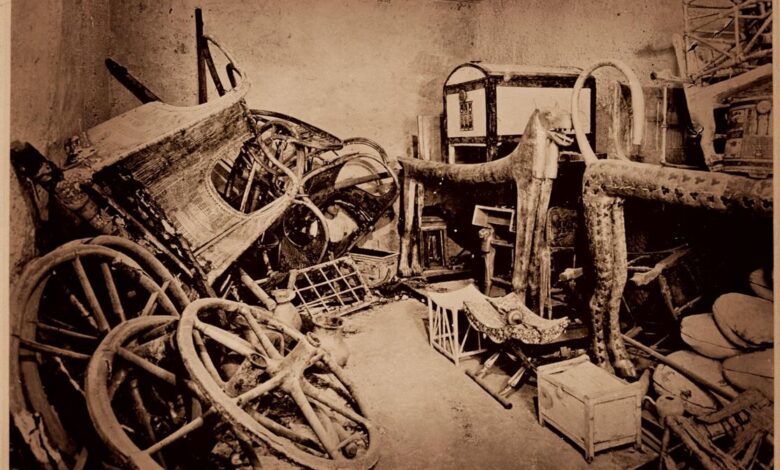
Inside were gilded furniture, statues, ornamental boxes, chariots, alabaster vessels and other objects associated with the burial of the young Egyptian pharaoh Tutankhamun.
The man who peered through the opening was Howard Carter, the British archaeologist whose name would become inseparable from one of the most famous archaeological discoveries in history.
But the familiar story of the discovery has often concentrated on Carter, his wealthy sponsor Lord Carnarvon and the treasures they encountered.
A closer examination of the original excavation records reveals another story: the Egyptian workers who cleared the debris, uncovered the entrance, moved the objects and helped make the discovery possible.
Many of these men remain unidentified in the very archive that preserves the excavation’s history.
The anniversary of 26 November therefore offers two historical perspectives: the extraordinary moment that brought ancient Egypt before the world’s attention, and the modern effort to restore recognition to the people whose contributions were overshadowed by the celebrated European archaeologist.
November 26 Was The First Glimpse — Not The Day The Tomb Was Found

The distinction matters because popular accounts sometimes describe 26 November as the day Carter discovered or opened Tutankhamun’s tomb.
The actual sequence began earlier.
On 4 November 1922, members of the excavation workforce uncovered the first step of a staircase cut into the rock beneath the remains of ancient workmen’s huts in the Valley of the Kings.
One of Carter’s Egyptian foremen, Ahmed Gerigar, informed him that the workers had found the step.
The excavation continued, revealing a descending staircase and, on 5 November, a sealed doorway bearing impressions of royal and necropolis seals.
Carter recognised the potential importance of the find. He covered the opening again and sent a telegram to Lord Carnarvon, who was in England, reporting that he had made a remarkable discovery.
Carnarvon travelled to Egypt with his daughter, Lady Evelyn Herbert, arriving in Luxor later that month.
By 24 November, the excavation team had cleared the first doorway and identified impressions bearing Tutankhamun’s royal cartouche.
The following work exposed a rubble-filled passage.
Then came 26 November.
After clearing approximately nine metres of the descending passage, the team encountered a second sealed doorway.
Carter made a small opening in its upper corner, tested the space beyond and used a candle to look inside.
His original diary records Carnarvon asking whether he could see anything. Carter’s recorded reply was: “Yes, it is wonderful.”
The more famous expression, “wonderful things”, became popular through a later published account of the discovery.
That difference is not merely literary. It demonstrates why original historical documents remain important when reconstructing celebrated events.
The Tomb Was Not Officially Entered That Afternoon

Another important detail is often lost in the popular retelling.
On 26 November, Carter and the others looked through the breach in the second doorway. They did not conduct the formal inspection of the chamber that day.
Carter’s diary records that on 27 November, after an electrical lighting installation had been prepared, he, Lord Carnarvon, Lady Evelyn and Arthur Callender entered the first chamber, subsequently known as the Antechamber.
The official opening of the Antechamber followed on 29 November, attended by Egyptian and foreign dignitaries and a representative of The Times of London.
The tomb was not entirely untouched before the modern excavation. Carter’s own observations recorded evidence of earlier openings and resealing, indicating that ancient intrusions had occurred.
Nevertheless, an extraordinary quantity of burial equipment remained inside.
The discovery ultimately yielded more than 5,000 objects, making the work of recording, conserving and removing them a major archaeological undertaking that extended over years.
The Egyptian Workers Behind The Famous Discovery

An archival photograph associated with the excavation shows Egyptian workers undertaking physical tasks inside Tutankhamun’s tomb. Many of the local workers who made the discovery and its subsequent clearance possible were not identified by name in the principal European-authored records. Image lead: historical reporting and excavation photographs reproduced by the BBC and other archives.The most compelling part of this anniversary is the question of who actually made the discovery possible.
The Griffith Institute at the University of Oxford, which preserves Carter’s excavation records, has acknowledged that the archive presents a strongly European and American perspective.
Its research on the Egyptian workforce estimates that Carter relied on approximately 50 local workmen and dozens of children, reflecting labour practices common at the time.
These workers carried out much of the physically demanding work involved in excavating and clearing the site.
They removed rubble, carried baskets, transported objects, helped dismantle burial equipment and moved fragile antiquities to conservation areas.
The archive also acknowledges that their contributions have often been overlooked because their names were not routinely recorded in the same way as those of the European and American members of the expedition.
Carter did record the names of four Egyptian foremen in his published account:
-
Ahmed Gerigar
-
Gad Hassan
-
Hussein Abu Awad
-
Hussein Ahmed Said
These men were part of the local leadership that organised and supervised the workforce.
Yet even with their names preserved, researchers have struggled to match some of them confidently to individual faces in the excavation photographs.
The contrast is striking. The names of prominent foreign participants became internationally recognised, while many of the Egyptians whose labour sustained the excavation remained anonymous.
The Griffith Institute’s own digital project now seeks to address that imbalance by identifying and documenting the Egyptian contribution.
An Archive That Reveals Its Own Blind Spots
The historical significance of the discovery extends beyond the objects themselves.
Carter’s diaries, sketches, photographs and excavation notes are preserved at the Griffith Institute in Oxford.
They provide researchers with an unusually detailed record of the excavation, including the condition of objects, the sequence of work and the observations made by members of the expedition.
However, the archive also demonstrates how historical records reflect the people who created them.
The Griffith Institute explicitly warns that the records were produced largely by English and American team members and must be interpreted within the colonial context in which the excavation took place.
This is an important acknowledgement.
An archive can preserve extraordinary evidence while still leaving gaps in the experiences of the people who performed the work.
The Egyptian workforce appears in photographs, but many of its members are not individually identified. Their physical contribution is visible, while their personal histories remain difficult to reconstruct.
Modern scholarship is attempting to restore those identities and place Egyptian knowledge and labour more firmly within the history of Egyptology.
It is a reminder that recovering history is not always about discovering something that has been buried underground. Sometimes it involves asking better questions about documents and photographs that have been available for generations.
The Treasure Also Raised Questions About Ownership
Tutankhamun’s tomb became an international sensation, but the question of who had the right to own its contents was never a simple matter.
The excavation operated under Egyptian antiquities legislation.
In 2010, the Metropolitan Museum of Art in New York announced that it had formally recognised Egypt’s title to 19 objects in its collection that research had established came from Tutankhamun’s tomb.
The museum explained that the legislation governing the excavation meant the objects should not have left Egypt and therefore rightfully belonged to the Egyptian government.
The acknowledgement followed research into the provenance of objects that had entered the museum’s collection between the 1920s and 1940s.
This was an important development in the wider discussion about the ownership and return of cultural property.
It also illustrates why documentation matters. Without reliable excavation records, photographs, object cards and inventories, establishing the origins of antiquities held in collections around the world becomes much more difficult.
The history of Tutankhamun’s tomb therefore continues to influence discussions about museum ethics, provenance research and the responsibilities of institutions holding cultural objects from other countries.
Egypt Is Still Bringing The Discovery Back Into Public View
Egyptian authorities displayed a surviving plaster blocking wall associated with Tutankhamun’s tomb at Luxor Museum on 14 May 2026. The wall bears official seals linked to the pharaoh and the necropolis guards. Reuters reported that an Egyptian team had reconstructed it for public display.The story has also acquired a contemporary chapter.
On 14 May 2026, Egyptian authorities exhibited a surviving plaster blocking wall associated with Tutankhamun’s tomb at the Luxor Museum.
According to Reuters, the wall was displayed publicly for the first time more than a century after the tomb’s discovery.
It carries seals associated with Tutankhamun and the necropolis guards responsible for protecting royal burial places.
Egyptian antiquities officials described it as an exceptional surviving artefact, and an Egyptian team reconstructed it for the exhibition.
The development is significant because it demonstrates that the story of the tomb is not frozen in Carter’s 1922 account.
Egyptian researchers, conservators and heritage authorities continue to investigate, preserve and interpret the country’s ancient history.
The country is not merely the location of an archaeological discovery remembered by the rest of the world. It is the living custodian of the heritage itself.
Why This History Matters To Uganda
Uganda has its own important archaeological, historical and cultural collections, and the questions raised by the Tutankhamun excavation are relevant to how the country documents and preserves its heritage.
The official Uganda Museums and Monuments portal describes an archaeological and palaeontological collection containing approximately 4,200 objects, including fossil material and Acheulean hand axes.
Its Ethnology and Cultural Heritage Collection lists approximately 8,700 objects, including royal regalia, musical instruments and ceremonial items. The institution also notes that some objects remain under community stewardship arrangements with Buganda Palace.
Its historical and photographic archive is described as containing more than 15,000 glass-plate negatives, nitrate-film negatives and print photographs.
These collections are more than displays of old objects. They are records of the knowledge, technology, beliefs, political institutions and daily lives of the people who built Ugandan societies.
The lesson from Egypt is that preserving an object is only part of preserving heritage.
Museums and researchers must also record where objects came from, who made or used them, who contributed to their recovery, how communities understand them and what rights communities retain over their cultural inheritance.
For Uganda, this means continuing to invest in local archaeological research, documentation, conservation, public education and partnerships with cultural institutions and communities.
It also means ensuring that future generations encounter not only the artefacts of their ancestors but the human stories behind them.
A Discovery That Changed Archaeology — And Whose Story Is Still Being Rewritten
On 26 November 1922, Howard Carter’s candle revealed the extraordinary contents of Tutankhamun’s Antechamber to a modern audience.
The discovery transformed public interest in ancient Egypt, attracted worldwide attention to the Valley of the Kings and created an enormous task of archaeological documentation and conservation.
But the anniversary should not be remembered only through the image of a British archaeologist peering into a dark chamber.
It should also remember the Egyptian workers who moved the earth, cleared the passageways, handled the objects and helped bring the ancient king’s burial equipment into the modern world.
Their story is a reminder that great historical achievements are often collective efforts, even when the public memory gives most of the credit to a few celebrated individuals.
The candle illuminated the treasures of a pharaoh. A century later, the historical record is being examined again to bring the people behind that discovery into the light.
Today In History: The Uganda Today Historical Perspective — One Date, One Story, A Fresh Historical Lens.