Muhoozi’s Alupo Showdown And Fake Ruhamya Accounts: Uganda’s Political Conversation Takes A New Social Media Turn
+256 702 23 93 37: The two developments, which unfolded within approximately 48 hours, have brought renewed attention to the growing influence of social media in Uganda's political discourse, the relationship between the country's political and military establishments, and the dangers of impersonation in an increasingly digital society.


UgandaToday: Muhoozi’s Alupo Showdown And Fake Ruhamya Accounts: Uganda’s Political Conversation Takes A New Social Media Turn

By Uganda Today Reporter
KAMPALA, UGANDA — Uganda’s political landscape has been thrown into another public debate following a dramatic series of social media posts by Chief of Defence Forces (CDF), Gen Muhoozi Kainerugaba, directed at Vice President Jessica Alupo, followed by revelations that several social media accounts purporting to belong to his son, Second Lieutenant Ruhamya Kainerugaba, are fraudulent.
The two developments, which unfolded within approximately 48 hours, have brought renewed attention to the growing influence of social media in Uganda’s political discourse, the relationship between the country’s political and military establishments, and the dangers of impersonation in an increasingly digital society.
At the centre of the controversy is a series of extraordinary statements by the country’s military chief, who openly questioned Alupo’s continued occupation of the Vice Presidency, suggested that he could take over the position and threatened consequences if allegations he made against her were established.
The controversy was compounded by the emergence of several accounts using the name and photographs of his son, Ruhamya, some of which had published controversial statements targeting senior government officials, including the Vice President.
However, the young military officer has since distanced himself from those accounts, warning the public against attributing their publications to him.
Muhoozi Opens A New Front Against Vice President Alupo

On Monday, November 9, 2026, Gen Muhoozi took to his established X account, @mkainerugaba, with a series of posts that directly challenged the position of Vice President Jessica Alupo.
In what appeared to be an expression of dissatisfaction with her continued occupation of the office, the army chief declared that whoever was serving as Vice President should prepare to relinquish the position.
“About being Vice President. I think we have been diplomatic enough. Whoever is in that office should prepare to hand it over soon,” he wrote.
The statement immediately attracted attention because it went beyond ordinary political commentary. It appeared to suggest that Muhoozi considered the Vice Presidency an office he could personally assume.
He subsequently elaborated on what he considered his preferred approach to government administration, declaring that if he became Vice President, government would operate on military terms.
“As Vice President, the government will operate on military terms. There will be no more inefficiency,” he posted.
These statements raised important questions about the relationship between Uganda’s military establishment and its civilian political leadership, particularly when the country’s serving military chief publicly discusses taking over a constitutional civilian office.
Alupo Accused Of Political Disloyalty
Muhoozi’s posts subsequently became more confrontational.
He accused Alupo of questionable political loyalties, revisiting the 2015–2016 political contest in which former Prime Minister Amama Mbabazi challenged President Yoweri Museveni.
The army chief alleged that Alupo had supported Mbabazi during that period, suggesting that the matter had not been forgotten.
“Jessica supported Amama Mbabazi to the maximum in 2015-16 when he stood against Mzee. If they think we have forgotten about that they are joking,” he wrote.
The military chief also raised allegations concerning former military commander General Peter Elwelu, suggesting that there were indications that Alupo had supported what he described as Elwelu’s treachery.
He warned that she would be held accountable if the allegations were established.
In one of the most consequential statements in the series, Muhoozi threatened that Alupo could face arrest if investigations established her involvement.
“We shall arrest Jessica, without hesitation if she is part of Elweru’s treachery,” he posted.
It is important to emphasise that these were allegations made by Muhoozi on social media. No independent evidence establishing Alupo’s involvement in the alleged activities was presented in the posts.
The statements therefore raise questions about due process, the presumption of innocence and the appropriate channels through which allegations against a senior constitutional officeholder should be investigated.
The Declaration Against Women’s Political Leadership
Another particularly striking aspect of the controversy was Muhoozi’s declaration concerning women’s leadership in Uganda.
In one post, he declared that the country’s “gynocracy” was coming to an end.
The remark attracted attention because Alupo is not simply another government official. She occupies one of the highest constitutional offices in Uganda and is among the most senior women in the country’s political establishment.
Her tenure as Vice President, which began in May 2021, has placed her at the centre of the country’s executive leadership.
Muhoozi’s statement therefore generated a wider debate about women’s participation in leadership, political representation and whether public disagreements involving individual officeholders should be extended into generalised statements about women in positions of authority.
Uganda has women serving in Parliament, Cabinet, local government and other institutions of public administration.
Consequently, the controversy goes beyond the relationship between two individuals. It raises questions about the language used by influential public figures when discussing women’s leadership.
Muhoozi’s X Account Goes Dark
The controversy took another turn on Tuesday, November 10, when Muhoozi’s established X account, @mkainerugaba, became inaccessible.
The disappearance followed the series of posts directed at Alupo.
Several media organisations reported that the account appeared to have been deactivated, although neither Muhoozi nor the Uganda People’s Defence Forces had provided an official explanation establishing whether he personally deactivated it or whether X had taken action.
The development attracted further public interest because Muhoozi has previously withdrawn from the platform and subsequently returned.
In January 2025, for example, he announced that he was leaving X to concentrate on his military responsibilities before returning approximately six days later.
His latest disappearance therefore does not necessarily mean that he has permanently abandoned the platform.
Nevertheless, the timing of the latest withdrawal, immediately following the controversial statements about the Vice President, has added another dimension to an already significant political discussion.
Ruhamya Kainerugaba Disowns Accounts Using His Name

While the controversy surrounding his father was attracting national attention, another development emerged involving Second Lieutenant Ruhamya Kainerugaba.
On Wednesday, November 11, reports emerged that Ruhamya had publicly warned against fraudulent social media accounts using his name and photographs.
In a message reportedly shared through his Instagram story, he displayed screenshots of several accounts and distanced himself from their activities.
His reported clarification was unequivocal:
“These are all fraudulent accounts. I do not have an X or TikTok account.”
According to reports by Pulse Uganda, the screenshots showed as many as eight accounts using different variations of his name and photographs.
Some were described as fan or parody accounts, while others appeared to present themselves as genuine profiles belonging to the young military officer.
The distinction is important because social media users may easily mistake an account carrying a prominent public figure’s name, military photograph and official-sounding description for an authentic communication channel.
Ruhamya’s warning effectively places the public on notice that the statements circulating under his name should not automatically be attributed to him.
The Fake Accounts Also Targeted Vice President Alupo
One particularly interesting aspect of the impersonation controversy is that an account using Ruhamya’s name had also published remarks directed at Vice President Jessica Alupo.
According to the reporting on the matter, the account called for changes to the Vice President’s social media profile following unspecified directives.
Other publications from the same impersonating account reportedly targeted telecommunications companies MTN Uganda and Airtel Uganda over internet data bundles.
The account also directed criticism at Uganda Electricity Distribution Company Limited, demanding changes in its leadership over alleged safety concerns.
The posts covered a range of government institutions, public officials, technology and national affairs.
However, following Ruhamya’s clarification that he does not operate an X account, these statements cannot responsibly be presented as his personal political positions.
The fact that some of the impersonating accounts reportedly attracted thousands of followers makes the situation particularly concerning.
It demonstrates how easily false statements can circulate under the identities of prominent individuals, potentially generating political tensions, public confusion and reputational damage.
The Sandhurst Graduate At The Centre Of An Identity Controversy
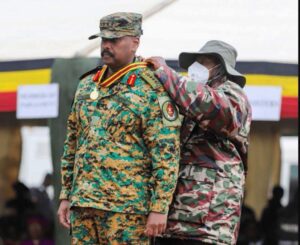
Ruhamya recently attracted national attention following his military training and commissioning as an officer in the Uganda People’s Defence Forces.
He completed military officer training at the Royal Military Academy Sandhurst in the United Kingdom in August 2026.
On October 20, 2026, President Yoweri Museveni commissioned him as a Second Lieutenant during a ceremony at Uganda Military Academy, Kabamba, in Mubende District.
His commissioning was part of a wider ceremony involving 280 officer cadets and other military trainees.
His growing public profile may partly explain why accounts bearing his name and photographs have attracted considerable attention.
However, being a member of a prominent political family does not make every social media account carrying one’s name authentic.
The incident reinforces the importance of verifying the identity of online publishers, especially when their posts concern government policy, national security and senior political leaders.
What Does Uganda’s Constitution Say About The Vice Presidency?
Beyond the personalities involved, the controversy raises an important constitutional question: who has the authority to appoint or remove Uganda’s Vice President?
Article 108 of the Constitution of the Republic of Uganda provides for the office of Vice President.
Under Article 108(2), the President appoints the Vice President with the approval of Parliament by a simple majority.
Article 108(5) further provides that the office becomes vacant if the appointment is revoked by the President or if the incumbent resigns or dies.
The Constitution therefore establishes a specific legal procedure governing the appointment and vacation of the office.
The military commander’s social media declarations, however forceful, do not themselves constitute a constitutional instrument for removing the Vice President or appointing a successor.
Furthermore, Article 208(2) provides that the Uganda People’s Defence Forces must be non-partisan, national in character, patriotic, professional and subordinate to civilian authority as established under the Constitution.
These provisions are particularly relevant when public statements by serving military officers touch on civilian political appointments.

Uganda’s constitutional framework provides institutions and procedures through which such matters must be addressed.
The controversy therefore presents an opportunity for renewed public discussion about constitutionalism, institutional responsibility and the separation of military and civilian political functions.
The Bigger Question: Where Does Social Media End And Official Authority Begin?
The two incidents illustrate a growing challenge facing Uganda’s political communication environment.
On one hand, the country has a serving military chief using a personal social media platform to communicate statements with significant political implications.
On the other, fraudulent accounts are using the identity of a newly commissioned military officer to publish statements that could easily be mistaken for official or family-authorised positions.
This creates an environment in which the distinction between personal opinion, official government communication, political messaging and impersonation can become blurred.
For public institutions, the challenge is to maintain clear communication channels and ensure that official decisions are communicated through recognised procedures.
For citizens, the responsibility is to verify information before sharing it or treating it as authoritative.
For media organisations, the responsibility is even greater: screenshots and social media posts must be authenticated, claims must be attributed, and allegations must never be converted into established facts without supporting evidence.
Alupo’s Position And The Questions Awaiting Answers
As the controversy develops, attention remains on Vice President Jessica Alupo and the response, if any, from the Presidency and the military establishment.
At the time of the latest reports, Alupo had not publicly responded to Muhoozi’s statements.
Neither had there been an official announcement that she had been removed from office.
Several questions therefore remain unanswered.
Will President Museveni publicly address the statements made by the serving CDF concerning his Vice President?
Will the military leadership clarify the distinction between personal social media commentary and official military positions?
Will the impersonating accounts be investigated or taken down?
And will the institutions responsible for safeguarding constitutional order provide reassurance that public offices remain governed by the law rather than social media declarations?
These are important questions because Uganda’s political and military institutions are bigger than the individuals who temporarily occupy their offices.
A Lesson In Digital Responsibility And Constitutional Leadership
The developments involving Muhoozi, Alupo and the impersonating Ruhamya accounts provide a timely reminder that social media influence carries considerable responsibility.
A statement published by a person holding a senior public office can have consequences far beyond the number of followers who read it.
Likewise, a fraudulent account using the identity of a prominent person can create confusion, damage reputations and potentially inflame political tensions.
Uganda needs a political communication culture in which disagreements are handled through established institutional channels, allegations are subjected to lawful investigation and constitutional offices are respected.
The latest controversy may have begun with a series of posts on X, but the questions it has raised concern the foundations of public accountability, civilian authority, constitutionalism and responsible leadership.
For now, one account has gone dark, several others have been exposed as fraudulent, and Uganda is left debating a fundamental question: In a constitutional democracy, should the authority of public office be communicated through social media declarations or exercised through the institutions and laws of the Republic?
Uganda Today — Reporting Beyond The Headlines.
#MuhooziKainerugaba #JessicaAlupo #RuhamyaKainerugaba #UgandaPolitics #Constitutionalism #UgandaToday