
The Night Humanity Learned To See Through The Human Body
+256 702 23 93 37: Today in History

UgandaToday: The Night Humanity Learned To See Through The Human Body
UGANDA TODAY | TODAY IN HISTORY | 8 NOVEMBER 2026


On 8 November 1895, a German physicist stumbled upon a scientific phenomenon that would transform medicine, change the way doctors diagnose disease and open an extraordinary window into the human body. Yet the most remarkable part of his discovery was not simply what he saw — but what he chose to give to the world.
A Strange Glow In A Darkened Laboratory
On the evening of 8 November 1895, German physicist Wilhelm Conrad Röntgen was conducting experiments at the University of Würzburg.
He was investigating cathode rays — streams of electrons produced inside glass tubes under electrical conditions. His experiments were part of a scientific investigation that had occupied researchers across Europe.
But something unexpected happened.
Although his apparatus was covered to prevent visible light from escaping, a nearby fluorescent screen began glowing. Röntgen realised that something was travelling beyond the apparatus, something that ordinary light could not explain.
He had encountered a previously unknown form of radiation.
The discovery was not immediately understood. Röntgen began conducting further experiments, carefully investigating the mysterious rays and their ability to penetrate materials.
He eventually named them “X-rays” — the letter X representing something unknown.
The discovery would become one of the most consequential scientific breakthroughs of the 19th century.
The Photograph That Changed Medical History

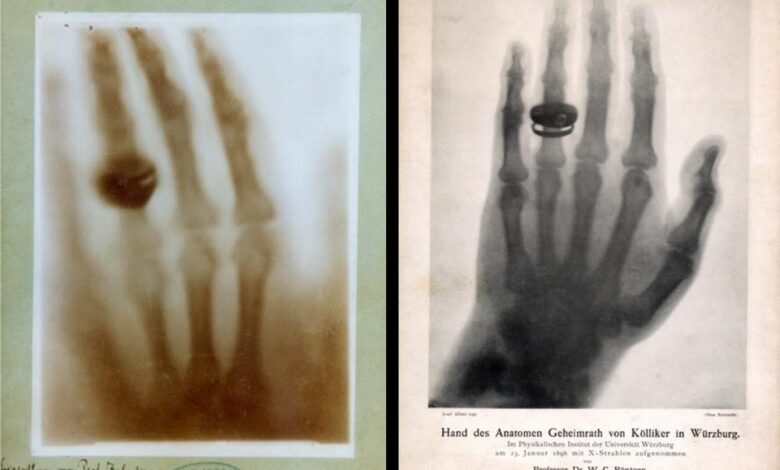
Perhaps the most extraordinary demonstration of Röntgen’s discovery involved his wife, Anna Bertha Röntgen.
In December 1895, Röntgen directed the mysterious rays through her hand onto a photographic plate.
When the plate was developed, the image revealed the bones of her hand and the unmistakable outline of her wedding ring.
For the first time, a living human body could be examined internally without surgery.
The image was more than a scientific curiosity. It represented a completely new way of understanding the human body.
Doctors could now begin to identify fractures, locate foreign objects such as bullets and investigate certain diseases without having to open the body.
The first X-ray photograph of Anna Bertha’s hand became one of the most famous images in the history of science.
Röntgen’s discovery was formally presented to the scientific community in December 1895. By early 1896, the technology was already being applied in medicine.
A Discovery That Became A Gift To Humanity
There is another dimension to Röntgen’s story that makes this anniversary particularly significant.
In an age when scientific discoveries could be turned into commercial fortunes, Röntgen chose not to patent X-rays.
He believed the discovery should benefit humanity rather than be restricted by private ownership.
His decision helped ensure that scientists, doctors and medical institutions around the world could develop and apply the technology.
In 1901, Röntgen received the first-ever Nobel Prize in Physics in recognition of his discovery.
He donated the prize money to the University of Würzburg to support scientific research.
His legacy therefore extends beyond the discovery itself. It also reflects a philosophy of scientific responsibility — that knowledge capable of improving human life should serve the public good.
From A Laboratory In Germany To Hospitals Across Africa


More than 130 years later, the consequences of Röntgen’s discovery remain visible in hospitals across Uganda and Africa.
From the diagnosis of fractures following road traffic accidents to the examination of chest conditions and the detection of certain abnormalities, X-ray technology remains an essential component of modern healthcare.
The discovery also laid the foundation for further developments in medical imaging, including computed tomography (CT), which uses X-rays to produce detailed cross-sectional images of the body.
However, the technology has also taught humanity an important lesson.
Although X-rays revolutionised medicine, scientists eventually discovered that exposure to excessive radiation could cause harm. Modern radiology therefore relies on carefully controlled exposure and radiation-protection practices.
The history of X-rays is not simply a story of scientific triumph. It is also a reminder that every powerful discovery carries responsibilities.
The Lesson Of 8 November
Röntgen’s discovery began with an observation that could easily have been ignored.
A screen glowed unexpectedly. A curious scientist investigated. A new field of science emerged.
The story reminds us that the greatest discoveries do not always begin with grand plans. Sometimes they begin with the courage to question the unexpected, the patience to investigate and the willingness to share knowledge.
For Uganda, where access to quality healthcare and advanced diagnostic technologies remains an important development priority, the anniversary is a reminder of the enduring relationship between scientific innovation and human welfare.
On this day in 1895, humanity discovered a way to see beyond the surface.
And in doing so, it changed medicine forever.
#TodayInHistory #UgandaToday #WorldRadiographyDay #MedicalInnovation #ScienceAndHistory #PhoenixNewsFeeds