
Uganda’s Shs5bn software question: MPs demand answers over Shs122bn Entebbe Expressway tolling contract
+256 702 23 93 37: Missing vehicles and possible revenue leakage, the committee has also raised concerns about discrepancies in the tolling system. According to the latest parliamentary reporting, internal audit records showed that 586 vehicles were unaccounted for in November 2024, representing an estimated revenue shortfall of about Shs407 million. In December 2025, another 2,860 vehicles were reportedly not captured by the tolling system. By May 2026, more than 7,000 vehicles were said to have gone unrecorded, with the estimated revenue loss exceeding Shs1 billion.

UgandaToday: Uganda’s Shs5bn software question: MPs demand answers over Shs122bn Entebbe Expressway tolling contract
By UgandaToday Reporter
Uganda’s management of the Kampala-Entebbe Expressway has come under renewed parliamentary scrutiny, with lawmakers questioning why government entered into a contract worth about Shs122 billion with French engineering and infrastructure firm Egis to operate and maintain the expressway while collecting toll revenue.
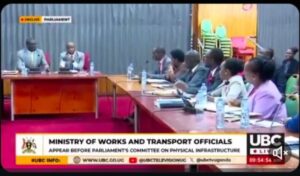
The controversy intensified following a recent sitting of Parliament’s Committee on Physical Infrastructure, where Ministry of Works and Transport officials were questioned about the financial performance, toll collections, missing vehicle records and the operation and maintenance arrangements for the expressway.
The debate has also triggered public questions over an alleged decision by government not to procure a toll-management software system reportedly costing about Shs5 billion, opting instead to engage Egis.
However, UgandaToday’s review of parliamentary records shows that the Shs122 billion figure should not be described simply as a payment to Egis for collecting tolls. Parliament records indicate that the contract covered a broader five-year performance-based operation and maintenance arrangement.
The Shs5bn software question
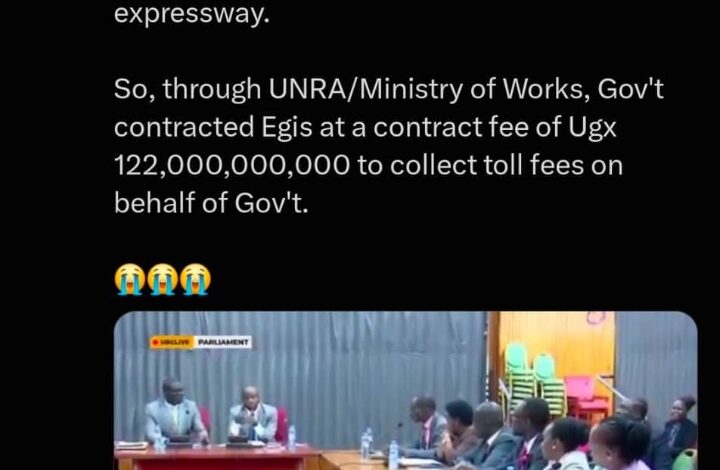
A social-media post accompanying the UBC parliamentary footage claims that government lacked the capacity to purchase software reportedly costing Shs5 billion to initiate toll collection on the Entebbe Expressway.
The post alleges that government subsequently contracted Egis through UNRA/Ministry of Works and Transport at Shs122 billion to collect tolls on its behalf.
UgandaToday could not independently establish from the publicly accessible parliamentary documents reviewed whether the Ministry specifically told MPs that a Shs5 billion software package was available for government to purchase and operate independently.
That distinction is important because the parliamentary documentation available to the public describes the Egis arrangement as an operation and maintenance contract, rather than a software-purchase or toll-collection-only contract.
What Parliament records say about the Shs122bn
Parliamentary records from January 2023 provide a clearer picture of the original arrangement.
According to the report, government, through the then Uganda National Roads Authority (UNRA), contracted Egis Road Operation on 13 April 2021 to undertake a performance-based management contract for the Kampala-Entebbe Expressway.
The contract commenced on 24 May 2021 and had an initial duration of 60 months, with provision for a further two-year extension subject to satisfactory performance.
The contract value was recorded as Shs122 billion, excluding VAT and contingencies. (Parliament of Uganda)
This means the Shs122 billion covered considerably more than the mere electronic collection of toll fees.
But the toll revenue figures raise questions
The latest parliamentary inquiry has nevertheless produced a striking comparison.
According to reporting on the committee proceedings, MPs were told that the expressway had generated approximately Shs129 billion in toll revenue, while the cost associated with the Egis contract stood at about Shs122 billion.
The comparison prompted legislators to question whether the tolling arrangement represents value for money for taxpayers. On the face of those two figures, the difference is only about Shs7 billion.
That means the contractual value is equivalent to roughly 94.6 per cent of the toll revenue figure.
But this does not mean that Uganda spent Shs122 billion merely to collect Shs129 billion. The Egis contract included operation and maintenance responsibilities, and the figures cannot properly be treated as a simple “cost of collection versus revenue” calculation without examining the full contract, payment schedule, maintenance expenditure and other obligations.
That distinction, however, does not remove the central parliamentary question: was the arrangement the most economical way for Uganda to manage its toll road?
Missing vehicles and possible revenue leakage
The committee has also raised concerns about discrepancies in the tolling system.
According to the latest parliamentary reporting, internal audit records showed that 586 vehicles were unaccounted for in November 2024, representing an estimated revenue shortfall of about Shs407 million.
In December 2025, another 2,860 vehicles were reportedly not captured by the tolling system.
By May 2026, more than 7,000 vehicles were said to have gone unrecorded, with the estimated revenue loss exceeding Shs1 billion.
These revelations have added another dimension to the controversy: even as government pays for a sophisticated tolling and road-management system, Parliament wants to know whether every vehicle passing through the toll plazas is being properly captured and charged.
Why is government still relying on external operators?
The committee also questioned why government continues to depend on external contractors despite efforts to build local institutional capacity.
Parliament was told that 12 officials from the Ministry of Works and Transport and NITA-U received training in India in March 2025 on toll-road operations and maintenance, tolling systems, contract management and project supervision.
The training was financed under a Shs200 million provisional sum managed by Egis, while government separately paid the officials’ airfares and subsistence allowances.
This has raised a broader question: if government is investing in training its own personnel, when will Uganda acquire the technical and institutional capacity to manage its own tolling infrastructure?
The Egis contract was already controversial
The Shs122 billion arrangement is not a new parliamentary concern.
In 2023, Parliament’s Committee on Commissions, Statutory Authorities and State Enterprises (COSASE) questioned the costs associated with management of the expressway and called for scrutiny of the arrangement.
The parliamentary record confirms the Shs122 billion contract value and its five-year duration. (Parliament of Uganda)
A subsequent report by Uganda Radio Network also reported that parliamentary oversight had raised concerns about the cost of the Egis arrangement and called for a forensic examination of expressway maintenance costs. (Uganda Radionetwork)
Tolling system faces another test
The latest inquiry has gone beyond the Egis contract itself.
MPs are examining the Automated Payment Collection Unit (APCU), an account designed to temporarily receive electronic toll payments before the funds are transferred to the Consolidated Fund.
Lawmakers demanded an explanation for reported withdrawals from the account, given that officials have described it as a transit account for electronic toll payments.
The committee has also questioned why Shs1.6 billion allocated for weigh-in-motion bridges remained unused, while the overload-control component of the expressway remained incomplete.
Government now faces the accountability test
The emerging controversy is therefore bigger than the alleged Shs5 billion software purchase.
At its heart is a question of public-sector capacity, procurement, value for money and revenue accountability.
If Uganda could have acquired and operated an effective toll-management system for a fraction of the cost of outsourcing the wider operation, Parliament will want to know why that option was not pursued.
Conversely, if the Shs5 billion software proposal was technically inadequate, incompatible with the expressway’s existing infrastructure, or incapable of delivering the wider operation and maintenance obligations performed by Egis, government will need to provide the documentation and technical justification.
Either way, the public deserves more than competing figures circulating on social media.
The Ministry of Works and Transport should publish the relevant contract, its payment schedule, the precise toll-collection component, maintenance obligations, performance deductions, revenue collected and the terms under which the arrangement was procured.
From Shs5bn software to Shs122bn contract
The fundamental question confronting Parliament can therefore be framed simply:
Could Uganda have built and operated its own toll-management capacity at substantially less cost, or was the Shs122 billion Egis arrangement necessary to deliver a service that government could not provide itself?
That is the question the ongoing parliamentary inquiry must answer.
And with Parliament already identifying missing vehicle records, unexplained account transactions and concerns about the continued dependence on external operators, the debate over the Kampala-Entebbe Expressway is increasingly becoming a test of how Uganda manages—and accounts for—the revenue generated by its major public infrastructure.
Fact-check note
What is established: Parliament’s own records confirm that Egis Road Operation was awarded a Shs122 billion, 60-month performance-based operation and maintenance contract, excluding VAT and contingencies. (Parliament of Uganda)
What is newly reported: Parliament’s current inquiry is examining toll revenue of about Shs129 billion, missing vehicle records and other aspects of the expressway’s financial management.
What remains to be independently established: The specific claim that government was offered or considered purchasing a Shs5 billion toll-collection software package and rejected it specifically because it lacked the funds. The claim appears in social-media material accompanying the parliamentary footage, but I did not find a publicly accessible official parliamentary document independently confirming that precise assertion.