Business

World Bank Keeps Uganda in Low-Income Category as Togo Makes Historic Leap

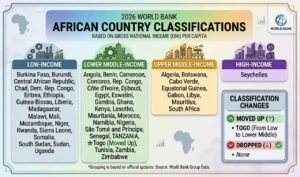
+256 702 239 337: Uganda Still in Low-Income Bracket According to the latest World Bank classification, Uganda remains grouped alongside countries such as Rwanda, Ethiopia, Burundi, Malawi, South Sudan, Sudan, Somalia, the Democratic Republic of Congo, Mozambique and Niger in the low-income category. For the current fiscal year, the World Bank defines: Low-income economies: GNI per capita of US$1,175 or less Lower-middle-income economies: US$1,176–US$4,635 Upper-middle-income economies: US$4,636–US$14,375 High-income economies: Above US$14,375


WorldBank World Bank headquarters office building interior. Main building  atrium. View towards the entrance. Washington DC USA Stock Photo - Alamy
WorldBank World Bank headquarters office building interior. Main building atrium. View towards the entrance. Washington DC USA Stock. The World Bank updates global income classifications annually based on Gross National Income (GNI) per capita. Photo – Alamy

UgandaToday: World Bank Keeps Uganda in Low-Income Category as Togo Makes Historic Leap

By UgandaToday Reporter

KAMPALA – Uganda has remained among Africa’s low-income economies in the latest World Bank income classification for the 2026/2027 fiscal year, underscoring the country’s continuing struggle to raise incomes despite years of sustained economic growth and ambitious development programmes.

The annual classification, which is based on Gross National Income (GNI) per capita calculated using the World Bank’s Atlas Method, places African countries into four categories: low-income, lower-middle-income, upper-middle-income and high-income economies. The updated classification took effect on July 1, 2026, and is based on countries’ 2025 GNI per capita.

Uganda Still in Low-Income Bracket

According to the latest World Bank classification, Uganda remains grouped alongside countries such as Rwanda, Ethiopia, Burundi, Malawi, South Sudan, Sudan, Somalia, the Democratic Republic of Congo, Mozambique and Niger in the low-income category.

The classification indicates that Uganda has yet to attain the income threshold required to graduate into the lower-middle-income category.

For the current fiscal year, the World Bank defines:

  • Low-income economies: GNI per capita of US$1,175 or less
  • Lower-middle-income economies: US$1,176–US$4,635
  • Upper-middle-income economies: US$4,636–US$14,375
  • High-income economies: Above US$14,375

Togo Emerges Africa’s Biggest Success Story

Togo became Africa’s only country to move from low-income to lower-middle-income status in the latest World Bank update.

The biggest African story in this year’s rankings is Togo, which officially graduated from the low-income category into the lower-middle-income group.

The World Bank says the promotion reflects a combination of economic developments and updated statistical information, including revised population figures following the country’s latest census, which increased its GNI per capita enough to cross the required threshold.

Notably, no African country dropped into a lower income category during this year’s review.

Only One High-Income Economy in Africa

The latest classification once again highlights Africa’s uneven economic landscape.

According to the World Bank:

  • Seychelles remains Africa’s only high-income economy.
  • Countries including South Africa, Botswana, Mauritius, Algeria, Libya, Gabon, Cabo Verde and Equatorial Guinea remain classified as upper-middle-income economies.
  • Major regional economies such as Kenya, Tanzania, Nigeria, Ghana, Zambia, Morocco and Egypt remain in the lower-middle-income category.
  • Uganda continues to belong to the continent’s largest group of low-income economies.

Why the Classification Matters

Although the World Bank’s income categories are analytical rather than political, they carry considerable significance.

Governments, investors, development partners and international financial institutions use the classifications to:

  • Assess economic progress.
  • Determine eligibility for certain concessional loans and development financing.
  • Compare development performance across countries.
  • Inform investment and policy decisions.

The classifications do not necessarily reflect overall quality of life, industrialisation or wealth distribution, but instead measure average national income per person.

Uganda’s Long Road to Middle-Income Status

A view of Kampala, along Kampala-Jinja road. The World Bank updates global income classifications annually based on Gross National Income (GNI) per capita.

For more than a decade, successive Ugandan governments have repeatedly expressed ambitions of transforming Uganda into a middle-income country through industrialisation, infrastructure expansion, value addition and private-sector growth.

However, the latest World Bank assessment suggests that average income levels remain below the threshold needed to attain lower-middle-income status.

Economists have consistently argued that while Uganda’s economy has expanded in overall size, rapid population growth means income gains per person have been relatively modest.

Moving into the next income category will require faster growth in household incomes, increased productivity, industrial expansion and stronger job creation.

Africa’s 2026 Income Landscape

The updated classification paints a picture of a continent where economic transformation remains uneven.

While countries such as Togo are beginning to move up the income ladder, a large number of African nations—including Uganda—remain in the low-income bracket, illustrating the continuing challenge of translating macroeconomic growth into higher living standards for ordinary citizens.

As governments pursue economic reforms and regional integration under the African Continental Free Trade Area (AfCFTA), future World Bank classifications will remain an important barometer of progress across the continent.

UgandaToday

UgandaToday is published by CMK Media Solutions. UgandaToday is your trusted source for news and analysis. Partner with Uganda Today where your story matters in shaping the social and economic dynamics of the country. Let’s help you grow your brand and keep your audience informed. Website: https://www.ugandatoday.co.ug WhatsApp: +256 702 239 337 X (formerly Twitter): @uganda43443 | Email: ugandatodayedition@gmail.com P.O.BOX 184351 Kampala. Uganda

Related Articles

Back to top button
error: Content is protected !!