The Ugandan-Born Kenyan Who Took Cannabis To The Presidential Ballot
+256 702 23 93 37: George Wajackoyah’s Unorthodox 2022 Campaign Turned Bhang, Debt, Jobs And Economic Freedom Into One Of Kenya’s Most Unusual Presidential Debates


UgandaToday: The Ugandan-Born Kenyan Who Took Cannabis To The Presidential Ballot
George Wajackoyah’s Unorthodox 2022 Campaign Turned Bhang, Debt, Jobs And Economic Freedom Into One Of Kenya’s Most Unusual Presidential Debates
There are few presidential campaigns in East Africa that have managed to turn a plant associated for decades with illegality, policing and social controversy into the centrepiece of a national economic conversation.
In Kenya, however, George Luchiri Wajackoyah did precisely that.
When the lawyer, academic and former police officer entered Kenya’s 2022 presidential race under the Roots Party banner, he did not offer voters the conventional catalogue of roads, hospitals, schools, industrial parks and public-sector reforms.
Instead, Wajackoyah placed bhang — cannabis or marijuana — at the heart of his economic proposition, arguing that Kenya could cultivate and export cannabis, particularly for medicinal and industrial purposes, and use the proceeds to confront unemployment and the country’s growing public debt.
His message was unconventional, provocative and, to many Kenyans, startling.
But behind the theatrics was a serious political question: could a crop that remained illegal under Kenyan law be transformed into a regulated export industry capable of generating significant national revenue?
That question made Wajackoyah one of the most talked-about candidates of Kenya’s 2022 presidential election.
A Kenyan Political Figure With A Ugandan Birth Story
George Luchiri Wajackoyah’s biography is almost as unconventional as was his political campaign.
Several biographical accounts place his childhood and family roots in western Kenya, particularly the Mumias area. However, Wajackoyah himself has said that he was born on October 24, 1959, at St Mary’s Hospital in Jinja, Uganda, to Kenyan parents.
His father, Tito Olilo Jakoya, was from the Mumias area, while his mother, Melenia Makokha, was also Kenyan.
The account of his Jinja birth has appeared in multiple biographical sources, although other references give Mumias, Kenya, as his birthplace. Uganda Today therefore treats Jinja as Wajackoyah’s own reported birthplace rather than presenting the matter as completely uncontested.
Despite being born in Uganda, Wajackoyah grew up in Kenya and built his professional and political career there.
His early life was marked by considerable hardship.
Published accounts describe him as having spent part of his youth on the streets of Nairobi after his parents separated. A well-wisher subsequently helped him return to education.
His journey eventually took him into the Kenya Police, criminal investigation, law and academia.
He studied law in the United Kingdom and later became a practising lawyer and lecturer.
That transformation — from a difficult childhood to a legal and academic career and eventually a presidential candidacy — became an important part of Wajackoyah’s political persona.
But it was his cannabis agenda that ultimately made him internationally famous.
When Cannabis Became A Presidential Campaign Issue
Wajackoyah announced that, if elected president, he would seek to legalise cannabis cultivation and trade.
His argument was principally economic.
Kenya was struggling with a substantial public debt burden, unemployment and the challenge of generating foreign exchange. Wajackoyah argued that cannabis could provide an alternative source of export earnings.
His Roots Party manifesto, launched at the Kenyatta International Convention Centre in Nairobi on June 30, 2022, contained a programme built around ten principal pillars, including the legalisation and commercialisation of bhang. Contemporary Kenyan reporting described cannabis and snake farming as central elements of the party’s economic vision.
The proposal was radical because cannabis remained illegal in Kenya.
Consequently, Wajackoyah was not merely proposing another agricultural policy.
He was proposing a fundamental change in the country’s approach to a controlled substance.
Industrial Hemp, Medical Cannabis And Recreational Use
One of the most important distinctions in Wajackoyah’s campaign was the difference between legalising cannabis as an economic and medicinal crop and simply permitting unrestricted recreational marijuana use.
Wajackoyah repeatedly emphasised industrial and medicinal applications.
The Washington Post reported during the campaign that, despite becoming identified with marijuana legalisation, Wajackoyah said his principal focus was industrial hemp and medical marijuana rather than recreational legalisation.
At the same time, he expressed a more permissive personal view about recreational consumption.
That distinction is important.
Industrial hemp can be used for fibre, textiles, paper, construction materials, food products and other industrial applications, while medical cannabis refers to controlled cannabis-derived products used within medical frameworks.
Recreational cannabis involves possession and consumption for personal enjoyment.
These categories may originate from the same plant, but governments regulate them differently according to factors including THC content, intended use, cultivation systems, licensing and public-health considerations.
Wajackoyah’s campaign therefore went beyond the simplistic interpretation that he was merely asking Kenyans to smoke marijuana.
His economic argument was principally about commercial cultivation, processing and export, although his public statements also generated a broader debate about recreational use.
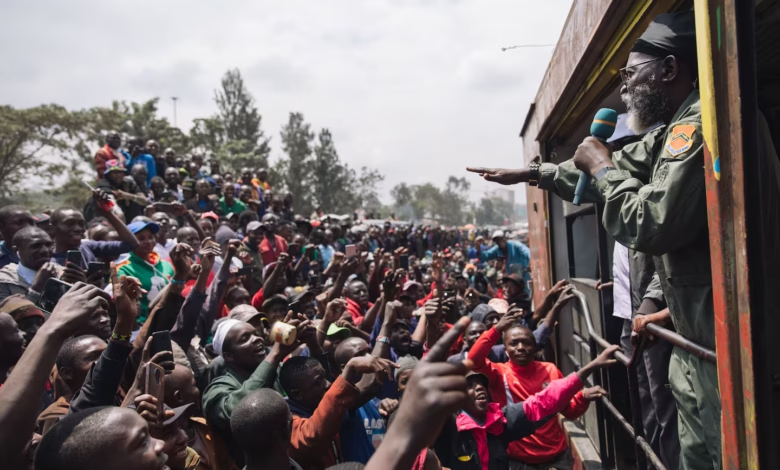
Wajackoyah’s reggae-inspired campaign rallies, distinctive dress and bhang message gave Kenya’s 2022 presidential contest an unusually unconventional political character.
The Bhang Economy
Wajackoyah’s proposition became known informally as “ganjanomics” — an economic philosophy built around cannabis.
The argument was straightforward in principle.
If Kenya could legally cultivate cannabis under government supervision, farmers could grow it commercially; processors could convert it into medicinal and industrial products; exporters could sell those products internationally; workers could find employment along the value chain; and the government could collect taxes and foreign exchange.
Wajackoyah linked this directly to Kenya’s debt crisis.
He argued that Kenya was borrowing heavily and that a new export industry could provide the country with a new source of revenue.
The Roots Party manifesto consequently placed cannabis among a broader group of unconventional export proposals.
People Daily reported at the time that the manifesto envisioned marijuana plantations and other unconventional agricultural and export ventures as part of the party’s economic strategy.
But the economic figures attached to the idea became one of the most controversial aspects of the campaign.

The Numbers Under Scrutiny
Wajackoyah made exceptionally ambitious claims about the amount of money Kenya could earn from cannabis.
He cited enormous potential revenues and argued that production on relatively limited acreage could generate billions.
The claims attracted considerable attention because they appeared to offer a simple answer to an extremely complicated economic problem.
But fact-checkers subsequently challenged several of his figures.
Africa Check examined claims made during Wajackoyah’s campaign concerning international cannabis markets, production costs and potential revenues, finding problems with several of the figures and comparisons he used.
The significance of this scrutiny was not that cannabis could never become an economically valuable crop.
Rather, it demonstrated that legalisation alone does not automatically translate into the extraordinary revenues claimed during a political campaign.
A functioning cannabis industry would require land, licences, laboratories, standards, security systems, financial institutions, processing facilities, export markets, quality control and compliance with the laws of importing countries.
It would also require taxation and regulatory systems capable of preventing diversion into illegal markets.
Kenya’s Cannabis Debate Was Bigger Than Wajackoyah
Although Wajackoyah became the most prominent political advocate of cannabis reform during the 2022 campaign, the cannabis debate did not begin with him.
Across Africa, governments have increasingly examined the medicinal and industrial potential of cannabis while maintaining restrictions on recreational use.
This distinction matters because a government can permit cannabis cultivation for export or pharmaceutical production without permitting citizens to freely possess and consume marijuana.
Wajackoyah’s campaign helped push that distinction into mainstream Kenyan political conversation.
From Cannabis To Snake Venom
Cannabis was not Wajackoyah’s only unconventional economic proposition.
His manifesto and campaign speeches included plans involving snake farming and the commercialisation of snake venom for medicinal purposes.
He also spoke about exporting animal products, including hyena parts, as part of a broader strategy to generate foreign exchange.
Al Jazeera reported that his economic programme combined cannabis farming with proposals involving snake venom and hyena products, with the stated objective of generating export earnings and tackling Kenya’s debt burden.
The combination made his campaign unusual by conventional political standards.
But it also demonstrated the central idea behind his politics: find unconventional commodities and turn them into sources of foreign exchange.
The Four-Day Working Week
Wajackoyah’s manifesto did not stop at agriculture.
He also proposed reducing the conventional working week to four days.
The proposal was among a series of unconventional ideas through which he sought to distinguish his campaign from those of the leading presidential contenders.
Contemporary reporting described a manifesto that included proposals on cannabis, unconventional exports, constitutional changes and other departures from Kenya’s traditional political programmes.
Consequently, Wajackoyah’s campaign became as much a political performance as a policy campaign.
The “Bhangi” Candidate
The cannabis message became inseparable from Wajackoyah’s campaign identity.
At rallies, supporters chanted “bhangi”, the Swahili term commonly used for marijuana.
The Washington Post reported that his campaign rallies sometimes featured reggae music, dancing and crowds chanting the word.
His distinctive clothing, campaign bus and unconventional public appearances reinforced that image.
For supporters, the approach represented a challenge to established politics.
For critics, it was an unrealistic programme.
For the media, it was an extraordinary political story.
And for Kenya’s political conversation, it introduced an issue that conventional politicians had generally avoided.
The Youth And The Politics Of Frustration
Perhaps the most important aspect of Wajackoyah’s campaign was not cannabis itself but what cannabis came to represent.
Kenya’s 2022 election took place against a backdrop of economic pressure, unemployment, public debt and dissatisfaction with established political leadership.
Wajackoyah presented himself as an outsider.
He spoke to people who believed that conventional political programmes had failed to solve their economic problems.
His message was essentially a challenge to conventional thinking:
If traditional economic policies have not produced the desired results, why not consider radically different economic opportunities?
His cannabis proposal therefore became a vehicle for a larger debate about economic innovation, youth unemployment, taxation, agriculture and Kenya’s dependence on external borrowing.
But The Ballot Told Another Story
Kenya held its presidential election on August 9, 2022.
The election was ultimately won by William Ruto, who was declared president-elect after securing more than half of the valid presidential vote.
Wajackoyah finished third among the four presidential candidates, receiving approximately 61,969 votes, or 0.44 percent of the valid vote.
The result demonstrated the distinction between public attention and electoral support.
Wajackoyah’s cannabis message generated enormous media interest, social-media discussion and popular curiosity, but the attention did not translate into anything approaching the vote totals required to seriously challenge the two leading candidates.
The Irony Of A Cannabis Campaign
There was another irony.
Despite becoming Kenya’s most recognisable political advocate for cannabis legalisation, Wajackoyah said during the campaign that he did not personally smoke marijuana.
The Washington Post reported that he said he did not smoke weed, while explaining that his principal interest was industrial hemp and medical marijuana.
The distinction was revealing.
The man who became synonymous with bhang politics was presenting cannabis principally as an economic commodity and policy instrument, rather than merely advocating personal recreational consumption.
What Wajackoyah Left Behind
Wajackoyah did not become President of Kenya.
His cannabis proposal did not transform Kenya’s economy, nor did it result in nationwide legalisation.
But political campaigns can become historically significant for reasons beyond winning elections.
Wajackoyah demonstrated that an unconventional candidate could force a mainstream national conversation around a previously taboo economic and social issue.
He made Kenyans debate whether cannabis should remain exclusively within the framework of criminal prohibition or whether some forms of cannabis production could be incorporated into agriculture, medicine, manufacturing and international trade under regulation.
He also forced another question into the public arena:
Could Africa move from treating cannabis exclusively as a drug-enforcement problem to treating some forms of cannabis production as a regulated economic activity?
That debate has implications beyond Kenya.
For Uganda, the story is particularly interesting because of Wajackoyah’s own account that he was born in Jinja, despite being a Kenyan citizen and politician whose family roots are in western Kenya.
It is a reminder of how deeply intertwined the histories, families, economies and political cultures of Uganda and Kenya are.
From Jinja To Nairobi — And From Cannabis To The Presidential Ballot
George Wajackoyah’s political journey remains one of the most unusual episodes in recent East African electoral history.
A man who has described himself as having been born in Jinja, who endured childhood hardship, entered the police service, pursued law, became an academic and eventually sought the highest office in Kenya, ended up making cannabis the unlikely centrepiece of his presidential campaign.
His manifesto promised Kenyans a radically different economic path.
The proposal was ambitious.
Its financial projections were heavily disputed.
Its legal implications were significant.
And its political appeal was unmistakable.
What remains beyond dispute is that, during Kenya’s 2022 presidential campaign, a Kenyan presidential candidate who has publicly described himself as Ugandan-born succeeded in making bhang part of the country’s mainstream political conversation.
And that may be the most enduring legacy of the Wajackoyah phenomenon: not that Kenya became a cannabis-exporting nation, but that an unconventional candidate demonstrated the political power of taking an issue considered too controversial for mainstream politicians and putting it directly before millions of voters.
Editorial Note
This feature distinguishes between Wajackoyah’s stated political proposals and independently reported facts. His reported birthplace is presented with attribution because sources differ: Wajackoyah has said he was born at St Mary’s Hospital in Jinja, Uganda, while other biographical references identify Mumias, Kenya, as his birthplace. His cannabis revenue projections should likewise not be treated as established economic forecasts because independent fact-checking raised questions about several of the figures used during the campaign.