The Succession Circle In East Africa: Are The Sons Being Prepared For Their Fathers’ Political Thrones?
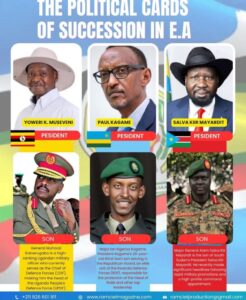
+256 702 23 93 37: Of the three cases, Uganda's is currently the most explicit. General Muhoozi Kainerugaba, President Yoweri Kaguta Museveni's son, is the Chief of Defence Forces of the Uganda People's Defence Forces (UPDF). The UPDF's current leadership listing confirms his position as CDF.

UgandaToday: The Succession Circle In East Africa: Are The Sons Being Prepared For Their Fathers’ Political Thrones?
Muhoozi’s 2031 Declaration, Ian Kagame’s Military Career And Atem Kiir’s Presidential Guard Appointment Have Renewed Debate About Political Succession In Uganda, Rwanda And South Sudan
By Uganda Today Editorial Desk
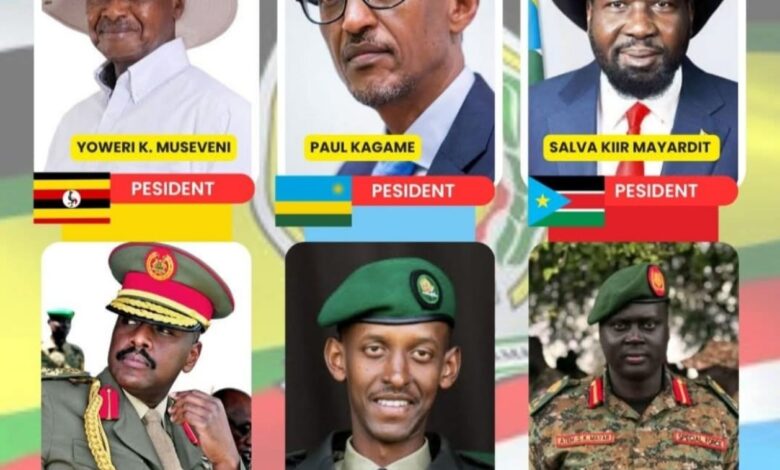
Across East Africa, questions about political succession are increasingly being discussed alongside the careers of the sons of three long-serving presidents: Uganda’s General Muhoozi Kainerugaba, Rwanda’s Ian Kagame and South Sudan’s Major General Atem Salva Kiir.
The three men have something significant in common: each is the son of a sitting president and each has pursued a career within, or close to, the security establishment.
But there is an important distinction between being positioned within a powerful state institution and being formally designated as a political successor.
At present, there is no publicly established succession arrangement in Uganda, Rwanda or South Sudan that makes any of the three men automatically heir to the presidency.
Indeed, the constitutional systems of the three countries provide for presidential office through political and electoral processes rather than hereditary succession. Uganda’s Constitution, for example, provides for election of the President by universal adult suffrage through secret ballot. South Sudan’s constitutional framework likewise provides for a directly elected president, while a presidential vacancy is temporarily handled through the vice-presidency pending elections.
What, therefore, is behind the growing succession debate?
Uganda: Muhoozi Has Moved From Speculation To An Open Presidential Ambition
Of the three cases, Uganda’s is currently the most explicit.
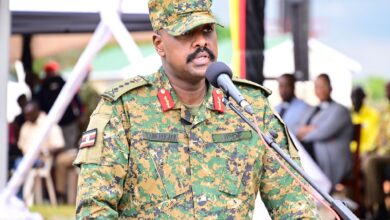
General Muhoozi Kainerugaba, President Yoweri Kaguta Museveni’s son, is the Chief of Defence Forces of the Uganda People’s Defence Forces (UPDF). The UPDF’s current leadership listing confirms his position as CDF.
His military career has increasingly been accompanied by political activity.
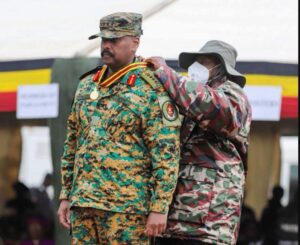
On August 26, 2026, Muhoozi publicly stated that he intended to run for Uganda’s presidency in 2031. Reuters reported that he had previously been regarded as a possible successor to his father and that he had also led the Patriotic League of Uganda, a political pressure group.
That declaration substantially changes the nature of the succession conversation.
Previously, much of the discussion surrounding Muhoozi’s future was based on his military rise, his family connection and speculation by political observers. His own declaration now provides a documented political intention.
However, intention to contest an election is not the same as succession.
Uganda’s constitutional framework requires a presidential candidate to go through an electoral process, and the presidency is decided by votes rather than automatic inheritance.
The question facing Uganda, therefore, is not simply whether Muhoozi is being positioned by his father. It is also whether he can transform his military and political profile into an electoral coalition capable of taking him to State House.
Rwanda: Ian Kagame And The Significance Of The Republican Guard
Rwanda presents a different picture.
Ian Kagame, son of President Paul Kagame, graduated from the Royal Military Academy Sandhurst in the United Kingdom in August 2022 and was commissioned as a second lieutenant in the Rwanda Defence Force. This is confirmed by Rwanda’s Ministry of Defence.
He subsequently served in the Republican Guard, the elite formation responsible for protecting Rwanda’s president and other senior leadership.
Public reporting has documented his involvement with the Republican Guard. In 2024, he was reported as a captain, while in 2025 and 2026 he continued to be associated with the unit.
This is significant because the Republican Guard occupies an important position within Rwanda’s security architecture.
Yet the available public evidence does not establish that President Kagame has designated Ian as his political successor.
That distinction matters.
Military service by a president’s son can generate succession speculation, particularly where the son serves in an elite unit close to the presidency. But it does not, by itself, demonstrate that a presidential succession plan exists.
President Kagame remains the country’s political leader, having secured another presidential term in the 2024 election.
The eventual question of succession in Rwanda will therefore depend on political decisions, institutions and the electoral process rather than simply Ian Kagame’s military career.
South Sudan: Atem Kiir’s Rise Comes At A Particularly Sensitive Moment
The South Sudan case is perhaps the newest development in the succession discussion.
On September 9, 2026, President Salva Kiir Mayardit appointed his son, Major General Atem Salva Kiir, commander of the Tiger Division, the presidential guard responsible for protecting the president and senior government officials.
Radio Tamazuj reported that Atem, 36, had recently been promoted from brigadier general to major general and had previously served within the National Security Service.
The appointment has attracted considerable attention because of the importance of the Tiger Division and because South Sudan is preparing for elections scheduled for December 2026.
But even here, there is an important caveat.
Radio Tamazuj reported that President Kiir has not publicly stated that Atem is being groomed to succeed him. The South Sudan military has defended the appointment as having been made through the established command structure and on merit.
Consequently, it would be premature to convert Atem’s military promotion into a confirmed presidential succession plan.
The development is nevertheless politically noteworthy because it places the President’s son in command of one of the country’s most strategically sensitive military formations at a time when South Sudan is preparing for an electoral transition.
Three Presidents, Three Different Succession Signals
There is a striking similarity in the three cases: military institutions are central to the careers of all three sons.
| Country | President | Son | Documented Position | What Is Publicly Established? |
|---|---|---|---|---|
| Uganda | Yoweri Museveni | Gen. Muhoozi Kainerugaba | UPDF Chief of Defence Forces | Has publicly declared intention to run for president in 2031 |
| Rwanda | Paul Kagame | Ian Kagame | Rwanda Defence Force/Republican Guard | Has pursued military career; no public presidential succession designation established |
| South Sudan | Salva Kiir Mayardit | Maj. Gen. Atem Salva Kiir | Commander, Tiger Division | Recently appointed to presidential guard; no public succession designation established |
The difference is therefore important.
Muhoozi has made a political declaration.
Ian has built a military career within an elite security formation.
Atem has recently received a strategically important military command.
Those are facts. Whether they eventually translate into presidential succession is a separate question.
The Museveni-Kagame-Kiir Connection
The three countries are also connected by decades of regional political and security relationships.
President Museveni and President Kagame have a particularly long historical association dating back to the period surrounding the Rwandan Patriotic Front’s struggle and the 1994 genocide.
A historical account published through Rwanda’s government records Kagame’s repeated contacts with Museveni during the RPF’s struggle between 1990 and 1994, including discussions concerning military assistance.
Uganda and South Sudan also have a long political and security relationship.
One important historical episode was the relationship between Museveni and the late Dr John Garang de Mabior, then leader of the Sudan People’s Liberation Movement/Army.
Garang met Museveni at Rwakitura in July 2005 to discuss issues surrounding Sudan’s Comprehensive Peace Agreement and regional affairs. He subsequently died when a Ugandan presidential helicopter carrying him back to South Sudan crashed on July 30, 2005. Contemporary reporting on the investigation attributed the crash to aviation and weather-related factors rather than presenting it as evidence of a political plot.
Garang’s death resulted in Salva Kiir becoming the leading figure in the emerging South Sudanese political order.
That history helps explain why the political relationships between Kampala, Kigali and Juba have often been viewed through a regional-security lens.
Is East Africa Moving Towards Political Dynasties?
The comparison inevitably raises a wider question: are presidential families becoming increasingly important to political succession in East Africa?
Kenya provides an important historical example.
Jomo Kenyatta’s son, Uhuru Kenyatta, eventually became President of Kenya after winning the 2013 presidential election. The Kenyan presidency’s official biography records that Uhuru contested the March 4, 2013 election on the Jubilee Coalition ticket and was declared elected after receiving more than 50 percent of the vote.
But Uhuru’s route to State House also demonstrates why family connection alone cannot explain political succession.
A presidential son still requires a political vehicle, alliances, voter support and an electoral process.
That distinction is especially relevant when examining Muhoozi, Ian and Atem.
The Question Is Not Simply “Who Will Succeed?”
The more useful question may be:
What political, institutional and electoral conditions would have to exist before any of these presidential sons could actually succeed their fathers?
Several factors will matter.
1. Electoral Legitimacy
In Uganda and Rwanda, presidential succession ultimately involves elections. South Sudan’s constitutional framework also provides for direct presidential elections.
2. Political Organisation
A military career does not automatically create a national political organisation.
A potential successor needs political structures capable of mobilising voters and building alliances.
3. Support Within The Ruling Establishment
In long-established political systems, relationships within ruling parties, security institutions, business networks and regional constituencies can be important to any future transition.
4. Public Acceptance
Ultimately, political succession is not determined solely inside presidential residences or military headquarters.
Public opinion, elections and constitutional institutions matter.
5. The Father’s Own Political Decisions
None of the three presidents has publicly established a constitutional mechanism through which his son automatically inherits the presidency.
That means future developments could alter the current picture considerably.
So, Who Among The Three Will Succeed His Father?
At this point, there is insufficient evidence to responsibly declare that Muhoozi Kainerugaba, Ian Kagame or Atem Salva Kiir will become president after his father.
The evidence points to three different stages of political visibility.
Muhoozi is the only one of the three who has publicly announced a presidential ambition, specifically for 2031.
Ian Kagame has accumulated military experience in Rwanda’s elite security structure, but there is no publicly documented presidential designation.
Atem Kiir has recently acquired a powerful security command, but reporting also indicates that President Kiir has not publicly identified him as a political heir.
Therefore, the most defensible conclusion is not a prediction about which son will eventually occupy State House.
Rather, East Africa is witnessing three closely watched examples of presidential sons building prominence within institutions that are central to national power.
Whether those careers eventually become political successions will depend on decisions, institutions, elections and political developments that cannot yet be known.
And that is precisely why the succession question remains one of the most closely watched political stories in the region.
EDITORIAL NOTE
This article is an analytical examination of publicly documented developments and succession speculation. It does not assert that any of the three presidential sons has been formally designated as successor, nor does it predict the outcome of any future election.
#UgandaToday #EastAfrica #PoliticalSuccession #MuhooziKainerugaba #Rwanda #SouthSudan