
Plastic Pollution Begins Long Before The Bin: Why The World Must Rethink How Plastic Is Designed
+256 702 23 93 37: Plastic Pollution Begins Long Before The Bin: Why The World Must Rethink How Plastic Is Designed


UgandaToday: Plastic Pollution Begins Long Before The Bin: Why The World Must Rethink How Plastic Is Designed
By UgandaToday Editorial Desk
The world is producing plastic at an unprecedented scale, generating more than 400 million tonnes of plastic waste every year—a mountain of discarded material that is increasingly overwhelming waste-management systems and threatening natural ecosystems.
But according to an analysis shared by Nature Mentors, the plastic crisis is not simply a problem of what happens after products are thrown away. It is fundamentally a problem of how products are designed, produced, consumed and discarded.
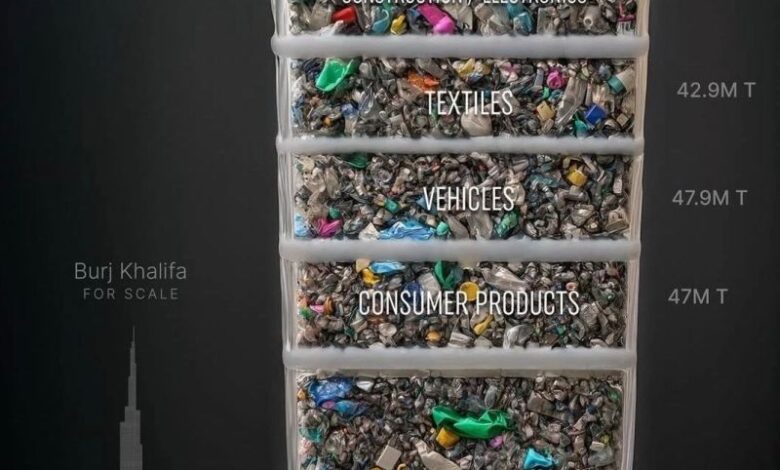
The striking infographic accompanying the analysis, drawing on data from the OECD Global Plastics Outlook, illustrates the scale of the challenge by comparing one year’s global plastic waste with the height of Dubai’s Burj Khalifa.


Packaging Emerges As The Biggest Culprit
Packaging accounts for the largest share of global plastic waste, with the infographic attributing about 155.9 million tonnes to the sector—roughly 39 per cent of the total depicted.
Much of this plastic is manufactured for convenience and short-term use. Food wrappers, bottles, bags, sachets and other forms of packaging can be used for only minutes, yet the material may remain in the environment for decades or longer when it is not properly managed.
This creates a fundamental contradiction: products designed for very short periods of use can generate waste with extraordinarily long environmental consequences.
The problem, however, extends far beyond packaging.
Consumer products contribute about 47 million tonnes, vehicles about 47.9 million tonnes, textiles approximately 42.9 million tonnes, while construction and electronics account for about 37.5 million tonnes. Other sources contribute another 67.7 million tonnes.
Together, the figures demonstrate that plastic pollution is not confined to one industry.
A Problem Woven Into The Global Economy
Plastic has become deeply embedded in modern economies because it is lightweight, versatile, durable and relatively inexpensive.
Those same characteristics, however, create enormous environmental challenges when products reach the end of their useful lives.
The Nature Mentors analysis argues that the world has developed a predominantly linear economic model—one based on taking resources, making products, using them and ultimately throwing them away.
Under such a system, responsibility for plastic pollution often begins only when an item becomes waste.
But the more fundamental decisions have already been made much earlier: during product design, manufacturing, packaging and distribution.
Recycling Alone Cannot Solve The Crisis
Globally, less than 10 per cent of plastic waste is effectively recycled, according to the information shared by Nature Mentors.
The remainder may be landfilled, incinerated, mismanaged or leak into the environment.
This means that simply encouraging people to recycle, while important, cannot by itself resolve the plastic problem.
If products are difficult to collect, separate, clean or process, recycling becomes expensive and inefficient. If packaging is made from complex combinations of materials, recovering those materials can become even more difficult.
The real opportunity therefore lies in preventing unnecessary waste and designing products that remain useful for longer.
The Crisis Starts At The Design Stage
Nature Mentors identifies several points where the plastic problem can be addressed before products become waste.
These include designing products and packaging for reuse, durability and recyclability, strengthening supply chains around circularity, reducing unnecessary packaging and improving Extended Producer Responsibility (EPR) systems.
Under EPR, producers can be given greater responsibility for the environmental impacts of products and packaging throughout their life cycle.
Such approaches shift part of the responsibility away from consumers and waste collectors and towards the companies and systems that determine what enters the market in the first place.
Uganda Cannot Ignore The Global Plastic Challenge
For countries such as Uganda, the global debate has particular relevance.
Rapid urbanisation, growing consumption and increasing use of packaged products mean that managing discarded materials is becoming an increasingly important environmental and municipal challenge.
The lesson from the global figures is that waste management cannot be treated solely as a matter of collecting rubbish from streets and dumping it elsewhere.
There is a need to consider what happens before the waste is created.
Manufacturers, retailers, policymakers, local authorities and consumers all have roles to play in reducing unnecessary plastic, promoting reusable alternatives, improving collection systems and ensuring that materials that can be recovered actually enter recycling streams.
From A Throwaway Culture To A Circular Economy
The alternative is a circular economy, where materials are kept in use for as long as possible, products are designed for repair and reuse, and waste is minimised from the outset.
For packaging, this could mean reducing unnecessary material, increasing reuse and ensuring that what remains can be easily recovered and recycled.
For manufacturers, it could mean designing products with their entire life cycle in mind rather than focusing only on production and sales.
For consumers, it could mean choosing reusable products where practical and supporting businesses that reduce unnecessary packaging.
And for governments, it means creating policies and infrastructure that make sustainable choices easier and economically viable.
The Bigger Question Is How We Design The Future
The plastic crisis is often portrayed through images of overflowing dumpsites, polluted rivers, beaches covered in bottles and animals trapped in discarded materials.
Those images represent the consequences.
But the roots of the problem are often much less visible.
They are found in product specifications, packaging decisions, manufacturing systems, supply chains and policies that determine whether an item is designed to be reused—or simply thrown away.
The central message from Nature Mentors is therefore a powerful one: the future of plastics will not be determined by recycling alone. It will also depend on how intelligently the world designs, produces and uses materials in the first place.
The challenge is no longer simply understanding the problem. It is turning solutions that already exist into everyday practice.
The question facing governments, businesses and consumers is no longer what do we do with plastic waste?
It is increasingly becoming:
Why are we designing so much waste in the first place?