Rwanda’s Formula One Dream Faces A Human Rights Test: Can Global Motorsport Outrun The Accountability Question?
+256 702 23 93 37: Rwanda Secures A Historic Formula One Opportunity On October 13, 2026, Formula One and the Fédération Internationale de l’Automobile (FIA) announced a 10-year agreement to bring the championship back to Africa, with Rwanda selected to host the African Grand Prix from the early 2030s. The continent last hosted a Formula One race in 1993, at South Africa’s Kyalami circuit.

UgandaToday: Rwanda’s Formula One Dream Faces A Human Rights Test: Can Global Motorsport Outrun The Accountability Question?
UGANDA TODAY | INTERNATIONAL AFFAIRS, SPORT AND HUMAN RIGHTS
As Rwanda seeks to position itself among Africa’s premier destinations for international sport, its Formula One ambitions raise a bigger question: can the economic promise of a global sporting spectacle be separated from concerns about human rights, political freedoms and accountability?
The prospect of Rwanda hosting a Formula One Grand Prix has opened an important debate about the future of African motorsport, the continent’s search for global investment and the responsibilities of international sporting institutions. It has also brought renewed attention to criticism of Rwanda’s human rights record, including concerns raised by Amnesty International.
For Kigali, a successful Formula One bid would represent much more than a race. It would be a statement of national ambition, an opportunity to attract international visitors and investors, and a chance to strengthen Rwanda’s reputation as a destination for major global events.
But there is another side to the story. When a country seeks to host one of the world’s most commercially powerful sporting competitions, questions about civil liberties, political opposition, freedom of expression and the treatment of critics do not automatically disappear beneath the noise of racing engines.
The central issue is not whether Rwanda should be denied the opportunity to host a major sporting event simply because its government faces criticism. Rather, it is whether the pursuit of sporting prestige can become an opportunity to advance human rights—or whether international sport risks providing a government with a powerful image-building platform without sufficient accountability.
That is the debate Rwanda’s Formula One ambitions invite Africa and the wider international community to confront.


Rwanda Secures A Historic Formula One Opportunity
On October 13, 2026, Formula One and the Fédération Internationale de l’Automobile (FIA) announced a 10-year agreement to bring the championship back to Africa, with Rwanda selected to host the African Grand Prix from the early 2030s. The continent last hosted a Formula One race in 1993, at South Africa’s Kyalami circuit.
The proposed race will take place on a purpose-built circuit in Bugesera, approximately 40 kilometres south of Kigali, near a new international airport under construction. The venue is expected to meet FIA Grade One standards, the highest circuit classification required for hosting Formula One races. Its planned capacity is approximately 100,000 spectators, and organisers envisage using the facility for other events beyond race weekends.
This is a significant achievement for Rwanda, which has spent years pursuing an international sporting profile through tourism promotion, club sponsorships and the hosting of major competitions. The country hosted the 2025 UCI Road World Championships and has previously hosted major football and motorsport-related gatherings.
For African fans, the significance extends beyond Rwanda. Formula One has been absent from the continent for more than three decades despite its large population, growing middle class and expanding interest in international sport.
The agreement could create opportunities for hotels, restaurants, transport operators, construction companies, event organisers and tourism businesses. It may also open pathways for African engineers, mechanics, hospitality professionals and young motorsport enthusiasts to acquire technical skills.
However, these are anticipated benefits, not guaranteed outcomes. Their scale will depend on how the project is financed, how many local businesses participate, how employment opportunities are distributed and whether the infrastructure remains economically useful after the race weekend ends.
Amnesty International Raises The Human Rights Alarm
The celebrations surrounding the announcement were accompanied by criticism from Amnesty International, which questioned the wisdom of Formula One entering into a long-term partnership with Rwanda without demanding stronger human rights safeguards.
In a statement reported by Reuters on October 13, Amnesty International UK’s head of campaigns, Felix Jakens, described the deal as a “sports washing prize” for the Rwandan authorities. The organisation argued that major sporting partnerships risk helping governments improve their international reputations while serious concerns about civil liberties remain unresolved.
The criticism is not an objection to African countries hosting major sporting competitions. Rather, it challenges the idea that commercial opportunity and global prestige should be pursued without considering the conduct of the governments involved.
Amnesty’s concerns include allegations of arbitrary detention, torture and restrictions on freedom of expression. These are serious allegations that deserve careful scrutiny, independent investigation and appropriate responses from the authorities concerned.
Amnesty International’s 2025 assessment of Rwanda also documented restrictions on civic space, unfair prosecution of political opposition members, concerns about labour rights and forced evictions linked to urban development. It cited cases in which residents reportedly received little notice before demolitions and lacked adequate consultation, compensation or alternative housing.
In its July 2024 report on Rwanda’s electoral environment, Amnesty described restrictions on opposition parties, civil society and independent media, including allegations of intimidation, arbitrary detention and enforced disappearances. Human Rights Watch has separately documented concerns about political repression and accountability for suspicious deaths and disappearances.
These reports do not mean every allegation has been established by a court. Nevertheless, the consistency of the concerns raised by established human rights organisations makes them relevant to any assessment of Rwanda’s international partnerships.

What Exactly Is Sports washing?
The term sports washing has become increasingly common in discussions about international football, motorsport, athletics and other major competitions.
It describes the use of sporting events, sponsorships or partnerships to improve a country’s reputation while diverting attention from allegations of human rights abuses, political repression or other controversial practices.
The mechanism is relatively straightforward. A government or state-linked tourism organisation invests in a famous sporting brand. The country’s name then appears before millions of television viewers, in stadiums, on athletes’ clothing and across international media. The resulting exposure can strengthen tourism, investment and national prestige.
Those benefits are not inherently wrong. Tourism campaigns and international sporting partnerships are legitimate tools of economic development. Nor does every sporting agreement with a government facing criticism automatically constitute sports washing.
The question is whether the sporting partnership contributes to genuine public benefit and encourages improvements in governance—or whether the commercial relationship proceeds without meaningful regard for the people whose rights are at stake.
Rwanda’s Visit Rwanda branding has already featured in partnerships with major football clubs and other sporting organisations. Formula One represents a considerably larger platform because it combines global television exposure, wealthy corporate sponsors, international travel and a highly visible calendar of events.
A Grand Prix can therefore become both a sporting celebration and a contest over national reputation.
For Formula One, the challenge is to demonstrate that its commitment to making sport a positive force has practical meaning beyond the language of promotional announcements.
The Human Rights Question Extends Beyond Rwanda’s Borders
The debate also touches on Rwanda’s role in the conflict in the neighbouring Democratic Republic of Congo (DRC), where the activities of the M23 armed group have contributed to a severe humanitarian crisis in eastern Congo.
Amnesty International has accused Rwanda of supporting the M23 movement and contributing to abuses associated with the conflict. Human Rights Watch has likewise documented allegations concerning Rwanda’s support for the group and abuses committed in the region. These allegations are contested political and security matters, and should be assessed against independent investigations, documentary evidence and the responses of the parties concerned.
The regional dimension matters because international sporting partnerships can confer prestige on governments whose policies affect people beyond their own borders.
For East Africans, the question is particularly significant. Rwanda and Uganda share deep economic, cultural and security interests, while instability in eastern Congo affects regional trade, displacement, security and livelihoods.
A Formula One race in Rwanda could become a source of continental pride. But the claim that the event represents progress for Africa should also invite scrutiny of whether that progress includes stronger respect for human dignity, peaceful political participation and accountability for alleged abuses.


Can Formula One Deliver Economic Benefits Without Ignoring Rights?
Formula One has defended the African return as an opportunity to bring the sport closer to more than 100 million fans across the continent. Its leadership has presented the Rwanda agreement as a means of generating tourism, investment, employment and opportunities for young people.
Those ambitions deserve serious consideration. Africa should not be permanently excluded from major sporting events, and Rwanda should not be presumed incapable of delivering a successful Grand Prix.
But the economic case must be tested rather than accepted as a guarantee.
Large sporting projects require substantial expenditure on roads, transport, security, utilities, accommodation and specialised facilities. Their eventual value depends on the balance between public and private financing, the distribution of economic gains, environmental impacts and the long-term use of infrastructure.
Rwanda’s authorities and project partners should therefore make transparent information available on financing, procurement, employment, land acquisition, compensation and the projected public return on investment.
Workers constructing the circuit and associated infrastructure should be protected from exploitation. Residents affected by development should receive meaningful consultation and fair treatment. Security arrangements should protect spectators without subjecting vulnerable people or peaceful critics to arbitrary detention.
A project can create jobs and still cause harm if its benefits are concentrated among a small group while the costs fall on poorer communities.
For Formula One, these are not peripheral issues. They are central to the credibility of claims that the Grand Prix will deliver a lasting social and economic legacy.
What Formula One And The FIA Should Do
The most constructive response to Amnesty International’s criticism would be to move beyond competing public-relations statements and establish clear, measurable human rights commitments.
Formula One, the FIA, the Rwandan government and the Rwanda Development Board should consider the following safeguards:
1. Conduct an independent human rights assessment. Examine the risks associated with construction, land acquisition, policing, event security, labour conditions and freedom of expression before major project commitments are implemented.
2. Publish enforceable human rights standards. The agreement should include clear obligations, measurable benchmarks and regular public reporting, rather than relying solely on assurances of good intentions.
3. Protect journalists and peaceful critics. Reporters, civil society organisations and spectators should be able to discuss the event and the country’s record without intimidation or unlawful detention.
4. Safeguard workers and affected communities. Establish independent complaint mechanisms, protect labour rights, and require fair consultation and compensation where development affects homes or livelihoods.
5. Monitor progress independently. Credible human rights organisations and independent experts should have opportunities to assess compliance, with findings made public and corrective action required where problems arise.
6. Establish consequences for serious violations. If credible evidence reveals abuses linked to the project, contractual partners should have a transparent process for investigation, remedy and appropriate sanctions.
These measures would not require Formula One to abandon Rwanda. They would make the partnership more accountable and help ensure that the return of international motorsport to Africa is accompanied by credible commitments to human dignity.
Human Rights Watch has similarly called for an in-depth assessment of the risks and for measurable protections, particularly for journalists covering the event.
Rwanda’s Response And The Case For Fair Assessment
A balanced analysis must also acknowledge Rwanda’s argument for hosting the Grand Prix.
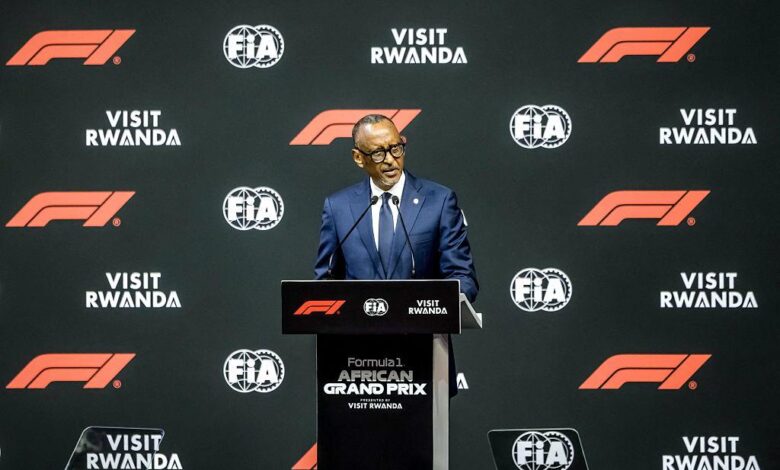
President Kagame has presented the agreement as a milestone not only for Rwanda but for Africa, emphasising the potential to develop local talent, attract investment and create opportunities that extend beyond a single race weekend. Formula One’s leadership has also argued that the event can expand the sport’s reach and generate lasting economic and social benefits.
Rwanda has made substantial efforts to rebuild its institutions, infrastructure and international standing following the 1994 genocide against the Tutsi. Its record of hosting major international events demonstrates an ability to attract global attention and organise high-profile gatherings.
Recognising those achievements does not require journalists or international partners to disregard human rights concerns. Equally, reporting those concerns should not become a reason to dismiss every development initiative undertaken by the country.
The appropriate standard is evidence, transparency and accountability.
The Rwandan government should be given a meaningful opportunity to respond to specific allegations. Where claims are disputed, they should be attributed accurately. Where credible evidence establishes abuses, the response should focus on remedy and accountability rather than allowing national prestige to overshadow the rights of affected people.
The strongest defence of Rwanda’s international ambitions would be demonstrable progress in protecting those rights.
What This Means For Uganda And The Rest Of Africa
Rwanda’s Formula One agreement presents an opportunity for the entire continent to reconsider how African countries compete for international investment and sporting recognition.
Uganda, Kenya, Tanzania, South Africa, Morocco and other African countries have reasons to welcome a stronger continental presence in global sport. A successful Grand Prix could encourage regional tourism, business partnerships, technical training and interest in motorsport among young Africans.
But African governments should also draw a lesson from the controversy: international prestige is more sustainable when it is supported by transparent governance, credible institutions and respect for civil liberties.
Uganda, for example, can study both the economic opportunities associated with Rwanda’s approach to sports tourism and the scrutiny that accompanies partnerships involving human rights concerns.
The continent should not have to choose between development and accountability. Neither should governments be permitted to treat criticism of their records as hostility towards Africa itself.
Human rights are not foreign obstacles to African progress. They are standards by which the benefits of progress should be judged.
The Verdict: A Grand Prix Should Be More Than A Publicity Victory
Rwanda’s planned African Grand Prix could mark a historic return of Formula One to the continent. It could attract visitors, stimulate businesses, create technical opportunities and inspire a new generation of African motorsport enthusiasts.
Yet the agreement, announced on October 13, 2026, is a long-term commitment to a race expected in the early 2030s—not an event that has already taken place. The circuit still has to be developed, and the promised economic benefits remain to be realised.
Amnesty International’s condemnation has introduced a question that Formula One and Rwanda cannot reasonably ignore: what does international sporting success mean if concerns about the rights of ordinary people remain unresolved?
The answer should not be to deny Africa a place on the global sporting calendar. Nor should it be to allow the excitement of a historic race to silence legitimate scrutiny.
Instead, the Grand Prix should become an opportunity to demonstrate that economic ambition, sporting excellence and human rights can reinforce one another.
If Rwanda delivers a world-class event while strengthening protections for journalists, political opponents, workers and affected communities, the achievement will carry greater credibility than any tourism slogan could provide.
If the project proceeds without meaningful safeguards, the controversy over sports washing may become as enduring as the race itself.
For Uganda Today, the essential message is clear: Africa deserves Formula One, but Africans also deserve development that respects their dignity, freedoms and rights. The true measure of Rwanda’s Grand Prix will be not only the spectacle on the track, but the legacy it leaves for the people beyond it.
#Rwanda #FormulaOne #HumanRights #Sportswashing #Africa #UgandaToday
Key Sources
-
Fédération Internationale de l’Automobile (FIA) — Official announcement of Rwanda’s Formula One agreement.
-
Amnesty International UK — Amnesty’s response to the Rwanda deal.
-
Human Rights Watch — Analysis of human rights risks surrounding the race.
Editorial note: The human rights criticisms in this article are attributed to the organisations that raised them.