When Ants Become Bridges: The Remarkable Engineering of Army Ants
+256 702 23 93 37: Scientific research has confirmed that certain army ants can assemble their bodies into structures capable of spanning gaps and helping thousands of colony members move more efficiently through the forest.


UgandaToday: When Ants Become Bridges: The Remarkable Engineering of Army Ants
By UgandaToday Science & Environment Desk
A forest floor can be a maze of fallen leaves, twigs, branches, holes and other obstacles. For most creatures, such barriers can mean a detour. But for army ants, an obstacle can become an engineering challenge—and the solution can be astonishingly simple: they build a bridge out of themselves.
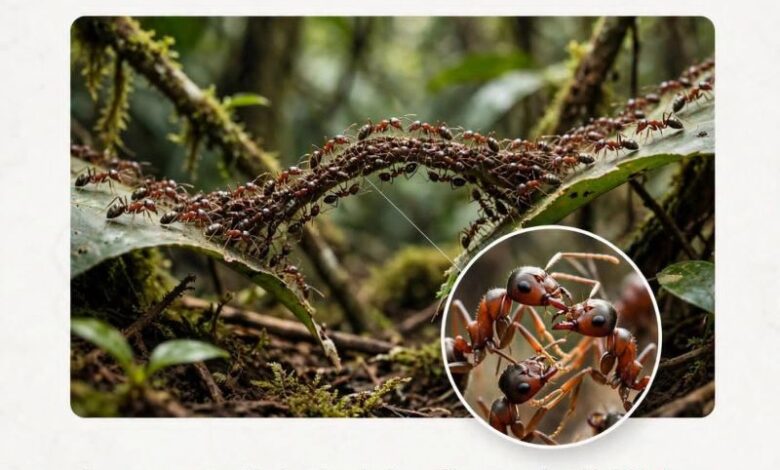
The striking image accompanying this story captures one of nature’s most remarkable examples of collective behaviour, in which ants link their bodies together to create a temporary, living pathway for members of their colony.
Scientific research has confirmed that certain army ants can assemble their bodies into structures capable of spanning gaps and helping thousands of colony members move more efficiently through the forest.
When the ants become the bridge
Army ants belonging to the Eciton group are particularly well known for this behaviour.
Rather than constructing a bridge from leaves, soil or wood, individual ants attach themselves to one another, linking their legs and bodies. Other ants then walk across this living structure, allowing the colony to maintain a relatively direct route across an otherwise difficult section of terrain.
The result is what scientists describe as a living bridge—a temporary structure created entirely from the bodies of members of the colony.
Research has shown that these bridges can be formed when an army-ant trail encounters a gap or other obstruction. The ants respond collectively, creating a passage that allows traffic to continue.
No architect, no blueprint—just collective intelligence
Perhaps the most fascinating part of the phenomenon is that there is no evidence of a single ant directing the construction.
Instead, complex behaviour emerges from relatively simple interactions among individual ants.
Researchers studying Eciton hamatum found that the insects can continuously modify their bridges, changing their length, width and position depending on the terrain and the amount of ant traffic.
In other words, the colony does not simply build a bridge and leave it there.
It adjusts the structure according to circumstances.
When traffic is heavy and a shortcut is valuable, more ants can become part of the bridge. When the need for the structure declines, the bridge can eventually be dismantled, freeing those workers to return to other activities.
A shortcut to food
For army ants, efficiency is critical.
These insects travel in large raiding columns as they search for prey and other resources. Their trails can encounter the irregular terrain of the forest floor, where holes, branches and other obstacles can slow movement.
A living bridge provides a shortcut.
Instead of forcing the entire colony to navigate around an obstruction, some workers sacrifice their immediate mobility by becoming part of the structure while their fellow ants pass over them.
Scientists have described this as a cost-benefit trade-off: the colony loses some workers temporarily from the foraging workforce, but gains efficiency by allowing the rest of the traffic to move more quickly.
The bridge is alive—and constantly changing
Unlike a conventional bridge, an army-ant bridge is not a fixed structure.
Research has demonstrated that these living constructions can respond to changing traffic conditions and environmental geometry. Bridges may become longer or wider, shift position, or disappear altogether when the flow of ants stops.
That ability to respond makes the phenomenon particularly interesting to scientists studying self-organisation, swarm intelligence and collective behaviour.
The ants demonstrate how a large and sophisticated system can emerge without a central command structure.
Nature’s lesson in teamwork
The behaviour offers a striking lesson about the power of collective action.
One ant alone cannot build a bridge across a forest gap. Hundreds of ants acting together, however, can transform their individual bodies into a temporary piece of living infrastructure.
This is one reason scientists have taken an interest in army-ant behaviour beyond entomology. Research into these self-assembling structures has potential relevance to fields such as swarm robotics and systems designed to operate through decentralised decision-making.
The ants do not need a foreman standing above them, issuing instructions. Their collective behaviour emerges through interactions between individuals responding to their immediate surroundings.
The phenomenon is not limited to the Americas
For years, living bridges were particularly associated with New World army ants of the genus Eciton.
But a 2026 study reported field observations of living-bridge formation in an Old World army ant, Aenictus glabrinotum. Researchers observed the ants linking their bodies across a small gap and maintaining the structure while traffic remained high, before the bridge eventually disassembled as traffic declined.
The finding suggests that this extraordinary form of collective construction may have evolved independently in different army-ant lineages.
A tiny creature with a huge lesson
The image of ants transforming themselves into a bridge may look almost unbelievable, but the underlying behaviour is firmly documented by scientific research.
It is a reminder that some of nature’s most impressive engineering does not involve steel, concrete or machinery.
Sometimes, it involves hundreds of tiny bodies working together.
For the army ants, survival depends not simply on the strength of an individual but on the ability of the colony to function as a coordinated whole.
In the world of army ants, when the road ends, the ants themselves become the road.
Photo Caption
Nature’s living bridge: Army ants can link their bodies together to span gaps and create temporary pathways that enable other members of the colony to move efficiently through difficult forest terrain.
Suggested Hashtags