The Mabonga Files: Leaked Safe-House Footage Reopens Uganda’s Torture And Disappearance Question
The material circulating since September 30, 2026 purports to show people who have previously been reported missing or detained, including opposition activist Sam Mugumya and former Butambala County MP Muhammad Muwanga Kivumbi, inside what Mabonga describes as a military-run safe house in the Entebbe-Abayita Ababiri area

UgandaToday: The Mabonga Files: Leaked Safe-House Footage Reopens Uganda’s Torture And Disappearance Question
From A Former Military Intelligence Officer’s Explosive Allegations To Parliament’s Demand For Answers, Uganda Is Once Again Confronted With Questions About Secret Detention, Torture And The Rule Of Law
By UgandaToday News Desk
A new wave of leaked videos and documents attributed to former Uganda Peoples’ Defence Forces (UPDF) intelligence officer Lt Herbert Matanda Mabonga has reopened one of Uganda’s most sensitive and longstanding human-rights questions: what happens to citizens who disappear after being taken into the custody of security agencies?
The material circulating since September 30, 2026 purports to show people who have previously been reported missing or detained, including opposition activist Sam Mugumya and former Butambala County MP Muhammad Muwanga Kivumbi, inside what Mabonga describes as a military-run safe house in the Entebbe-Abayita Ababiri area.
Mabonga, who identifies himself as a former intelligence officer, has alleged that security agencies operate undisclosed detention facilities where suspects and political opponents are subjected to arbitrary detention, torture and other forms of abuse.
The allegations are extraordinarily serious.
But they must also be handled with extraordinary care.
The location, date, provenance and authenticity of the leaked videos and documents have not independently been established. The UPDF has rejected the allegations outright, calling the material fabricated and describing Mabonga as a deserter wanted over separate alleged offences.
The controversy therefore presents two parallel questions for Uganda.
First: Are the leaked materials genuine, and what do they actually establish?
Second: Even before those questions are finally answered, what should happen when Ugandans disappear, allege torture or are held outside the ordinary criminal-justice system?
Those questions go beyond one former soldier.
Who Is Lt Herbert Matanda Mabonga?
Mabonga emerged publicly on September 30 with a lengthy video statement in which he identified himself as a former UPDF lieutenant and intelligence officer.
According to accounts of his statement, he said he joined the army in 2011 and served within military intelligence, formerly known as the Chieftaincy of Military Intelligence.
He also claimed to have worked as an aide to the late Gen Aronda Nyakairima and the late Brig Gen Tom Kikoyo Kabuye.
Mabonga said he had become increasingly troubled by what he described as arbitrary arrests, disappearances, kidnappings and torture.
He claimed that he had attempted to raise concerns through internal military channels before eventually leaving the institution.
He subsequently released what he described as a dossier concerning governance, corruption, security intelligence and human-rights abuses, together with video material that he said came from a secret detention facility.
These aspects of his biography and account remain matters to be independently established.
Uganda Radio Network reported that Mabonga published the video and alleged safe-house footage on September 30.
What The Leaked Videos Appear To Show
The most consequential material concerns Sam Mugumya.
One video appears to show a man believed to be Mugumya slowly walking around a compound, apparently requiring assistance. Another man is seen accompanying him.
The footage has generated particular concern because Mugumya disappeared after being reportedly taken by armed men from a hotel in Mbarara on August 26, 2025.
The latest footage has not been independently authenticated, nor has its date or precise location been established.
But the images have revived a case that had already reached Uganda’s courts.
A second clip appears to show Muwanga Kivumbi receiving what appears to be a blood-pressure check from a person in military attire.
Other footage reportedly shows rooms, bedding and other parts of a gated compound that Mabonga identifies as a detention facility.
None of these visual clues, by themselves, conclusively establishes who operated the premises, when the recordings were made or who was responsible for any treatment depicted.
Those questions require forensic examination of the original files, metadata, witnesses, location evidence and independent investigation.
Sam Mugumya: A Disappearance That Reached The High Court
Mugumya’s case predates the Mabonga disclosures.
In September 2025, the High Court considered Mugumya Sam v Chief of Defence Forces and Others, a habeas corpus application concerning his alleged military detention.
The court record states that the application sought his production so that the lawfulness of the alleged detention could be examined.
That legal history is significant.
It means that the question of Mugumya’s whereabouts was not created by the new videos. The issue had already entered Uganda’s judicial system.
The new footage has therefore added a potentially important piece of visual evidence—but one whose authenticity still requires independent verification.
In July 2026, another video purportedly showing Mugumya in a physically weakened condition had already circulated online. That footage too had not been independently authenticated.
The Kivumbi Case Has An Additional Independent Record
The allegations concerning Muwanga Kivumbi are particularly significant because there is already independent documentation concerning his treatment.
Human Rights Watch reported in August 2026 that Kivumbi said armed personnel removed him from his vehicle on July 10 and took him to an undisclosed location.
According to his account to the organisation, he was blindfolded, confined in a small room and kicked and beaten until he bled from the head.
A witness who saw him after his release reportedly described scars on his head, arms, legs and back.
Human Rights Watch’s account is separate from the Mabonga material.
That distinction matters.
The Mabonga video may potentially corroborate aspects of the wider detention story, but it does not automatically prove every allegation made by Mabonga.
Kivumbi subsequently faced criminal charges, which he denied, and was granted Shs3 million cash bail by the Butambala Grade One Magistrate’s Court on September 29, 2026.
The Names Appearing In The Alleged Detention Records
Perhaps the most politically sensitive aspect of the leaked material is the alleged documentation accompanying the videos.
Reports citing the documents say they contain names of people allegedly booked into or associated with a detention facility.
Among the names reported are:
– Sam Mugumya
– Muhammad Muwanga Kivumbi
– Bob Njagi
– Oyoo Nicholas
– Father Deusdedit Ssekabira
– John Mary Ssebuwufu
– Bright Muhumuza
– Dr Lina Zedriga
– Jolly Jacklyn Tukamushaba
– Gideon Tugume
– Miria Matembe
– Christopher Zale, also referred to in some reports as King Zale.
However, this list requires an important qualification.
The appearance of a person’s name in the alleged Mabonga records does not establish that the person was detained there, tortured there or even entered the facility.
The provenance and authenticity of the documents have not been independently verified.
The UPDF has specifically disputed the material, saying it contains forgeries and doctored images.
Miria Matembe: A Separate Detention Controversy
The inclusion of former Ethics and Integrity Minister Miria Matembe is notable because her detention was independently reported earlier in 2026.
Uganda Radio Network reported in June that Gen Muhoozi Kainerugaba publicly acknowledged Matembe was in security custody after her family raised concerns about her disappearance.
Her lawyers and associates reportedly alleged that she was being held at a military facility in Mbuya.
Human Rights Watch subsequently documented her case as part of a broader pattern involving critics of the government being seized, held incommunicado and later subjected to criminal proceedings.
Again, however, the independent reporting concerning Matembe’s detention should not be conflated with proof that she was held at the particular facility identified in Mabonga’s alleged documents.
That distinction is central to responsible journalism.
Lina Zedriga And The Problem Of Missing Persons
Another name reportedly appearing in the documents is NUP deputy president for Northern Uganda, Dr Lina Zedriga.
Her disappearance following the January 2026 elections generated a legal dispute.
The Attorney General and UPDF denied that the army was holding her. A military affidavit stated that officials had checked gazetted detention facilities under the relevant commands and found no record of her detention.
Her lawyers, however, had filed a habeas corpus application based on allegations that she had been arrested by joint security forces and taken to an unknown location.
The Zedriga case demonstrates why claims of secret detention cannot be settled simply by social-media assertions from either side.
They require evidence.
Bob Njagi And Oyoo Nicholas: Another Unresolved Chapter
The alleged Mabonga records reportedly also contain the names of Kenyan activists Bob Njagi and Oyoo Nicholas.
Their case had already generated international legal attention.
A United Nations human-rights communication records that their lawyers filed a habeas corpus petition in Uganda in October 2025 and that the High Court ordered authorities to produce them.
The UPDF subsequently denied holding them.
Their inclusion in the alleged Mabonga material therefore raises questions that could potentially be tested against existing court documents, security records and other independent evidence.
Uganda Has Been Here Before
The Mabonga disclosures have generated shock partly because the idea of secret detention facilities is not new to Uganda.
In 2022, Human Rights Watch published a major investigation into unauthorized detention facilities, based on interviews with 34 former detainees and witnesses and 17 other people, including officials, MPs, diplomats, activists and journalists.
The report documented allegations of arbitrary arrest, enforced disappearance, unlawful detention and torture.
It said detainees had been held in locations described as safe houses, as well as other unauthorized places including vehicles and military facilities.
Human Rights Watch called for unauthorized detention facilities to be closed, detainees to be either released or brought before independent courts, detention records to be made public and allegations of torture to be investigated impartially.
That historical record does not prove the Mabonga allegations.
It does, however, explain why the latest videos have resonated so strongly with Ugandans who have followed similar allegations for years.
What Does Ugandan Law Say?
Uganda’s Constitution is explicit on personal liberty and protection against torture.
Article 23 provides that an arrested or detained person must be kept in a place authorised by law, informed of the reasons for the arrest and of the right to a lawyer.
Except in circumstances provided by law, a person arrested on suspicion of committing any offence must be brought before a court as soon as possible and, in any event, not later than 48 hours after arrest.
The Constitution also provides access to next-of-kin, lawyers and medical treatment and protects the right to habeas corpus.
Article 24 states:
“No person shall be subjected to any form of torture or cruel, inhuman or degrading treatment or punishment.”
The Prevention and Prohibition of Torture Act, 2012 gives those constitutional protections criminal force. It prohibits torture and provides mechanisms concerning criminal responsibility, complaints and compensation.
The Human Rights (Enforcement) Act, 2019 provides a legal framework through which constitutional rights can be enforced before competent courts.
These provisions apply regardless of whether the person detained is an opposition politician, government supporter, journalist, activist, businessperson or ordinary citizen.
The UPDF Responds: “Unsubstantiated Rubbish”
On October 1, the UPDF formally responded to the allegations.
Acting Director of Defence Public Information Col Chris Magezi said the military regarded the material attributed to Mabonga as fabricated and described it as consisting of alleged forgeries, doctored images and concocted claims.
The UPDF identified Mabonga as a former junior officer attached to the Chieftaincy of Defence Intelligence and Security.
The army said he was transferred to the Mountain Infantry Division headquarters in Fort Portal but failed to report, subsequently becoming absent without official leave and later being classified as a deserter.
The UPDF also accused him of separate alleged offences involving extortion, fraudulent land transactions and forged land titles.
It said he would be arrested and subjected to military justice.
There has since been a correction concerning the chronology: on October 2, the UPDF revised its stated transfer date for Mabonga from April 2026 to November 2025.
That correction is itself worth recording because it demonstrates the importance of checking official claims as carefully as allegations made by an individual source.
Parliament Demands Answers
The controversy has now moved beyond social media.
On October 1, Leader of Opposition in Parliament Joel Ssenyonyi raised the Mugumya case during plenary and demanded that the government account for missing citizens.
He referred to the leaked video purportedly showing Mugumya in a weakened condition and questioned why anyone accused of a crime should not simply be brought before court.
Government Chief Whip Jane Ruth Aceng said the government had received a list of people reported missing and that security agencies would follow up.
Speaker Jacob Marksons Oboth directed the government to treat the matter urgently and report back within two weeks.
That parliamentary process is now one of the most important avenues for establishing what is fact and what is fabrication.
What Should Happen Next?
The question confronting Uganda is not simply whether the public believes Mabonga.
It is whether the State, Parliament, courts, human-rights institutions, journalists and independent investigators can establish the facts.
Several concrete steps would help.
1. Authenticate The Videos
The original video files should be preserved and subjected to independent digital-forensic examination.
Investigators should establish:
– when the footage was recorded;
– where it was recorded;
– whether the files have been edited;
– whether metadata remains intact;
– who recorded the material;
– who appears in each recording;
– and whether the premises can be independently identified.
2. Authenticate The Documents
The alleged detention registers, lists and other records should be compared with:
– court records;
– police records;
– prison and detention registers;
– immigration records where relevant;
– military administrative records;
– family reports;
– lawyers’ affidavits;
– and independent witness testimony.
3. Account For Missing Persons
Every person reported missing should have a clear status.
If a person is under lawful detention, authorities should state the legal basis for the detention and produce the person before the appropriate court within the requirements of Ugandan law.
If a person is not in State custody, the authorities should assist in establishing what happened to them.
4. Provide Medical Examination
Where a detainee appears injured or physically impaired, an independent medical assessment should be made available, with the person’s consent and appropriate protection of medical privacy.
5. Protect Evidence And Witnesses
Potential witnesses, whistleblowers, lawyers, families and victims should be protected from intimidation or retaliation.
The same principle should apply to anyone accused of wrongdoing: allegations must be tested through lawful investigation and due process.
6. Allow Independent Investigation
The credibility of the allegations would be strengthened—not weakened—by transparent independent investigation.
If the material is fabricated, forensic examination can help demonstrate that.
If some of it is genuine, an independent investigation can establish who was responsible and what actually occurred.
The Wider Lesson: Security Cannot Replace The Law
Uganda’s security agencies have a legitimate responsibility to protect national security and investigate serious crimes.
But national security does not eliminate constitutional rights.
A person suspected of terrorism, political violence, incitement, espionage or any other offence remains entitled to the protections provided by law.
Likewise, accusations against security officers must be investigated on evidence rather than assumed to be true merely because they appear in a viral video.
The fundamental issue is therefore larger than Mabonga.
It is the principle that no institution, individual officer, political party or government should operate outside the law.
A Call For Lawful Civic Accountability
The reaction from Ugandans should not be reduced to competing political camps.
Citizens concerned about alleged human-rights violations have lawful avenues available to them.
They can demand accurate information from public institutions, support credible human-rights investigations, assist victims in obtaining legal representation, petition Parliament, use the courts, report unlawful detention and preserve evidence of alleged abuses.
Ugandans can also participate peacefully in public affairs, demand accountability from elected representatives and security institutions, scrutinise competing political claims and insist that disagreements be resolved through constitutional and legal processes rather than violence.
That is a more durable route to protecting citizens than allowing allegations, counter-allegations and political mobilisation on social media to substitute for evidence.
The Central Question Remains
Lt Herbert Matanda Mabonga has put explosive allegations into the public domain.
The UPDF has rejected them as fabricated.
Some of the people appearing in the alleged material have histories of reported detention, disappearance or alleged mistreatment that predate Mabonga’s disclosures.
Human Rights Watch has independently documented allegations of arbitrary detention and torture involving Ugandan security agencies, while Uganda’s own courts have dealt with habeas corpus applications concerning alleged military detention.
Parliament has now demanded answers.
The responsibility for determining what happened next belongs not to social media, political rhetoric or anonymous claims—but to evidence, independent investigation and lawful institutions.
For the families of people reported missing, however, the issue is more immediate.
They want to know where their relatives are.
For alleged victims of torture, the question is whether they can obtain justice.
And for the country, perhaps the most fundamental question is whether every Ugandan—regardless of political affiliation—can depend on the protection of the law.
Until those questions are answered, the Mabonga files will remain not simply a viral political controversy, but a test of Uganda’s commitment to constitutional rights, accountability and the rule of law.
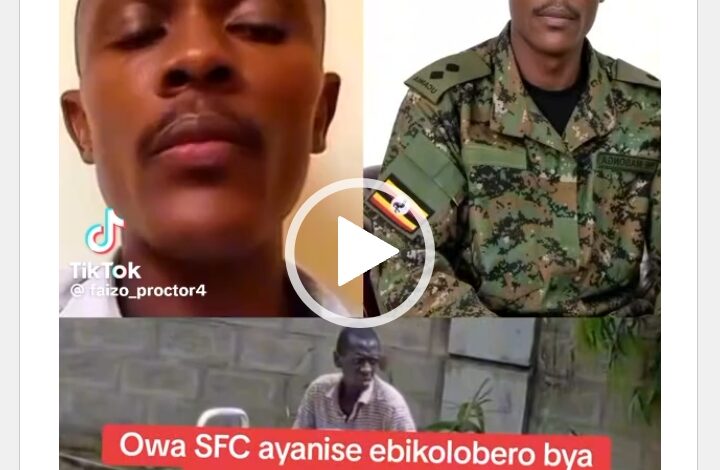
UgandaToday avoided publishing graphic torture imagery merely for impact. Where a screengrab is used, it is clearly labelled as unverified material and should not visually be identified as established fact.»
Editorial Disclaimer
UgandaToday has not independently established the authenticity of the videos, photographs or documents attributed to Lt Herbert Matanda Mabonga. Allegations of torture, unlawful detention and the operation of secret detention facilities contained in the material are presented as allegations and are not stated as established facts. The UPDF has rejected the allegations and described the material as fabricated, including alleged forgeries and doctored images. UgandaToday invites the relevant authorities, persons named in the material and other credible sources to provide evidence or clarification that may assist in establishing the truth.
#UgandaToday #HumanRights #RuleOfLaw #Uganda #UPDF #AccountabilityForpublication