From General To Private: Elwelu’s Dramatic Fall And The Unfinished Question Of Kasese
+256 702 23 93 37: When The Powerful Become The Pursued. Ugandans have watched with astonishment as Chief of Defence Forces General Muhoozi Kainerugaba publicly announced that Elwelu had been stripped of his military ranks and reduced to the rank of private.

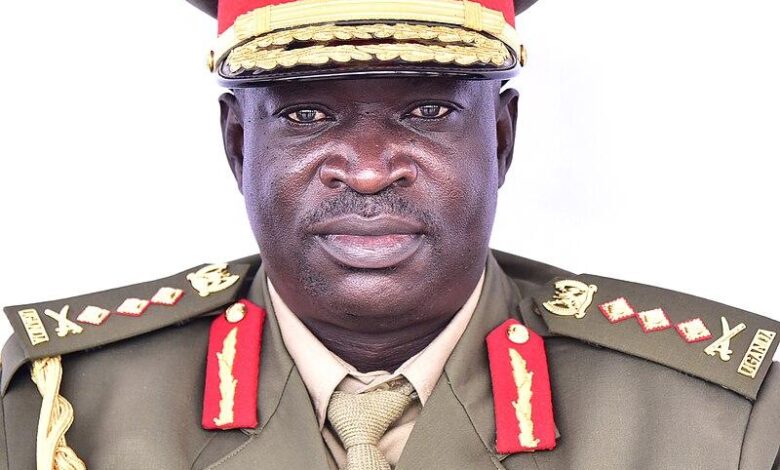
UgandaToday: From General To Private: Elwelu’s Dramatic Fall And The Unfinished Question Of Kasese
A Satirical Societal Commentary | Uganda Today
Uganda’s unfolding military drama has produced a situation that would challenge even the most imaginative political cartoonist. A retired lieutenant general, once among the country’s most powerful military officers, is now at the centre of a public security manhunt, with his former military associates reportedly being arrested and his military rank publicly declared reduced to that of a private.

The man at the centre of the storm is General Peter Elwelu, the former Deputy Chief of Defence Forces.
For a country accustomed to seeing military officers issue orders rather than become the subjects of dramatic announcements, the unfolding confrontation raises a curious question: what happens when yesterday’s powerful commander becomes today’s wanted man?
And, more importantly, what does this extraordinary episode teach Uganda about power, loyalty, military command and accountability?
When The Powerful Become The Pursued
Ugandans have watched with astonishment as Chief of Defence Forces General Muhoozi Kainerugaba publicly announced that Elwelu had been stripped of his military ranks and reduced to the rank of private.
Muhoozi also reported the arrest of former soldiers associated with Elwelu and announced the recovery of weapons and ammunition from a residence linked to the retired general. On October 29, 2026, he further reported the arrest of Elwelu’s driver and the seizure of a vehicle he said the general had been using.
The allegations have not all been independently established, and the full circumstances remain matters for investigation and due process.
Reports have also indicated that Elwelu’s wife was arrested. A relative subsequently told the media that the retired general had gone into hiding because of fears for his safety. The family has disputed the allegations against him.
The spectacle has nevertheless provided social media with an abundance of material.
In Uganda’s informal school of political satire, one can almost imagine a former commander looking at the military hierarchy and wondering whether the rules of the game have suddenly changed.
Yesterday, the general gave orders. Today, people are discussing whether he will surrender.
Yesterday, the uniform carried authority. Today, the public is debating what remains of that authority.
But beneath the humour lies a serious lesson: no military title, however impressive, can permanently shield its holder from scrutiny, investigation or the consequences of alleged wrongdoing.
The Kasese Question That Refuses To Disappear
For many Ugandans, Elwelu’s current predicament cannot be discussed without revisiting the tragic events in Kasese in November 2016.
At the time, Elwelu was a brigadier commanding military forces involved in the operation against the royal guards of the Rwenzururu Kingdom.
The operation and subsequent violence on November 26 and 27 left scores of people dead. Human Rights Watch documented at least 155 deaths over the two days, including civilians, members of the royal guards and security personnel. The organisation called for an independent investigation into the conduct of security forces.
The Office of the Prosecutor of the International Criminal Court also examined information concerning the Kasese events and reported credible information indicating that multiple killings had been committed by Ugandan security forces.
These findings make the Kasese tragedy much more than a historical footnote in Elwelu’s military career.
In May 2024, the United States imposed visa sanctions on Elwelu over alleged extrajudicial killings committed by members of the UPDF under his command. The allegations and the need for accountability remain matters of substantial public concern.
The victims were not merely numbers in a military report. They were people with families, children, parents and communities left to deal with grief and unanswered questions.
For their relatives, the passage of ten years does not necessarily mean that justice has been achieved.
The General Who Commanded The Guns
Military command is not simply about wearing stars on one’s shoulders, issuing instructions or commanding troops into battle.
It also carries responsibility for the conduct of those troops.
When soldiers kill civilians unlawfully, the public deserves answers about what happened, who issued the orders, what safeguards were in place and whether commanders exercised appropriate control.
Command responsibility is not the same as automatic criminal guilt. Individual responsibility must be established through credible evidence and the applicable legal process.
Nevertheless, a commander’s position makes questions about the conduct of forces under his command unavoidable.
This is why the Kasese tragedy continues to cast a shadow over Elwelu’s public legacy.
If the current allegations against the retired general are investigated, the process should be lawful, transparent and supported by evidence. Equally, questions surrounding the 2016 killings deserve a credible, independent process that gives victims and their families an opportunity to obtain answers.
Uganda cannot demand accountability only when a powerful person falls out with the people who currently hold authority.
A Curious Lesson In Military Loyalty
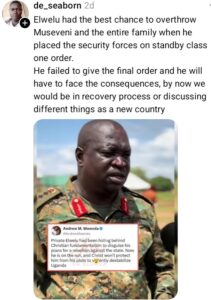
The social media post reproduced in the screenshot suggests that Elwelu once had an opportunity to overthrow President Yoweri Museveni’s government but failed to give the final order.
That is an individual’s interpretation of events, not proof that a coup plot existed or that Elwelu intended to seize power.
Nevertheless, the claim illustrates how quickly public opinion can turn military rumours into political mythology.
A commander who once held considerable authority can be portrayed by some as a potential kingmaker, by others as a loyal servant of the state and, following a public falling-out, as a suspected enemy.
The public should be cautious about accepting any of these descriptions without evidence.
A military officer’s duty is not to use troops to settle personal disagreements or decide who should govern the country outside constitutional arrangements. Equally, military institutions must not become instruments of personal vendettas.
Loyalty to an individual, a family or a powerful officeholder is not a substitute for loyalty to the Constitution, the law and the people.
When Social Media Becomes The Courtroom
One of the most striking aspects of the Elwelu affair is the extent to which major allegations and announcements have emerged through social media.
Public communication can help authorities inform citizens about genuine security concerns. However, announcing arrests, declaring a person a traitor or publicly announcing a change of rank does not, by itself, establish criminal guilt.
A person’s guilt must be determined through the appropriate legal process, with the evidence tested and the rights of the accused respected.
The same principle applies to Elwelu, regardless of his former rank or the seriousness of the allegations.
There are also legal questions about the procedure required to alter the rank of a retired commissioned officer. Such questions should be resolved by reference to the applicable military law rather than by social media declarations alone.
Ugandans deserve institutions that investigate allegations, preserve evidence, protect witnesses and deliver lawful decisions. They do not need trial by trending hashtag.
The Family, The Driver And The Cost Of A Military Storm
The reports concerning Elwelu’s wife, driver and former military associates add another troubling dimension to the unfolding drama.
Whenever a high-profile person becomes the subject of an investigation, relatives and associates may find themselves caught in circumstances they did not choose.
If individuals are suspected of offences, the authorities should identify the lawful basis for their arrest, explain the allegations as appropriate and respect their rights.
Being someone’s spouse, driver, friend or former colleague is not, on its own, proof of criminal conduct.
Nor should the public confuse an arrest with a conviction.
The law must protect the innocent while enabling legitimate investigations to proceed. That balance becomes particularly important when the people involved have previously served in the country’s security institutions.
Kasese Must Not Become A Convenient Footnote
There is a danger that the drama surrounding Elwelu’s current predicament could overshadow the people who lost their lives in Kasese.

The public may spend days discussing the retired general’s whereabouts, the latest announcements from the CDF and the fate of his former soldiers. Meanwhile, families who have waited years for answers may once again find themselves pushed to the margins of national debate.
That would be an unfortunate outcome.
The current confrontation and the Kasese tragedy are separate matters, and evidence must determine whether they have any direct legal connection. But both raise questions about the exercise of military power and the institutions responsible for holding public officials accountable.
An investigation into alleged misconduct by a former commander should not depend on whether he remains politically favoured. Likewise, allegations against him in the present day should not be treated as proof of responsibility for every past event associated with his command.
Justice requires consistency, not selective outrage.
The Final Salute: Power Is Temporary, Accountability Should Not Be
There is an unmistakable irony in the public spectacle surrounding a former lieutenant general whose military career once placed him among the most senior officers in the country.
But the most important story is not whether Elwelu will surrender, whether his former colleagues will continue to be arrested or whether the public will invent another nickname for him.
The deeper question is whether Uganda can build institutions in which the powerful and the powerless are treated according to the same legal principles.
If Elwelu is suspected of an offence, the evidence should be examined through a lawful process. If his rights have been violated, the appropriate remedies should be available. If credible evidence establishes criminal responsibility, accountability should follow.
And if the victims of Kasese are still waiting for a satisfactory reckoning, their suffering should not be forgotten simply because a new political drama has captured the headlines.
In the end, military stars may shine brightly, titles may change overnight, and political friendships may collapse without warning.
But the families who lost loved ones in Kasese cannot recover them through a change of rank or a social media announcement.
Uganda needs more than a dramatic fall from general to private. It needs a lasting commitment to the rule of law, responsible military command and justice for every victim, regardless of who holds power.
Editorial note: This article is a societal commentary based on publicly reported developments and historical human-rights documentation. Allegations concerning Elwelu and the current security operation should not be treated as established criminal findings. The views expressed in the satire do not constitute a finding of guilt.
#UgandaToday #Kasese2016 #PeterElwelu #RuleOfLaw #Accountability #PhoenixNewsFeeds