
Atacama’s Astonishing Answer To Water Scarcity: Turning Fog Into Drinking Water
+256 702 23 93 37: The findings are based principally on the 2025 peer-reviewed study, “Unlocking the fog: assessing fog collection potential and need as a complementary water resource in arid urban lands – the Alto Hospicio, Chile case,” published in Frontiers in Environmental Science.


UgandaToday: Atacama’s Astonishing Answer To Water Scarcity: Turning Fog Into Drinking Water
In The World’s Driest Desert, Scientists Are Harvesting Water From The Air
In one of the driest places on Earth, where rain is almost a stranger, scientists are turning an unlikely source of water into a potential lifeline — fog.
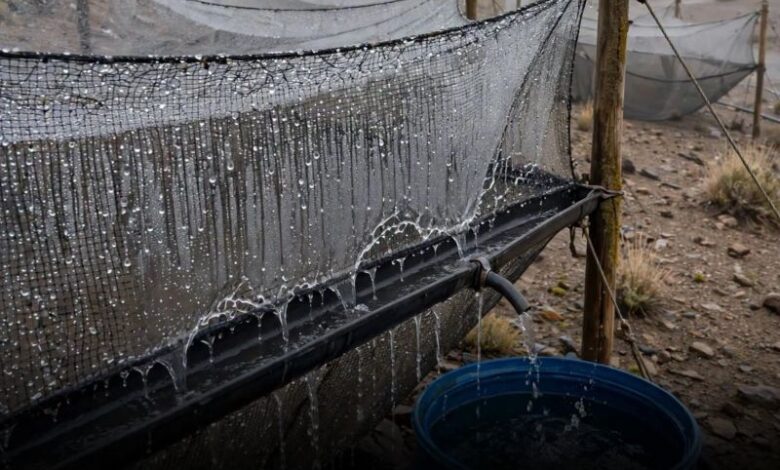
In Chile’s Atacama Desert, researchers are using simple mesh nets to capture tiny droplets of water suspended in passing fog, allowing them to condense, collect and flow into storage containers.
The technology, known as fog harvesting, could offer a new source of water for communities living in some of the world’s most water-stressed regions.
A 2025 study focusing on Alto Hospicio, a rapidly growing municipality in northern Chile, found that specially designed fog collectors could capture as much as 10 litres of water per square metre of mesh per day during peak fog conditions.
The findings have renewed interest in an unconventional technology that requires no electricity to capture water from the atmosphere.
How A Net Turns Fog Into Water
The principle behind the technology is surprisingly simple.
Large mesh panels are positioned vertically in areas where fog-laden winds are common. As the fog moves through the mesh, microscopic water droplets collide with the fibres and accumulate.
The droplets gradually join together and become larger. Gravity then causes them to run down the mesh into a collection channel, from where the water can be directed into tanks or other storage facilities.
The system is essentially a passive water collector.
It does not require pumps, sophisticated machinery or large amounts of electricity to capture the moisture. The principal requirements are suitable fog, wind, topography and appropriately positioned collection surfaces.
A Desert That Receives Almost No Rain
The Atacama is widely recognised as one of the driest regions on Earth.

Around Alto Hospicio, annual rainfall averages less than 1 millimetre, creating extraordinary pressure on conventional water resources. The region’s principal drinking-water supply depends heavily on underground aquifers, some of which were last naturally recharged thousands of years ago.
Yet above this extraordinarily dry landscape, moisture-laden fog regularly moves in from the Pacific Ocean.
That contradiction — almost no rainfall but a recurring supply of atmospheric moisture — is what researchers are seeking to exploit.
The 2025 Alto Hospicio Study
Researchers from Chile and international institutions conducted a year-long field study in Alto Hospicio and its surrounding areas.
Standard Fog Collectors were installed at different elevations, with measurements taken from 2023 into 2024. The research team also used the AMARU model, a numerical modelling system designed to estimate where fog occurs and how much water could potentially be harvested.

The study found that the most promising locations were generally at higher elevations outside the immediate urban area.
Across a wider 100-square-kilometre area surrounding Alto Hospicio, researchers estimated typical collection potential of between 0.2 and 5 litres per square metre per day.
During the strongest fog season, particularly in August and September 2024, collection potential rose to as much as 10 litres per square metre per day.
A Potential Lifeline For Thousands
Alto Hospicio has a significant population living in informal settlements.
The researchers cite government figures showing about 10,301 people in 30 informal settlements, many of whom lack direct connections to the public water-distribution network.
The study therefore examined whether fog water could help supplement water supplied to these communities.
Researchers calculated that approximately 17,000 square metres of fog-collecting mesh could theoretically provide the weekly water demand of about 300,000 litres for the urban settlements under the study’s modelled average collection conditions.
However, the researchers stress that fog harvesting would be most effective as a complementary source, because fog intensity varies seasonally and from one location to another.
Beyond Drinking Water
The potential uses extend beyond human consumption.
According to the research, harvested fog water could support irrigation of urban green spaces, hydroponic farming and fresh-food production, particularly in communities where conventional water resources are scarce.
This is already being demonstrated elsewhere in the Atacama.
Farmers and researchers have used fog-catching technology to collect water for growing crops including lettuce and lemons, showing how atmospheric moisture can support agriculture in a landscape where conventional farming faces enormous water challenges.
An Old Idea With A New Future
Fog harvesting is not entirely new to Chile.
One of the country’s pioneering projects was established in El Tofo in the 1980s. Large fog collectors were used to provide water to the community of Chungungo, demonstrating that atmospheric moisture could be converted into a practical water supply.

The earlier project used around 100 large fog collectors and, during the fog season, reportedly supplied up to 15,000 litres of water a day.
What is changing today is the attempt to combine this established technology with modern modelling, atmospheric monitoring and geographic mapping to identify the locations where fog harvesting can work most effectively.
A Possible Tool For A Water-Stressed World
Scientists are increasingly interested in atmospheric water as conventional freshwater supplies come under pressure from population growth, climate change and prolonged drought.
The Alto Hospicio research does not suggest that fog nets can replace reservoirs, groundwater, desalination plants or conventional water networks.
Instead, it points towards a different approach: using several water sources together.
For communities located near reliable fog corridors, relatively inexpensive mesh collectors could become part of a broader water-security strategy.
The researchers have consequently recommended that atmospheric water resources be incorporated into local water policies and that further research be undertaken to determine the long-term potential of fog harvesting around Alto Hospicio.
From Fog To A New Water Frontier
The extraordinary lesson from the Atacama is that a landscape can appear completely devoid of water while still holding an invisible reservoir in the atmosphere.
The fog does not fall as rain.
Instead, it passes silently through the desert, carrying microscopic droplets that would otherwise disappear back into the atmosphere.
With a carefully positioned mesh, those droplets can be intercepted, gathered and stored.
In a world increasingly confronted by drought and water insecurity, the Atacama experiment offers a powerful reminder that the next source of freshwater may not always be beneath the ground or flowing through a river.
Sometimes, it may be floating in the air.
Source
The findings are based principally on the 2025 peer-reviewed study, “Unlocking the fog: assessing fog collection potential and need as a complementary water resource in arid urban lands – the Alto Hospicio, Chile case,” published in Frontiers in Environmental Science.
#UgandaToday #PhoenixNewsFeeds #OperaNewsFeeds #AtacamaDesert #FogHarvesting #WaterCrisis #WaterSecurity #ClimateChange #ClimateInnovation #SustainableWater #WaterScarcity #GreenTechnology #EnvironmentalInnovation #Chile #Sustainability #Agriculture #CleanWater #Innovation