Brighton Builds Bees Into Its Buildings: The Unusual ‘Bee Brick’ Revolution Taking Root in the City
+256 702 23 93 37: “This City Is Building Homes for Bees Inside Its Walls — Could Kampala Do the Same?”


UgandaToday: Brighton Builds Bees Into Its Buildings: The Unusual ‘Bee Brick’ Revolution Taking Root in the City
As bee populations face mounting pressure from habitat loss and urbanisation, one British city is putting nature directly into its walls — literally
By Uganda Today
What if a building could provide more than shelter for people?
What if its walls could also become miniature homes for some of the world’s most important pollinators?
That is the thinking behind an unusual environmental initiative in Brighton & Hove, England, where bee bricks have become part of the city’s approach to integrating biodiversity into new development.
The initiative has attracted international attention because it challenges a familiar assumption about urban construction: that buildings and nature must compete for space.
In Brighton, planners are instead asking whether buildings can become part of the solution.
What Exactly Is a Bee Brick?
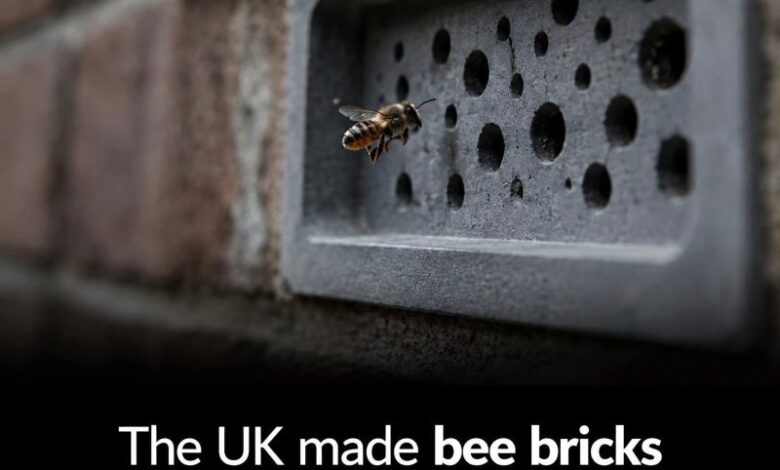
A bee brick is a specially designed brick containing small cavities that provide nesting spaces for solitary bees.
Unlike honeybees, which live in colonies, solitary bees generally live and nest individually. Some species make use of small cavities in walls, masonry and other structures.
The Bee Brick was developed by British company Green&Blue as a way of incorporating nesting habitat directly into buildings. Research associated with the project notes that about 90 per cent of Britain’s more than 250 bee species are solitary.
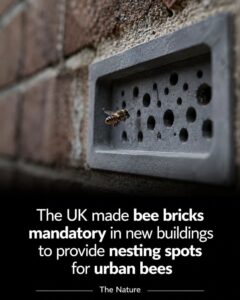
The concept is remarkably simple: instead of putting a conventional brick into a wall, a developer can install a brick designed to provide a small habitat for bees.
Green&Blue says the principal species using its Bee Brick include red mason bees and leafcutter bees, with occasional reports of wool-carder bees.
Brighton Turns the Idea Into Planning Policy
The initiative is more than an environmental experiment.
Brighton & Hove City Council began attaching a model planning condition requiring bee bricks to planning permissions for new-build developments from November 1, 2019.
In June 2019, councillors had already agreed that bee bricks should become standard in new-builds unless they were impractical.
By March 2020, the council formally noted the introduction of the planning condition and subsequently moved to expand biodiversity measures in new developments.
The council’s current Biodiversity and Nature Conservation guidance goes further, stating that new-build developments and extensions to existing buildings are required to incorporate bee bricks at a rate of one bee brick per dwelling, although different requirements may apply to major developments.
In other words, biodiversity has been brought into the planning process — not left solely to environmental campaigners.
Why Are Bees So Important?
The significance of the initiative lies in what is happening to pollinators and their habitats.
Bees are among the most important pollinators in natural ecosystems and agriculture. Their movement from flower to flower helps plants reproduce and supports food production.
But bees face a range of pressures, including habitat loss, intensive land use, pesticides, disease, climate change and urbanisation.
For solitary bees in particular, the disappearance of old walls, hedgerows, undisturbed ground and other nesting sites can remove essential habitat.
Research behind the Bee Brick project identifies habitat loss associated with construction and urbanisation as one factor contributing to the decline of solitary bees.
The challenge, therefore, is not simply to protect bees in remote countryside.
It is also to find ways of allowing them to survive in increasingly urbanised environments.
Turning Walls Into Wildlife Habitat
This is where the Brighton experiment becomes particularly interesting.
A conventional wall is designed primarily for human purposes — strength, insulation, security and appearance.
A bee brick introduces another consideration: ecological function.
The same building can potentially provide shelter for wildlife while continuing to perform its ordinary architectural role.
The Brighton model is not limited to bees.
The city’s biodiversity guidance encourages complementary nectar-rich planting around bee bricks so that bees have access to food as well as nesting spaces.
The council has also incorporated other wildlife-friendly measures, including swift bricks and boxes, biodiverse landscaping, living walls and roofs, and other habitat features.
The underlying principle is becoming increasingly clear: urban development does not necessarily have to mean the disappearance of nature.
But Do Bee Bricks Actually Work?
This is where the story becomes more complicated.
The idea has been praised for its creativity and simplicity, but enthusiasm for bee bricks should not be confused with conclusive evidence that they can reverse declining bee populations on a large scale.
Questions have been raised about the suitability of artificial nesting cavities, including whether particular designs provide adequate conditions for the species they are intended to support.
There are also wider concerns about the management of artificial nesting structures. Poorly designed or poorly maintained habitats can potentially create ecological problems rather than solving them.
That means bee bricks should not be viewed as a substitute for protecting natural habitats.
A brick embedded in a wall cannot replace flowering meadows, wetlands, hedgerows, forests and other ecosystems.
Even Green&Blue’s own guidance stresses that location matters: Bee Bricks should be placed in warm, sunny positions, preferably facing south, and at least around one metre above ground level.
The lesson is important: a wildlife feature is only as useful as the ecological conditions surrounding it.
The Bigger Question: Can Cities Make Room for Nature?
Perhaps the most important contribution of Brighton’s bee-brick experiment is not the brick itself.
It is the question the brick forces planners, architects and developers to confront.
Can modern cities be designed with wildlife in mind?
For decades, urban development has frequently meant clearing vegetation, covering soil with concrete, destroying habitats and replacing natural systems with engineered environments.
But as cities expand, conservationists and planners are increasingly exploring ways to reverse that relationship.
Buildings can incorporate nesting spaces.
Roofs can support vegetation.
Walls can become living surfaces.
Gardens can be planted with pollinator-friendly species.
Roadside spaces can become ecological corridors.
And developments can be planned to accommodate biodiversity rather than simply mitigate its loss after construction.
A Lesson Uganda Could Consider
For countries such as Uganda, the Brighton experiment offers an intriguing question.
Uganda is urbanising rapidly. Kampala and other cities are experiencing expanding construction, population growth and pressure on wetlands, green spaces and other natural habitats.
Yet Uganda also possesses extraordinary biodiversity and remains heavily dependent on agriculture and natural ecosystems.
The question is whether some elements of the Brighton philosophy could eventually be adapted to Uganda’s own urban environment.
Ugandan architects and planners could explore biodiversity-friendly building designs suited to the country’s climate — from flowering landscapes and indigenous trees to nesting spaces for birds and insects, green roofs, vertical gardens and other nature-based features.
Such measures would not replace the need to protect wetlands, forests and natural habitats.
Instead, they could complement those efforts.
From ‘Green’ Buildings to ‘Living’ Buildings
The bee brick represents a subtle but potentially important evolution in environmental thinking.
For years, the phrase “green building” has largely been associated with energy efficiency, water conservation, reduced emissions and environmentally friendly materials.
The bee brick introduces another dimension: biodiversity.
A genuinely nature-conscious building should perhaps not only consume fewer resources.
It should also consider what it can give back to the ecosystem.
That could mean providing nesting spaces for insects, habitats for birds, vegetation for pollinators or surfaces that support plant life.
In that sense, Brighton’s bee bricks are less about a hole in a brick than about a hole in conventional thinking.
A Small Brick, A Much Bigger Conversation
Whether bee bricks ultimately become a major tool in reversing pollinator decline remains an open question.
They are certainly not a magic solution to the complex environmental pressures facing bees.
But they have succeeded in doing something valuable: they have brought biodiversity into an area where it is often overlooked — the architecture and planning of cities.
The experiment also demonstrates that environmental policy does not always have to involve grand, expensive technological solutions.
Sometimes it can begin with a small change in the way something as ordinary as a brick is designed.
Brighton has effectively asked its developers to leave room in the walls for nature.
The question now is whether other cities around the world — including African cities undergoing rapid urbanisation — will ask themselves the same question.
Because the future of biodiversity may depend not only on how much land humanity sets aside for nature, but also on how much nature humanity is willing to build into the places where people live.
#UgandaToday #BeeBricks #SaveTheBees #Bees #Pollinators #Biodiversity #ClimateAction #Environment #GreenCities #SustainableCities #UrbanPlanning #NatureBasedSolutions #NatureConservation #GreenBuilding #SustainableDevelopment #ClimateChange #WildlifeConservation #Brighton #Uganda #Kampala #Newsfeeds #OperaNews #PhoenixNewsFeeds