Why The Kabaka’s Absence From Museveni’s Cultural Leaders’ Meeting Matters
+256 702 23 93 37: Buganda: A Kingdom With A Distinct Historical Identity To understand why the Kabaka’s absence attracted considerable attention, it is important to appreciate Buganda’s historical identity and its place in Uganda’s political development.

UgandaToday: Why The Kabaka’s Absence From Museveni’s Cultural Leaders’ Meeting Matters
Buganda’s Historical Status, Institutional Dignity And Separate Channels Of Engagement With Government Offer Insight Into The Monarch’s Non-Participation
By Uganda Today
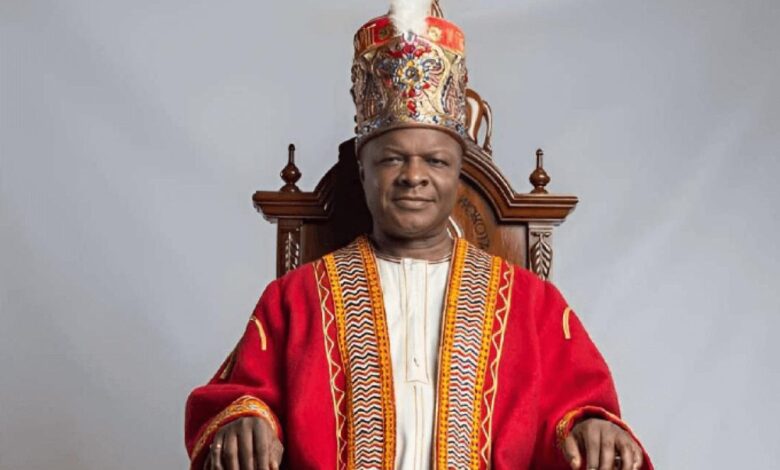
The conspicuous absence of the Kabaka of Buganda, His Majesty Ronald Muwenda Mutebi II, and the Katikkiro of Buganda, Owek. Charles Peter Mayiga, from President Yoweri Kaguta Museveni’s recent meeting with cultural leaders at State House, Entebbe, has once again drawn attention to Buganda’s unique historical and institutional position within Uganda.
The two-day Cultural Leaders Conference, which opened on November 4, 2026, brought together traditional and cultural leaders from across the country to discuss national unity, cultural preservation and the contribution of traditional institutions to Uganda’s development.
President Museveni called upon cultural leaders to preserve Africa’s heritage, promote indigenous knowledge and support economic transformation, while emphasising that political and administrative responsibilities should remain with elected government institutions.
However, the absence of Buganda’s two most senior leaders became one of the most noticeable aspects of the gathering, prompting public discussion about the relationship between the Buganda Kingdom and the central government.
While some observers interpreted the absence as a possible political statement, the circumstances surrounding Buganda’s institutional structure, historical status and established channels of engagement provide a broader perspective.
Buganda: A Kingdom With A Distinct Historical Identity
To understand why the Kabaka’s absence attracted considerable attention, it is important to appreciate Buganda’s historical identity and its place in Uganda’s political development.

Buganda is one of Africa’s oldest traditional kingdoms, with a rich cultural heritage, established governance structures and a history that predates the formation of modern Uganda.
At the centre of the kingdom is the Kabaka, whose authority represents the cultural identity, unity and continuity of the Baganda people.
The institution of the Kabaka is not simply a ceremonial title. It is closely connected to Buganda’s traditions, customs, historical memory and collective identity.
Buganda’s relationship with the modern Ugandan state has also been shaped by its historical encounters with colonial rule, particularly the 1900 Buganda Agreement, which established a framework for relations between the Kingdom and the British colonial administration.
The agreement remains an important reference point in discussions about Buganda’s historical status, land ownership and institutional relationship with the central government.
Buganda’s supporters argue that its historical position should be understood within this context, rather than treating the kingdom as an ordinary chiefdom operating within a collective national framework of cultural institutions.
A Kingdom With Its Own Institutional Structures
Buganda maintains its own traditional governance structures, including the Buganda Kingdom Government at Mengo and the Lukiiko, its parliament.
The Katikkiro serves as the head of the kingdom’s executive administration, working with the Kabaka and the kingdom’s ministers to oversee institutional affairs.

This structure has historically enabled Buganda to engage the central government on matters affecting the kingdom and its people through its own leadership.
Such matters have included land, kingdom properties, the restoration of assets, cultural rights, economic development and the broader relationship between Buganda and the Government of Uganda.
For this reason, some observers argue that Buganda’s participation in national cultural forums should not necessarily be measured by the physical attendance of the Kabaka alongside other traditional leaders.
Rather, they maintain that the kingdom’s institutional status and its established channels of engagement should be taken into account.
This perspective does not mean that Buganda is outside Uganda’s constitutional framework. It reflects the continuing debate about how Uganda’s national institutions should relate to its historically distinct cultural institutions.
The Kabaka And The Question Of Institutional Dignity
One of the arguments advanced in defence of the Kabaka’s absence is that the monarch occupies a unique position within Buganda’s cultural and traditional hierarchy.

The Kabaka is regarded by the Baganda as the supreme cultural leader of the kingdom and a symbol of their collective identity.
From this perspective, placing the Kabaka in a gathering of numerous cultural leaders, some of whom preside over smaller traditional institutions or territories historically associated with Buganda, may be viewed by some Baganda as failing to recognise the distinctive standing of the Buganda monarchy.
Supporters of this argument say that the Kabaka’s non-participation in such joint gatherings should not automatically be interpreted as disrespect towards the President or the other cultural leaders.
Instead, they view it as a reflection of the kingdom’s institutional identity and the dignity associated with the throne.
However, this remains an interpretation of Buganda’s traditional position rather than an officially confirmed explanation from the Kingdom regarding the November 4 meeting.
Direct Engagement Between Mengo And State House
Buganda has, over the years, maintained direct engagement with the central government through the Kabaka and the Katikkiro.
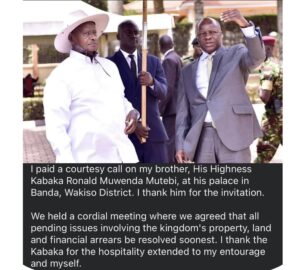
President Museveni has previously met the Kabaka at State House, Entebbe, and at the palace in Mengo.
These engagements have provided opportunities for discussions on issues concerning Buganda and the wider country.
The Katikkiro has also held meetings with the President and other senior government officials on matters affecting the kingdom.
Such engagements illustrate that the absence of the Kabaka from a collective cultural leaders’ conference does not necessarily imply the absence of communication between Buganda and the central government.
Indeed, the kingdom’s leadership has often pursued discussions on issues of mutual concern through separate institutional channels.
This approach is viewed by supporters as consistent with Buganda’s longstanding preference for kingdom-to-government engagement, rather than participation in forums where the Kabaka is expected to sit alongside other cultural leaders.
Why The Katikkiro Was Also Absent
The absence of the Katikkiro, Owek. Charles Peter Mayiga, also attracted attention.
According to the information provided by Buganda sources, the Katikkiro was away on official duties in Ssese County, while the Kabaka’s absence was understood within the kingdom’s established institutional context.
Buganda or the Kabaka for that matter, in such general cultural leaders’ meetings is very often than not represented. In the recent meeting, Buganda was represented by the First Deputy Katikkiro, Owek. Hajji Twaha Kawaase Kigongo.
This distinction is important because the absence of the Kabaka and the Katikkiro does not, by itself, establish that Buganda deliberately boycotted the conference.
The meeting was convened to bring together cultural institutions for discussions on national development, and the participation of representatives from different kingdoms and cultural institutions was part of that wider engagement.
At the time of reporting, no formal statement from the Buganda Kingdom or State House had publicly established that the Kabaka’s absence was intended as a protest against the President’s invitation.
Museveni’s Message To Cultural Leaders
The conference itself was significant, given President Museveni’s emphasis on the role of traditional institutions in national development.
Addressing cultural leaders at State House, the President urged them to concentrate on preserving cultural heritage, promoting indigenous knowledge and guiding their communities, while leaving legislation and public administration to elected government institutions.
He also called for greater cooperation between cultural institutions and government in areas such as agriculture, community industrialisation, skills development, tourism and wealth creation.
The cultural leaders proposed stronger partnerships with government, including support for model agricultural farms, community processing facilities and initiatives to preserve Uganda’s cultural heritage.
They also called for improved coordination among cultural institutions and the establishment of a Digital Cultural Park to document kingdoms, chiefdoms, historical sites and indigenous knowledge.
The discussions underscored the potential role of cultural institutions in Uganda’s social and economic transformation.
A Relationship Defined By History, Respect And Dialogue
The absence of the Kabaka and the Katikkiro from the State House conference has revived an important national conversation about the relationship between cultural institutions and the Government of Uganda.
For Buganda, the issue is not simply about attending or missing a meeting. It touches on the kingdom’s historical identity, institutional dignity and the way it engages with the central government.
At the same time, Uganda’s constitutional framework recognises traditional and cultural leaders while restricting them from exercising executive, legislative or administrative powers of government.
This creates a relationship in which cultural institutions retain their heritage and community roles, while operating within the broader constitutional order.
The challenge for both the central government and cultural institutions is to ensure that their engagements are guided by mutual respect, historical understanding and a shared commitment to national development.
Buganda’s historical position and the Kabaka’s cultural significance remain central to this conversation.
The kingdom’s absence from the conference should therefore be examined with a clear understanding of its institutional context, rather than through speculation alone.
Ultimately, the relationship between Buganda and the Government of Uganda continues to be shaped by history, identity, constitutional realities and the need for dialogue.
For a kingdom whose cultural identity has endured for centuries, the question of how its supreme traditional leader engages with the modern state remains an important subject in Uganda’s national story.
#Buganda #KabakaMutebi #Museveni #CulturalLeaders #UgandaToday #Uganda