
UgandaToday: Independence Day Question: If The West Opened Its Doors, Would Uganda Be Left With Only Seven Million People?
By Uganda Today Editorial Desk
As Uganda marks 64 years of Independence, a provocative question confronts the nation: if Europe and North America allowed Ugandans to move freely across their borders, how many would choose to remain at home? The question may be hypothetical, but the crisis of confidence it exposes deserves serious national debate.

The Seven-Million Question: A Provocation, Not A Prediction
Imagine waking up one morning to news that the United States, the United Kingdom, Canada and the countries of Western Europe had opened their doors to Ugandans, allowing them to live, work, study and settle there without the familiar barriers of restrictive visas, prohibitive migration costs and uncertain immigration procedures.
How many Ugandans would pack their bags?
Would the country’s population remain close to the 50 million mark, or would millions begin searching for a new home abroad? Could the country be left with only seven million people, as the provocative argument suggests?
There is no reliable evidence to establish that Uganda would lose such a proportion of its population under this hypothetical scenario. The seven-million figure should therefore be understood as a rhetorical question rather than a demographic forecast.
Nevertheless, the question touches a nerve in Uganda’s national consciousness. It asks whether the country has become a place where many people live because they have no practical alternative, rather than because they are confident in its institutions, economy and future.
The World Bank estimated Uganda’s population at approximately 51.4 million in 2025. Reducing that population to seven million would mean the departure of more than 44 million people—an extraordinary scenario that should not be confused with established migration trends.
But the real issue is not whether everybody would leave. It is why so many Ugandans aspire to build their futures elsewhere, and what that tells us about the state of independence at home.
Sixty-Four Years After Independence: What Does Freedom Mean In Everyday Life?
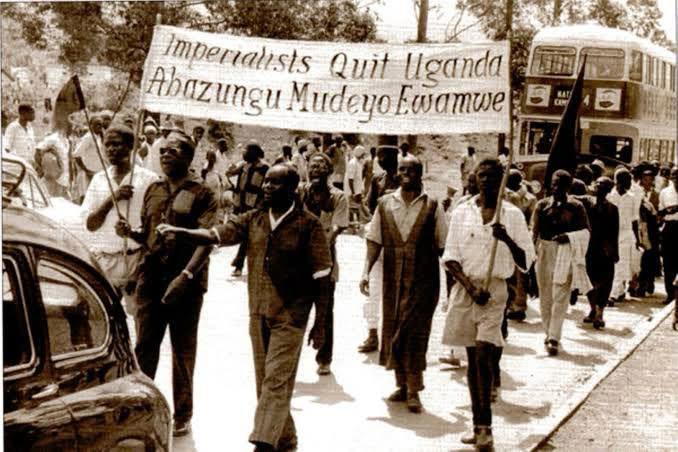
Uganda attained independence from Britain on October 9, 1962. The national celebration commemorates the restoration of political sovereignty and the right of Ugandans to govern their own affairs.
Yet independence is more than the lowering of a colonial flag and the raising of a national one. It must ultimately be experienced in the ordinary lives of citizens.
Can a child from a modest-income household attend a good school without forcing the family into financial distress? Can a patient receive timely, competent treatment at a public hospital without having to sell land, borrow money or seek assistance from well-wishers? Can a business owner transport goods reliably, access affordable credit and plan for the future without being undermined by unpredictable costs?
Can a qualified young Ugandan obtain a job because of competence rather than connections? Can a farmer earn a fair return from agricultural production? Can a citizen expect public institutions to work consistently, regardless of political affiliation, wealth or social status?
These are not abstract questions. They are the everyday tests by which citizens judge whether independence has translated into dignity, opportunity and self-government.
Uganda has made progress in several areas since 1962, and a balanced assessment must acknowledge development in infrastructure, education, health, communications and economic activity. But the existence of progress does not eliminate the question of whether its benefits are distributed fairly, whether services are dependable and whether public institutions inspire confidence.
Political independence is a historic achievement. Institutional independence, economic security and equal access to opportunity remain continuing responsibilities.
Clean Roads, Reliable Transport And Functional Public Services
One of the most revealing features of the migration debate is that many people are not necessarily looking for luxury. They are looking for predictability.
They want roads that are maintained, public transport that operates reliably, electricity that is dependable, schools that deliver quality education and hospitals that provide competent treatment without imposing unbearable financial burdens.
They want public services to function without requiring personal connections to obtain what should be available to everyone.
A clean road may appear to be a modest achievement, but it reflects a larger chain of public responsibility: planning, budgeting, procurement, supervision, maintenance and accountability. A functional school reflects the presence of trained teachers, appropriate learning materials, adequate facilities and effective management.
Similarly, a hospital is not truly functional merely because its building exists. It must have qualified personnel, essential medicines, diagnostic equipment, reliable referral systems and the capacity to treat patients promptly.
When these basic expectations are not consistently met, citizens begin to compare the services they receive at home with those available elsewhere.
The attraction of Western countries is therefore not simply about high salaries or fashionable lifestyles. For many migrants, it is also about the prospect of living in systems where rules are more predictable, public services are more dependable and the relationship between taxes and services appears more tangible.
Such comparisons are not always straightforward. Western countries also face housing shortages, expensive healthcare in some systems, unemployment, discrimination and immigration restrictions. Life abroad can be lonely, financially demanding and professionally frustrating.
But those difficulties do not erase the central question: why do so many people believe their chances of achieving a secure and dignified life may be better outside Uganda?
The Two-Tier Reality Of Education And Healthcare
Perhaps nowhere is the crisis of confidence more visible than in education and healthcare.
Uganda has public schools and health facilities that serve millions of people, alongside private institutions catering to families that can afford alternatives. The public system is indispensable, but differences in quality, staffing, equipment and affordability can create sharply unequal experiences.
For an ordinary family, the search for a better school may mean moving a child from one institution to another, taking out a loan or sacrificing other household needs. For a wealthier family, the answer may be an international school or a university abroad.
The same divide appears in healthcare. A family with sufficient resources may seek specialist consultations, advanced diagnostics or treatment outside Uganda when it believes local options are inadequate or unavailable.
This is not an argument that every foreign school or hospital is superior to every Ugandan institution. Uganda has capable teachers, outstanding medical professionals and institutions delivering valuable services. Nor is seeking treatment abroad inherently an indictment of the country: specialised care, individual medical circumstances and personal preference all matter.
The deeper concern arises when the ability to obtain good education and healthcare depends overwhelmingly on one’s capacity to pay, travel or draw on influential networks.
A country cannot claim to have achieved inclusive independence if quality education and essential healthcare are effectively secure only for those who can purchase alternatives.
The World Health Organization’s work on Uganda’s health system has highlighted the importance of adequate domestic health financing, a sustainable health workforce, stronger governance and equitable access to essential services. These are not merely technical policy questions; they determine whether citizens can depend on their own institutions when their health or their children’s future is at stake.
The question for Uganda’s leadership is straightforward: how can confidence in public services be restored if those with the greatest influence over them can routinely bypass the very systems ordinary citizens must rely upon?
When The Elite Look Abroad, What Message Does It Send?
The desire to migrate is not confined to unemployed graduates, low-income workers or young people struggling to establish themselves. It is also part of the conversation among professionals, businesspeople, senior public figures and families with considerable financial resources.
Some seek international education for their children. Others pursue overseas investments, acquire homes abroad, travel for specialised healthcare or explore alternative places of residence.
None of these activities, taken individually, proves a lack of patriotism. International mobility can be sensible, and global exposure can help Ugandans acquire knowledge, investment capital and professional experience that benefit the country.
The more difficult question is whether these choices reflect a temporary pursuit of opportunity or a deeper loss of faith in Uganda’s future.
Public debate has invoked prominent individuals, including Hon. Musherure and Ambassador Ayebare, as examples in discussions about the choices available to Uganda’s well-connected elite. However, the existence of international connections or the ability to travel does not establish that either individual intends to leave Uganda permanently. Such claims require verifiable evidence and should not be treated as established facts.
The broader issue does not depend on the intentions of particular personalities.
It concerns a system in which access to resources can enable some people to insulate themselves from failures in public services, while the majority must endure them.
If influential families can secure educational opportunities abroad, obtain medical treatment internationally and relocate their assets when circumstances become uncertain, they may experience the consequences of institutional weakness differently from citizens who have no such options.
That creates a dangerous distance between the governed and those who govern, or those who exercise substantial influence over public affairs.
The people making decisions about national education, healthcare, security and economic policy should have a direct stake in whether those systems succeed. Their children, families and businesses need not be confined to Uganda, but the country’s institutions should be good enough that remaining in Uganda is a credible and attractive choice.
Patriotism should not be measured by whether a person travels abroad. It should be measured, in part, by the willingness to contribute to building a country in which ordinary citizens can live with dignity.
Is Uganda A Home Or Merely A Side Hustle?
A particularly uncomfortable criticism in the national conversation is that Uganda has become a temporary economic platform for some people: a place to acquire wealth, secure contracts, establish connections and accumulate assets, while their long-term family plans and personal security are anchored elsewhere.
In this interpretation, the country becomes a means to an end rather than a shared national project.
The metaphor of a neighbourhood chapati stall captures the sharpness of this criticism. A stall may generate income, but its operator can close it, move to another location or pursue a different business when circumstances change. A nation, however, is not a temporary commercial venture. It is a shared home whose institutions must endure beyond individual fortunes, governments and generations.
The metaphor is provocative, but it should not be mistaken for a description of every wealthy Ugandan or public official. Many entrepreneurs, professionals and investors have committed substantial resources to Uganda, created employment and remained engaged in their communities.
Nevertheless, the criticism raises an important question about accountability: what obligations accompany the privilege of accumulating wealth or exercising power in a country?
Those who benefit from Uganda’s labour, natural resources, markets, public contracts and professional opportunities have a stake in ensuring that its institutions work. Their responsibilities should include lawful conduct, fair taxation, investment in productive activity and support for the public systems on which the country depends.
The objective is not to prevent people from travelling or investing abroad. It is to make the development of Uganda a serious, long-term commitment rather than an arrangement to be abandoned whenever domestic conditions become inconvenient.
The Cash-Crop Economy And The Question Of Economic Independence
Uganda’s economic history also invites a broader examination of what economic independence means.
Colonial economic arrangements were shaped substantially by the production and export of agricultural commodities for external markets. Coffee, cotton and other cash crops became important parts of the economy, connecting local producers to international trading networks and distant centres of capital.
Today, Uganda operates in a far more complex economic environment. Agriculture remains important, while services, manufacturing, construction, trade, technology and other activities contribute to livelihoods and national output.
International trade is not itself a problem. No modern economy can prosper in isolation, and Uganda benefits from exporting goods, attracting investment and participating in regional and global markets.
The challenge is whether the country captures sufficient value from its production, creates productive employment, develops domestic industries and uses public revenue to improve the lives of its citizens.
An economy that exports raw or minimally processed products while importing expensive finished goods can miss opportunities to retain more value at home. Farmers may produce valuable commodities but remain vulnerable to fluctuating prices, high input costs and weak bargaining power.
Similarly, a country may record economic growth without creating enough secure, adequately paid jobs for its expanding workforce.
Economic independence therefore requires more than control over national territory or the formal ownership of natural resources. It requires the capacity to create opportunities, build skills, process goods, support innovation and provide citizens with viable ways to earn a living.
If a young graduate sees no credible path to professional advancement at home, or a skilled worker believes that the only route to financial security is to leave, the economy faces a challenge that cannot be solved by patriotic speeches alone.
The task is to make Uganda a place where talent can grow, businesses can thrive and citizens can build futures without feeling compelled to exchange their roots for opportunity.
The Brain Drain: What Happens When Ambition Leaves?
Migration can be beneficial. Ugandans working abroad can send money to relatives, finance education, invest in businesses, transfer professional knowledge and build commercial links between Uganda and other countries.

The World Bank records substantial remittance flows to Uganda, illustrating one of the economic connections between citizens abroad and households at home. Such transfers can support consumption, education, healthcare and investment.
But the benefits must be weighed against the cost of losing skilled workers and experienced professionals, particularly where their education has been supported by public resources and their services are urgently needed at home.
When doctors, nurses, teachers, engineers, researchers and other skilled workers leave faster than institutions can train and retain replacements, the consequences can be felt in service delivery and productivity.
The problem is not that Ugandans seek better opportunities abroad. They have the right to pursue their ambitions. The problem is when domestic conditions make departure seem like the only realistic route to a decent professional life.
Retention cannot be achieved through appeals to sacrifice alone. Skilled workers need competitive remuneration, appropriate equipment, professional development, fair recruitment, safe working environments and confidence that advancement will be based on merit.
Young people need more than assurances that they are the leaders of tomorrow. They need practical opportunities to work, innovate, establish businesses and participate meaningfully in decisions that affect their lives.
The policy objective should be to create a country from which people can travel freely and to which they genuinely want to return—or in which they can build successful lives in the first place.
Independence And The Freedom To Stay
There is an important distinction between the freedom to leave a country and the freedom to remain in it without being trapped by poverty, insecurity or a lack of opportunity.

A Ugandan who chooses to study in Britain, work in Canada, establish a business in the United States or pursue a professional career elsewhere is exercising a legitimate aspiration.
But a Ugandan who feels compelled to leave because the local school system cannot meet a child’s needs, because essential treatment is inaccessible, because employment is scarce or because institutions cannot be trusted is confronting a different reality.
The first represents mobility as opportunity. The second risks turning migration into an escape route.
A genuinely independent country should make both staying and leaving viable choices. Citizens should be able to travel, learn and work abroad without believing that their only chance of security lies beyond their national borders.
This is why the seven-million question matters even if its literal premise is improbable. It asks whether Uganda’s institutions inspire sufficient confidence to persuade citizens that their ambitions can be fulfilled at home.
The answer cannot be obtained from the number of Ugandans who possess passports, apply for visas or travel each year alone. It requires serious evidence on migration intentions, skilled-worker departures, household choices, access to services, employment, investment and public trust.
It also requires the government and other national institutions to listen without dismissing criticism as disloyalty.
From Elite Positions To Public Service
The final challenge is one of leadership.
Holding public office should not be understood primarily as the acquisition of status, influence, wealth or privileged access. It should be understood as an obligation to serve.

Public servants must be judged by whether the institutions under their responsibility work, whether public resources are used lawfully and effectively, and whether citizens can obtain services without favouritism or unnecessary hardship.
The same principle applies beyond government. Business leaders, educators, health professionals, cultural institutions, civil society and the media all have roles in strengthening the country’s public life.
A nation cannot build lasting confidence if leadership is perceived as a competition for privileged access to resources while ordinary citizens are left to navigate failing systems.
Nor can national development depend indefinitely on individuals who are expected to solve public problems through personal generosity. Sustainable progress requires strong institutions, clear standards, accountable budgets and consistent delivery.
The question is not simply whether Uganda has enough talented people. It is whether the country has established the conditions under which their talent can serve the public good.
Moving from elite position to public service means treating authority as a responsibility, public money as a trust and national development as a commitment to the whole population.
What Must Change If Ugandans Are To Believe In The Future?
Restoring confidence requires action that citizens can see and measure.
First, strengthen public education. Improve teacher support, classroom conditions, learning materials, school leadership and accountability for educational outcomes. Quality education should not be an exclusive privilege reserved for families able to purchase expensive alternatives.

Second, make healthcare dependable. Invest in health workers, essential medicines, diagnostics, referral services and sustainable financing. The objective should be to ensure that ordinary citizens can obtain appropriate treatment without catastrophic financial hardship.
Third, create productive employment. Support value addition in agriculture, manufacturing, technology and services. Expand access to skills, finance and markets, and build conditions in which small businesses can grow into sustainable employers.
Fourth, improve transport and public infrastructure. Reliable roads, safe public transport, effective urban planning and properly maintained public facilities reduce the cost of doing business and improve everyday life.
Fifth, strengthen accountability. Public procurement, government expenditure and service delivery must be open to meaningful scrutiny. Citizens need confidence that public resources are being used for public purposes.
Sixth, protect merit and professional integrity. Recruitment, promotion and access to opportunities should be fair and transparent. Skilled citizens are more likely to invest their futures in institutions where competence is recognised.
Finally, make leadership answerable to citizens. National progress must be measured not only by speeches, projects announced or aggregate economic indicators, but also by improvements in the quality of life of ordinary households.
These reforms will not eliminate migration, nor should they. They would, however, make migration less of a necessity for people whose primary motivation is escaping institutional weakness and the absence of opportunity.
This Independence Day, Let The Struggle Continue
Uganda’s Independence Day should be a celebration of national achievement, but it should also be a moment of honest reflection.
There is no contradiction between loving one’s country and demanding better public services. There is no disloyalty in asking why citizens must sometimes seek abroad the education, healthcare, security or professional opportunities they hope to find at home.

Indeed, the ability to question national priorities openly is an important part of responsible citizenship.
The seven-million question is deliberately uncomfortable. It asks what might happen if the barriers that keep some people at home were suddenly removed. It challenges leaders to consider whether citizens remain because they believe in the country or because the practical alternatives are limited.
We cannot establish how many Ugandans would leave under such a hypothetical arrangement. But we can insist that the country become a place where staying is not a sacrifice imposed on those without options.
As Uganda celebrates another year of independence, the struggle must continue—not simply for the independence achieved in 1962, but for a deeper form of self-government expressed through capable institutions, accountable leadership, economic opportunity and equal dignity.
Let the goal be a Uganda where parents can trust the schools educating their children, patients can trust the hospitals treating them, workers can earn dignified livelihoods and young people can plan their futures without assuming that success requires permanent departure.
Let those who hold public office move beyond the privileges of position and embrace the responsibilities of service.
And let Ugandans abroad remain connected to a country that welcomes their knowledge, investment and experience—not merely their remittances.
Real independence must mean having the freedom to leave, the freedom to return and, above all, the confidence that one can build a dignified life at home.
Happy 64th Independence Day, Uganda.
Let us keep the struggle alive, even amid disappointment. Let us keep working for a country in which independence is not merely commemorated, but experienced in the daily lives of its people.
Uganda Today — For informed citizens and accountable leadership.
#UgandaToday #UgandaIndependenceDay #UgandaAt64 #BrainDrain #PublicService #PhoenixNewsFeeds #OperaNewsFeeds