The Myth of Stability in Uganda: Second Series Serialisation
Let’s go back to the beginning, the very foundation of the formation of the state called Uganda. When Britain declared the Uganda Protectorate in 1894, it did not take possession of an empty political landscape. The territory which formed Uganda was not a vacuum.


UgandaToday: The Myth of Stability in Uganda:Second Series Serialisation
S1E2: Containerization and Control of the Ugandan State
Following the maiden edition of serialisation of the myth of stability in Uganda last week, Ugandatoday.co.ug/ is pleased to publish the second edition as promised below:
Previously in The Myth of Stability
Last week, S1E1, we questioned Uganda’s most politically useful assumption: that the survival of one government is proof of a stable state. The NRM restored a degree of order after years of violence, rebuilt important parts of the economy and made Uganda a consequential regional security actor. Those achievements are real and acknowledged. But a state is not stable merely because one political order can preserve itself. On the contrary, I opine that a country is stable when institutions can govern, resolve conflict and transfer power without depending upon one indispensable individual. I want to submit that Uganda has not yet passed that test. To understand why authority remains so concentrated, and why succession beyond Museveni appears dangerous, we must look beyond 1986. Concentration of power did not begin with Museveni. The foundations were laid when Britain assembled Uganda as a territory to be controlled before it had become a nation.
Let’s go back to the beginning, the very foundation of the formation of the state called Uganda. When Britain declared the Uganda Protectorate in 1894, it did not take possession of an empty political landscape. The territory which formed Uganda was not a vacuum. What the British did was it placed an imperial claim over kingdoms, clan-based societies, trading networks and rival centers of authority that already possessed their own alternative ideas of government, legitimacy and justice.
We need to examine that distinction very well. The familiar conventional accounts presents Uganda as a rescue operation: Britain arrived, found disorder and supplied administration. But historical facts describe something far more consequential. Britain did not create political order from nothing. Instead, it enclosed different political orders within a single territory, selected the institutions most useful for governing it, and weakened or displaced those that did not fit its narrow feudalistic administrative model.
Uganda was therefore containerized twice. First, its peoples were enclosed by imperial boundaries drawn for strategic convenience. Then their political differences were reorganized into a hierarchy that made the new territory governable from a narrow center. Containerization created Uganda.
Divide and rule determined how Uganda would function.
Government Before Uganda
Buganda alone disproves the fiction of a political vacuum. By the time the white missionaries arrived in Buganda in the late nineteenth century, the kingdom possessed a Kabaka, a Katikiro, a Lukiiko and a territorial hierarchy of appointed chiefs capable of transmitting orders, collecting taxes/tribute and mobilizing labor and military force. Authority reached from Mengo into local communities through an administrative system the British could recognize, and eventually use.
Admittedly, Buganda did not have a liberal government. The kingdom could be coercive, expansionist and violent. Recognizing its institutional sophistication does not require romanticizing it. The point is that Britain did not build the structure in Buganda specifically. It found one already operating.
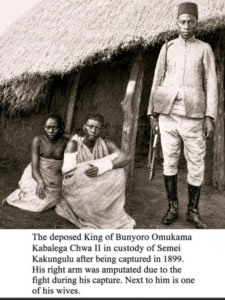
In the west, Bunyoro-Kitara presented a different challenge. Under Omukama Kabalega, Bunyoro had developed a standing army, Abarusura, a fighting force used to strengthen royal authority and resist external encroachment. Bunyoro was not waiting passively to be administered. It was pursuing its own strategy of political and military survival. Britain and its African allies had to defeat that resistance before they could describe the result as order.
Republican states of the north
Northern Uganda makes the same argument with even greater force. Among the Acholi, political authority was organized through a number of chiefdoms rather than a single northern kingdom. The Rwot possessed ritual standing, received tribute and represented continuity, but his authority operated through relationships with lineage heads, elders, retainers and fighting men. Colonial officials later treated the Rwot as though he were a smaller version of the Kabaka. That translation exaggerated some powers, weakened other institutions and turned negotiated authority into an administrative chain of command.
The Langi presented an even less centralized structure. Political authority rested substantially in clans and local leaders, while military leadership could arise from reputation, age, ability and the demands of a particular conflict. There was no permanent Lango throne from which orders could be issued to the entire population. John Tosh’s history of clan leaders and colonial chiefs in Lango documents the central problem: British administration required recognizable chiefs, so fluid and local forms of leadership were converted into offices the colonial state could appoint, record and discipline.
The Alur and Lugbara also form a good example how not to treat “the North” as one political civilization. Alur communities developed more centralized hereditary chiefdoms under rwoth, while Lugbara political organization remained more strongly rooted in lineage authority and local councils.
These neighboring societies possessed different relationships to territory and centralized leadership. The Protectorate did not preserve those distinctions as the foundations of negotiated selfgovernment. It compressed them into districts administered through a common colonial hierarchy.
The Alur, Lugbara, Kakwa and related communities found themselves divided among Uganda, the Belgian Congo and Sudan. Kinship, grazing, cultivation and trade did not stop at the new borders. Ordinary movement could now be treated as trespass or smuggling. The northern and northwestern boundaries therefore did more than surround existing peoples; they reorganized their daily lives around jurisdictions negotiated elsewhere.
This distinction became decisive because British indirect rule worked most cheaply where authority could be located in a chief, attached to an office and made answerable to a colonial superior. A society organized through dispersed clan authority was harder to command. The colonial solution was not to understand that system on its own terms but to impose a hierarchy that resembled the feudal monarchical system Britain had learned to manipulate in Buganda.
Decentralized East States
In the east and the north, the system of governance was different from what the colonialist where used to. The Bamasaba around Mount Elgon exposed an even deeper colonial misunderstanding. They did not possess a Kabaka or Omukama. Their political life was organized principally through autonomous decentralized clans, or Bikuka. Clan leadership, commonly associated with the Umukuka, helped maintain order, settle disputes, preserve customary obligations and protect the continuity of the community.
Authority existed, but it was distributed. It was a decentralized liberal republican, alien to the feudal imperialistic monarchies the British were used to. The absence of a central palace did not mean the absence of government. It meant government followed a different logic.
This distinction became decisive because British indirect rule worked most cheaply where authority could be located in a chief, attached to an office and made answerable to a colonial superior. A society organized through dispersed clan authority was harder to command. The colonial solution was not to understand that system on its own terms. It was to impose a hierarchy that resembled the system Britain had already learned to manipulate in Buganda. They used Baganda colonial agents, especially a Muganda General, Semei Kakungulu
Semei Kakungulu was an African military and political tool of imperial expansion. Leading armed followers shaped by the Buganda feudal system, he extended British authority into eastern territories that colonial administrators grouped under the name “Bukedi.” Bukedi was not a single precolonial kingdom. It was a colonial category covering several and vast distinct peoples of parts of Busoga, Bugwere, Teso, Samia, Bunyole, Sebei and parts of Karamoja and political communities north of Buganda, east ward to present day Naivasha in Kenya and north to Karamoja. Bukedi was therefore a quasi-federated political entity distinct from the feudalistic south.
Kakungulu did not conquer one waiting state called Bukedi. He occupied communities of independent federal states with distinct political structures. The colonial government subsequently placed these distinct states inside the one administrative container.
Around 1901, his forces entered Bugisu after being forced out of Naboa, his original administrative center for the entire Bukedi region. He relocated to Nabumali, from where he established a fortified position from which further operations could be conducted.
Military incorporation was only the first stage. Kakungulu brought Baganda followers and a hierarchical model of chieftaincy into a society that had governed itself primarily through clans. Colonial systems where then translated into counties, appointed offices, taxation, labor obligations and mission influence, reducing the inhabitants of the land to tenants expected to provide labor.
This was containerization at ground level. It was not merely a line placed on a British map. It was a foreign chief arriving with armed men and local authority displaced by offices recognized by the colonial structures and people becoming subjects of a system whose creation they had never known, recognized or negotiated.
Kakungulu’s appears to have expected that conquest would earn him durable independent territory from Buganda. Britain had other plans. Once the East had been incorporated, imperial officials increasingly preferred administrators they could appoint, regulate and remove. Kakungulu was eventually expelled from the system he had helped build and later settled at Gangama Hill near Mbale, separated from the territorial sovereignty he had sought. The empire used African ambition to expand, then restricted that ambition when it threatened imperial control.
The Division
The conquest of the East and the north demonstrated how the container expanded. The 1900 Buganda Agreement demonstrated how Britain intended to manage the container.
The agreement recognized Buganda’s institutions while altering the foundations beneath them. Its land settlement helped create Mailo ownership, transforming large areas into registered estates and strengthening a class of chiefs whose status increasingly rested upon titles protected by the colonial state. Traditional clan custodians and peasants did not enter this new order with equal power.
Britain was manufacturing a governing constituency of loyal stoogies. Chiefs who benefited from the settlement acquired a material interest in preserving the authority that guaranteed their property. A leader’s accountability could now run upward toward the colonial administration rather than downward toward the community. They used British colonized Buganda and then used Buganda to colonize the rest of the country. This created a structure of divide and rule
The same governing logic appeared elsewhere in different forms. Institutions that could be captured were preserved and altered. Institutions that were difficult to command were bypassed, subordinated or replaced. Territorial categories grouped distinct communities together. Political access became uneven. Some regions and social groups stood closer to education, administration, land titles and the colonial center than others.
This did not mean every colonial decision followed one perfect conspiracy. British officials disagreed, improvised and frequently misunderstood the societies they governed. African rulers, chiefs, soldiers, merchants and converts also pursued their own interests. But the cumulative structure is unmistakable: Uganda was administered through unequal access to the state, not through the construction of equal citizenship.
That inheritance remains politically relevant. Successive Ugandan governments did not create the original machinery, but neither were they condemned to preserve it. They chose, repeatedly, to retain a system in which control of the center mattered more than the distribution of authority. Local governments remained dependent upon decisions and resources from above. Political communities learned that protection came through proximity to power. Elections became struggles not merely over policy, but over access to the state itself.
The NRM inherited this architecture in 1986 and adapted it with considerable skill. It broadened local administration, created new districts and built national political networks, but it also concentrated decisive authority at the presidency. The result is a familiar colonial paradox of an elaborate administrative presence across the country combined with persistent dependence upon the center.
Uganda’s diversity is not the defect. Diverse political societies governed themselves before Uganda existed. The deeper defect is that these societies were enclosed without negotiating an enduring constitutional relationship among themselves, then governed through institutions designed to transmit commands downward and loyalty upward.
The country’s future therefore cannot be secured merely by replacing the person at the center. Uganda must reconsider the center itself: what powers belong there, what powers should reside in credible local institutions, how public resources are distributed, and how communities can lose a national political contest without feeling they have lost access to the country.
Britain built the container. It then made the container manageable by converting land, office, territory and identity into instruments of political separation. The next installment will examine that machinery more closely: how colonial divisions hardened into regional inequality, religious competition and a dangerous separation between those who controlled the administration and those who carried the gun. Look out for next week’s serialisation review here.
Next week in The Myth of Stability
In Next week’s episode, S1S3, we examine how colonial Uganda divided military power from economic and administrative power, and carried that imbalance into independence.
Kriss Namakola Dallas, Texas
This is a weekly series adapted from the book, The Myth of Stability: The Invisible Cost of Museveni’s One-Man Rule and the Hoax of Peace. The complete historical evidence, extended analysis, and reform proposals are available in the book.
Purchase the book: >>HERE<<. There is also a free e-book version on Amazon
Subscribe to receive next week’s installment.
- #TheMythOfStabilityInUganda #PhoenixNewsFeeds #UgandaToday #SemeiKakungulu
- #bit.ly/3REw5gR