Rwabwogo’s Reform Call Sparks Debate Within Uganda’s Political Establishment
+256 702 239 337: Senior presidential adviser urges rule of law, free speech and institutional renewal as Daudi Kabanda insists internal criticism should remain behind closed doors

UgandaToday: Rwabwogo’s Reform Call Sparks Debate Within Uganda’s Political Establishment
Senior presidential adviser urges rule of law, free speech and institutional renewal as Daudi Kabanda insists internal criticism should remain behind closed doors
By UgandaToday Political Desk
KAMPALA — A public exchange between Presidential Adviser Odrek Rwabwogo and former Patriotic League of Uganda (PLU) Secretary General Daudi Kabanda has ignited fresh national debate over the future of governance, freedom of expression and institutional reform within Uganda’s ruling establishment.
At the centre of the discussion is Rwabwogo’s call for the National Resistance Movement (NRM) to embrace reform, strengthen the rule of law and end impunity if Uganda is to achieve its long-term economic ambitions.
Kabanda, however, countered that public criticism from senior insiders risks undermining government institutions and handing political ammunition to the opposition, arguing that such concerns should instead be addressed through established internal channels.
Rwabwogo: Reform is not betrayal
In a widely circulated statement, Rwabwogo challenged fellow NRM members to look beyond the party’s liberation history and instead focus on its ability to adapt to Uganda’s changing realities.
“The question is not whether the NRM has a history. It does.
“The question is whether the Movement can reform, renew itself, and protect its founding purpose for Uganda’s next stage of growth.”
He argued that institutions cannot survive solely on historical achievements but require continuous renewal, self-correction and visionary leadership.
According to Rwabwogo, Uganda’s aspiration to transform into a US$500 billion economy cannot be achieved through infrastructure development alone.
Instead, he said sustainable economic transformation depends on strengthening governance principles including:
- Rule of law;
- Honest communication;
- Institutional accountability;
- Disciplined leadership;
- Protection of free expression; and
- Respect for citizens’ rights.
He further warned that fear suppresses innovation and public participation.
“We must keep the country communicating freely. We must allow people to speak without fear. We must stop impunity.
Reform is not betrayal. Reform is how institutions remain alive.
Fear disables people.”
The remarks have been interpreted by many observers as one of the strongest public calls from a figure closely associated with the First Family for institutional introspection and governance reform.
A governance message from within
Political analysts say Rwabwogo’s intervention carries unusual significance because it comes from someone widely regarded as part of Uganda’s governing establishment rather than from opposition politics or civil society.
His emphasis on ending impunity, protecting free speech and strengthening institutions echoes concerns that have increasingly featured in public discourse regarding governance, accountability and respect for constitutional freedoms.
Observers note that while successive governments have repeatedly pledged to eliminate corruption and improve service delivery, public confidence continues to be tested by recurring allegations of abuse of office, delayed justice and perceived selective enforcement of the law.
Kabanda pushes back
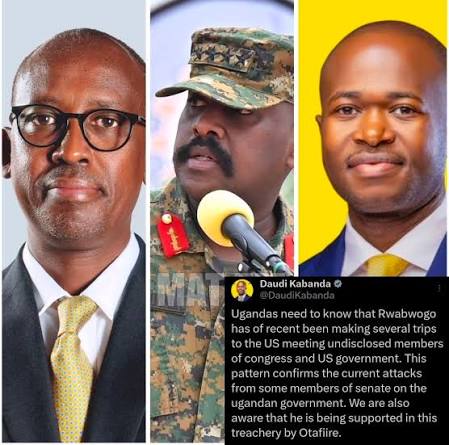
The remarks were swiftly challenged by Daudi Kabanda, who argued that senior figures close to government should exercise caution when making public statements that may be interpreted as criticism of state institutions.
According to Kabanda, corruption and governance challenges should indeed be confronted, but through existing government mechanisms rather than public pronouncements that could weaken confidence in the state.
He reportedly maintained that those enjoying direct access to the Presidency should privately raise concerns instead of airing disagreements publicly, warning that such debates risk portraying divisions within government while emboldening political opponents.
Two competing philosophies
The exchange reflects two contrasting schools of thought emerging within sections of Uganda’s political establishment.
Rwabwogo appears to advocate for greater openness, arguing that accountability begins when citizens can freely express concerns and leaders remain willing to listen.
Kabanda, by contrast, places greater emphasis on institutional cohesion, arguing that internal disagreements are better resolved within government structures than through public debate.
While both acknowledge governance challenges, they differ on the most effective means of addressing them.
The constitutional perspective
Uganda’s Constitution guarantees freedom of speech, freedom of conscience, freedom of assembly and access to justice.
Human rights organisations, legal scholars and governance advocates have consistently argued that protecting these freedoms strengthens democratic governance by allowing citizens to participate meaningfully in national affairs.
Government officials have equally maintained that national security, public order and constitutional stability remain important considerations in regulating public conduct.
Balancing these competing interests continues to shape Uganda’s governance debate.
Economic ambitions and governance
Rwabwogo’s remarks also link governance directly to Uganda’s economic transformation agenda.
Economists have long argued that attracting investment and accelerating industrialisation requires more than roads, electricity and factories.
Predictable institutions, an independent justice system, policy consistency and protection of property rights remain among the factors international investors consider before committing long-term capital.
His argument therefore frames governance reform not simply as a political issue but also as an economic necessity.
A conversation likely to continue
Whether the exchange signals genuine ideological differences within Uganda’s broader political establishment remains open to interpretation.
What is clear, however, is that it has revived public discussion about institutional reform, accountability, human rights and freedom of expression.
As Uganda continues implementing its long-term development agenda, debates over how to balance political stability, economic growth and constitutional freedoms are likely to remain central to the country’s national conversation.