Uganda Parliament Clears UPDF Deployment To Gaza Under International Stabilisation Mission
+256 702 23 93 37: The approval was granted on Thursday, August 6, 2026, after Defence and Veteran Affairs Minister Kiryowa Kiwanuka presented the government’s request before Parliament. The decision makes Uganda one of the countries preparing to contribute personnel to the proposed international force, which is linked to the Gaza peace framework backed by United States President Donald Trump.

UgandaToday: Uganda Parliament Clears UPDF Deployment To Gaza Under International Stabilisation Mission
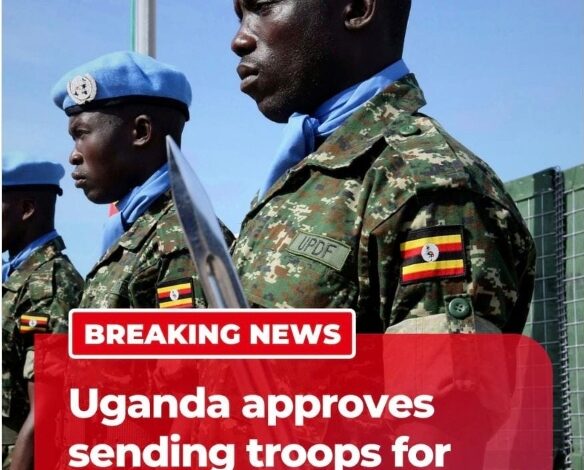
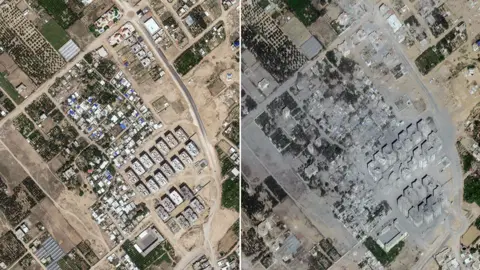
Uganda’s Parliament has approved a government motion authorising the deployment of the Uganda Peoples’ Defence Forces (UPDF) to the Gaza Strip as part of a proposed multinational International Stabilization Force (ISF), opening the way for Uganda to participate in an international security mission aimed at stabilising the war-ravaged territory.
The approval was granted on Thursday, August 6, 2026, after Defence and Veteran Affairs Minister Kiryowa Kiwanuka presented the government’s request before Parliament.
The decision makes Uganda one of the countries preparing to contribute personnel to the proposed international force, which is linked to the Gaza peace framework backed by United States President Donald Trump.
Parliament’s official account says the deployment is intended to support efforts to restore peace and facilitate humanitarian assistance in Gaza. The government says the UPDF contingent would operate neutrally, comply with international humanitarian law and protect civilians without taking sides in political disputes.
Trump’s Request To Museveni
Defence Minister Kiryowa Kiwanuka told legislators that Uganda’s participation followed a request from President Donald Trump.
According to Reuters, Kiwanuka said Trump, through emissaries, contacted President Yoweri Museveni in July seeking Uganda’s contribution to the proposed multinational force.
The parliamentary debate therefore marked the first public acknowledgement by the Ugandan government that Kampala was prepared to participate in the Gaza stabilisation initiative.
Kiwanuka argued that Uganda’s decision was consistent with the country’s constitutional obligations and international commitments to promote peace, security and cooperation.
The government also pointed to the UPDF’s extensive experience in peace-support operations, particularly in Somalia, South Sudan, the Democratic Republic of Congo and other international missions.
What The Gaza Mission Is Intended To Do
The proposed International Stabilization Force originates from the Gaza peace framework endorsed by the United Nations Security Council.
UN Security Council Resolution 2803, adopted on November 17, 2025, authorised participating states working with the Board of Peace to establish a temporary International Stabilization Force in Gaza.
The resolution gives the force a broad mandate, including helping secure border areas, stabilising the security environment, protecting civilians and humanitarian operations, supporting vetted Palestinian police forces and helping establish humanitarian corridors. It also provides for the demilitarisation of Gaza and the decommissioning of weapons held by non-state armed groups.
The proposed force is expected to operate under a unified command acceptable to the Board of Peace.
According to AP, the force has been envisaged as potentially numbering about 20,000 personnel and would be led by U.S. Major General Jasper Jeffers. Morocco has also publicly pledged troops to the mission.
Uganda Says Its Troops Would Remain Neutral
The Ugandan government has sought to emphasise that any UPDF participation would be a stabilisation and humanitarian mission rather than an intervention on behalf of one side in the Israeli-Palestinian conflict.
According to the parliamentary motion, Ugandan troops would remain neutral, operate within international humanitarian law and focus on protecting civilians and supporting the mandate of the stabilisation mission.
Kiwanuka told Parliament that Uganda’s participation was motivated by legal, diplomatic, humanitarian and strategic considerations, including preventing renewed conflict and facilitating humanitarian access.
UPDF representatives also defended the deployment.
Major General Henry Masiko argued that Uganda should take pride in the international confidence placed in its armed forces, while Major General David Gonyi said Uganda had a moral and diplomatic obligation to contribute to efforts aimed at restoring peace in Gaza.
Opposition Raises ‘Ambush’ Concerns
The parliamentary approval was, however, accompanied by strong objections from opposition legislators who questioned both the procedure used to introduce the motion and the lack of detailed information supplied to MPs.
Opposition Chief Whip Paul Mwiru argued that MPs needed more time to examine the proposal, including the implications of Uganda joining another major overseas military mission.
Deputy Speaker Thomas Tayebwa acknowledged that the motion had been submitted by the Defence Minister earlier but admitted that its omission from the Order Paper had been an oversight.
He nevertheless ruled that the House needed to consider the matter urgently, noting that decisions concerning the international mission were expected shortly.
The controversy did not prevent Parliament from ultimately adopting the motion.
MPs Demand Answers On Troop Welfare
Beyond the procedural dispute, legislators raised questions about the welfare and safety of Ugandan soldiers who could eventually be sent to Gaza.
MPs sought information about the number of troops to be deployed, their terms of service, financing, equipment, insurance and support for their families.
The government did not announce the number of UPDF personnel that Uganda intends to send or specify when the contingent would be deployed. Reuters reported that a Status of Forces Agreement would be negotiated after Parliament’s approval.
Some MPs also warned that Gaza could present operational challenges different from Uganda’s previous peacekeeping theatres.
Manjiya County MP John Baptist Nambeshe argued that the densely populated urban environment could expose soldiers to considerable risks, while other legislators demanded guarantees that troops would be properly facilitated and protected.
Kampala Woman MP Shamim Malende said the Opposition was not necessarily opposed to Uganda participating but wanted Parliament to exercise stronger oversight over the mission and the conditions under which Ugandan soldiers would serve.
Questions Over Uganda’s Strategic Interests
The decision has also triggered questions about Uganda’s diplomatic calculations.
AP reported that some opposition lawmakers questioned why Uganda had agreed to participate and whether there were broader diplomatic considerations behind the decision.
MP Hassan Kirumira raised concerns about the implications for Uganda’s position as a member of the Organisation of Islamic Cooperation, while asking the government to clarify which side Ugandan forces would be expected to support if the mission encountered armed confrontation.
The government, however, maintains that the UPDF would operate under the mandate of the international stabilisation mission and would remain neutral.
A New Chapter In Uganda’s Peacekeeping Role
Uganda has long presented its military participation in foreign missions as an instrument of regional security and diplomacy.
The UPDF has served in peace and security operations in Somalia, South Sudan, the Democratic Republic of Congo, the Central African Republic and other theatres.
The government argues that these deployments have strengthened Uganda’s international standing and given the UPDF valuable operational experience.
Parliament’s decision now potentially extends that role beyond Africa into one of the world’s most politically sensitive and closely watched conflict zones.
For the government, the Gaza mission offers an opportunity to demonstrate Uganda’s contribution to international peace and humanitarian security.
For critics, however, the decision raises difficult questions about the risks to Ugandan soldiers, the financial burden of another overseas deployment, Uganda’s diplomatic interests and the precise circumstances under which UPDF personnel could operate.
Deployment Still Depends On The Mission’s Next Steps
Despite Parliament’s approval, the decision does not mean that Ugandan troops have already entered Gaza.
Reuters reported that the international force’s deployment timetable remains unclear, while the wider Gaza stabilisation framework has faced implementation challenges.
The next stages will include determining Uganda’s troop contribution, operational arrangements, rules governing the soldiers and the agreement regulating their presence in Gaza.
The parliamentary vote therefore represents an authorisation for Uganda to participate rather than confirmation that a UPDF contingent is already on its way to the territory.
As the international community works to establish the proposed stabilisation force, Uganda will now be under growing scrutiny over the size, mandate and conditions of its contribution.
For President Museveni’s government, the decision reinforces Uganda’s long-standing ambition to play a significant role in international peace and security operations.
For Parliament and the Ugandan public, the central question now shifts from whether Uganda will participate to what exactly the UPDF will be required to do in Gaza, under whose command, at what cost and with what safeguards for Ugandan soldiers.