Today In History: The 1961 Deal That Put Uganda’s Hotel Workers At The Tourism Table
+256 702 23 93 37: Sixty-five years ago today, hotel and safari-lodge workers secured a collective agreement with the Uganda Development Corporation. As Uganda approached independence, the little-remembered arrangement revealed that building a tourism industry required more than attractive destinations: it also required rules governing the people who made hospitality possible.

UgandaToday: The 1961 Deal That Put Uganda’s Hotel Workers At The Tourism Table
Sixty-five years ago today, hotel and safari-lodge workers secured a collective agreement with the Uganda Development Corporation. As Uganda approached independence, the little-remembered arrangement revealed that building a tourism industry required more than attractive destinations: it also required rules governing the people who made hospitality possible.
Today In History: The Uganda Today Historical Perspective
14 November 1961
On 14 November 1961, as Uganda prepared for independence, an important agreement was concluded in Kampala between hotels and safari lodges controlled by the Uganda Development Corporation (UDC) and the Uganda Hotels and Domestic Workers’ Union.
It was a significant moment in the country’s labour and tourism history, yet it rarely features in the familiar accounts of Uganda’s journey to independence.
The agreement covered hotels in Entebbe, Gulu, Kasese, Kabale, Masaka and Mbale, as well as the Entebbe Airport restaurant. It also covered Mweya Safari Lodge in Queen Elizabeth National Park and Paraa Lodge in Murchison Falls National Park.
The number of employees covered was estimated at several hundred. Supervisory staff were excluded because they had individual employment contracts.
A Tourism Industry Was Also A Workplace
The agreement was intended to prevent industrial disputes and strikes in a growing hospitality sector.
One of its most important provisions established a procedure for handling disagreements between management and workers. The parties were expected to pursue joint consultation first. If that failed, they agreed to use the machinery provided under the Trade Disputes (Arbitration and Settlement) Ordinance.
That provision matters because it recognised that disagreements at work needed an agreed process rather than being left entirely to the discretion of individual hotel managers.
The underlying legal framework dated back to the 1949 ordinance, which introduced statutory machinery for settling labour disputes in Uganda. Historian John-Jean Baryaharwego Barya, in his 1990 University of Warwick doctoral thesis, explains how the colonial administration developed formal mechanisms for managing industrial disputes during the period.
The surviving public account does not provide the full signed agreement or its detailed provisions on wages, working hours, leave and other employment conditions. It would therefore be misleading to claim that the 1961 arrangement settled all those matters.
Its documented importance lies particularly in the establishment of a recognised procedure for resolving disputes across a network of hospitality establishments.
The Union Had Already Made History

The organisation representing the workers was not new.
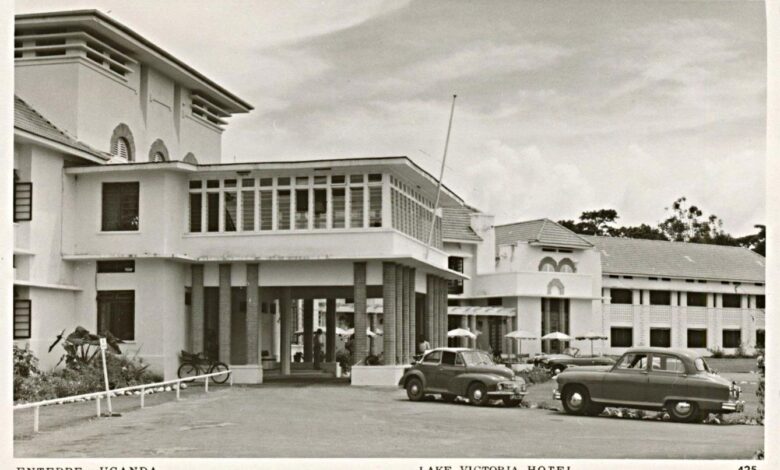
According to its institutional history, the Uganda Hotels and Domestic Workers’ Union was formed in 1957 at Lake Victoria Hotel in Entebbe and registered in 1959 as Trade Union No. 2.
Its original purpose was to advance and protect the social and economic interests of workers in the hotel and domestic service sectors. The organisation has since evolved into the Uganda Hotels, Food, Tourism, Supermarkets and Allied Workers’ Union, commonly known as HTS-Union.
The 1961 agreement therefore represented an important step in the union’s development: an organisation established by hospitality workers was negotiating with a major state-linked enterprise over conditions affecting employees across several parts of the country.
The Wider Labour Climate Was Changing
The agreement did not emerge in a peaceful industrial environment.
Uganda was experiencing increasing worker organisation and labour activism in the years immediately before independence.
Barya’s historical research reproduces figures from official labour reports showing that Uganda recorded 76 strikes in 1961, resulting in 105,631 working days lost.
The figures cover the wider economy, not just the hotel industry. Nevertheless, they illustrate the scale of industrial tension during a period when workers were increasingly demanding better remuneration and greater influence over their conditions of employment.
In that context, the hotel agreement was more than an administrative arrangement. It was part of a wider movement towards formal negotiation between employers and organised labour.
UDC Was Building More Than Factories

The Uganda Development Corporation had been established in June 1952 under an Act of Parliament to promote the country’s industrial and economic development.
Its activities extended beyond manufacturing and mining. Tourism and hospitality were also part of the corporation’s development interests, with the Lake Victoria Hotel among its early ventures and Uganda Hotels later becoming one of its subsidiaries.
By 1970, UDC had expanded to 38 subsidiaries and 19 associated companies, according to the corporation’s official history. Its portfolio included enterprises in textiles, mining, cement, food production, hotels and other sectors.
Uganda Development Corporation
The hotel agreement therefore belonged to a larger experiment in state-supported economic development.
It connected workers in urban hotels and remote safari lodges to a national business structure that was helping to shape Uganda’s emerging economy.
The Story Continues In Modern Uganda
The union’s work did not end with independence.
HTS-Union says it later concluded a recognition agreement with the Uganda Hotel Owners’ Association in 2007 and a collective bargaining agreement in 2008. The union reports that these later agreements covered more than 130 hotel units across Uganda.
These were separate agreements, not a continuation of the 1961 arrangement. However, they demonstrate the continuing importance of organised labour in the hospitality sector. The union identifies negotiated employment standards, grievance procedures, communication between workers and management, and improved industrial relations among the purposes of collective bargaining.
This remains relevant as Uganda promotes itself as a destination for international visitors, wildlife tourism, conferences and business travel.
A country’s tourism success is measured not only by the number of visitors it attracts, the quality of its lodges or the beauty of its national parks. It is also reflected in the treatment of the people who welcome visitors, prepare meals, maintain facilities, guide guests and keep hospitality businesses running.
Remembering The Workers Behind The Tourism Story

The agreement of 14 November 1961 deserves recognition as part of Uganda’s labour history and the development of its hospitality industry.
It reminds us that the country’s independence story was not written only by politicians, constitutional negotiators and nationalists. Workers in hotels, factories, public services and other workplaces were also shaping the institutions of the society that was about to emerge.
Sixty-five years later, the agreement offers a useful historical lesson: a sustainable tourism industry needs investment, infrastructure and natural attractions, but it also needs fair workplace relations and a meaningful voice for its employees.
The history of Uganda’s hotels is therefore not just a story of buildings and visitors. It is also a story of the workers who helped build the industry.
-
HTS-Union, “About Us” — the union’s institutional history, including its formation at Lake Victoria Hotel in 1957 and registration in 1959.
HTS-Union
-
Uganda Development Corporation, “Our History” — the corporation’s establishment, development mandate and business portfolio.
Uganda Development Corporation
-
John-Jean Baryaharwego Barya, Law, State and Working Class Organisation in Uganda: 1962–1987, University of Warwick doctoral thesis, 1990 — historical context on trade unionism, the 1949 ordinance and labour activity before independence.
WRAP_THESIS_coversheet+2
-
HTS-Union, “Collective Agreements” — the later 2007 recognition agreement and 2008 collective bargaining agreement with the Uganda Hotel Owners’ Association.
HTS-Union
Important verification note: The original signed 1961 agreement was not located in the public digital sources consulted. The claim that it was the first of its kind in Uganda is attributed to New Vision’s historical account and should not be presented as independently established from the original document. New Vision also states that the agreement came 333 days before independence; the calendar interval from 14 November 1961 to 9 October 1962 is actually 329 days.
#UgandaToday #PhoenixNewsFeeds #OperaNewsFeeds #TodayInHistory #UgandaHistory #WorkersRights