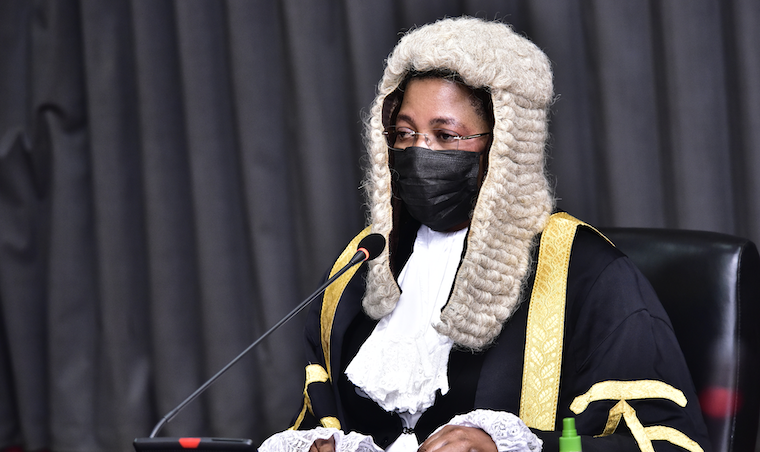
The Rise and Fall of Rt. Hon. Anita Annet Among
+256 702 239 337 Reflections on Corruption, Governance and Women’s Leadership

UgandaToday: The Rise and Fall of Rt. Hon. Anita Annet Among:
Reflections on Corruption, Governance and Women’s Leadership

Reflections by Solome Nakaweesi
Long Interesting Read… Tighten Your Belts!
The rise and fall of Anita Annet Among reflects the complex intersection of power, ethics, governance, accountability, and gender within political systems. It demonstrates how leadership that is not grounded in ethical values, transparency, merit, constituency accountability, and institutional integrity can quickly shift from public admiration to intense public scrutiny.
Her trajectory also exposes how patronage politics operates in Uganda, particularly how power is negotiated, protected, and withdrawn within political systems. It reveals the dynamics of inner-circle and outer-circle politics, and how individuals perceived to threaten entrenched power structures are often politically isolated or managed.
More importantly, it highlights that corruption in Uganda is not simply an individual failing or a gender issue; it is often a symptom of deeper governance weaknesses, weak oversight systems, patronage networks, and concentrated unchecked power.
The Gendered Nature of Public Responses
The situation also exposes the gendered nature of public responses to corruption and abuse of office. Society often normalizes or excuses excesses when committed by men in power, yet reacts far more harshly when women are involved.
This reflects persistent patriarchal perceptions about women, power, ambition, authority, and access to resources. Women in leadership continue to navigate a political terrain where they are judged differently, scrutinized more intensely, and often denied the same political room for failure or redemption afforded to men.
Leadership Beyond Numbers
From a transformative feminist leadership perspective, Anita Among’s leadership appeared insufficiently grounded in clear principles, ethics, accountability, and transformative political vision. Her tenure increasingly vulgarized the institution of Parliament and, unfortunately, damaged public confidence in women’s leadership at a time when Uganda has made important gains in advancing women in political spaces.
We have moved beyond the simplistic idea that gender equality is achieved merely by increasing the number of women in positions of power. The critical question today is: What values, ethics, political consciousness, and transformative agenda inform women’s leadership?

Leadership in the 21st century must be grounded in integrity, competence, ideology, accountability, and service to people—not proximity to power. Having women in those spaces does not necessarily imply that things will automatically change.
Transformative leadership also requires accountability to a collective. Leaders must remain answerable to constituencies, movements, institutions, and citizens so that checks and balances exist against excessive abuse of power.
In Anita Among’s case, there appeared to be weak accountability to her constituency, to women as a political constituency, and even to broader democratic principles. Her leadership became heavily centralized around loyalty to appointing authority and financial influence rather than rooted accountability to the public.
This becomes particularly risky for women leaders operating within patriarchal political systems. When political survival is tied primarily to proximity to powerful individuals or financial networks, rather than strong constituencies, institutions, movements, and values-based alliances, women often become politically vulnerable once those relationships shift.
The collapse is usually swift, public, and unforgiving. We are now seeing Anita Among becoming increasingly vulnerable and politically alienated.
Relationship With Women’s Movements
From the beginning of her tenure, Rt. Hon. Among maintained a strained relationship with sections of the women’s movement and many women leaders, partly due to political rivalries linked to her predecessor, Rebecca Kadaga, and the perception that she did not need the women’s movement.
In the process, she appeared to isolate herself from genuine sisterhood and feminist solidarity, surrounding herself with opportunists and political patrons while navigating leadership without trusted accountability spaces.
As a result, her leadership did little to meaningfully transform the lives of the women she represented both as Woman MP and as a national leader.
Leadership without rooted accountability is always fragile. In deeply gendered political systems, this fragility becomes even more dangerous for women leaders because society quickly weaponizes their failures against the broader struggle for women’s political participation.
The Risk of Generalizing Women’s Leadership
On gender parity, therefore, this moment presents both risk and opportunity.
The danger lies in the possibility that the failures or controversies surrounding one woman leader may be generalized to undermine women’s leadership as a whole.
In Uganda, this may reinforce existing patriarchal backlash narratives that women are “not good leaders,” that they “belong in kitchens,” that “women have had it all,” or that “it is time to abolish affirmative action.”

However, gender equality and equity should never be measured by the success or failure of one individual.
If Rt. Hon. Anita Among failed Uganda, then she failed Uganda in the same way many male leaders have failed Uganda before her. The country must resist the temptation to ghettoize or generalize all women leaders based on one person’s shortcomings, just as society rarely does with failed male leadership.
Building Institutions Stronger Than Individuals
Ultimately, this moment calls for leadership anchored in integrity, humility, public service, ethical conduct, and accountability rather than personality cults, dominance, patronage, or political survival.
Uganda’s governance challenges will not be solved simply by changing individuals. They will require building institutions that are stronger than personalities; institutions where ethical values, checks and balances, citizen participation, and public accountability are consistently protected and enforced.
The true goal of feminist and transformative leadership is not merely increasing the number of women in positions of power, but advancing leadership that is ethical, accountable, inclusive, people-centered, and transformative regardless of gender.
Women leaders must be held to the same standards of integrity and accountability as men, while ensuring that anti-corruption efforts are not selectively weaponized against women.
Confronting Corruption Within Political Structures
Lastly, if Uganda is serious about fighting corruption, then the ruling National Resistance Movement (NRM) must intentionally confront corruption, abuse of office, and impunity within its own ranks.
Genuine accountability cannot emerge only when political interests shift or alliances collapse. Sustainable governance reform requires strong institutions, consistent accountability mechanisms, and leadership rooted in public service rather than political survival.
About the Author
Solome Nakaweesi
Pan-African Feminist
Great African Housewife
Chairperson, Board of Forum for Women in Democracy
Vice Chairperson, Board of African Institute for Investigative Journalism
#UgandaToday #PhoenixNewsFeeds #OperaNewsFeeds #WomenLeadership #GovernanceMatters #Accountability