
UgandaToday: Kyagulanyi Meets 97-Year-Old Mzee William Mukaira, Freed After Blowing Treason Charges
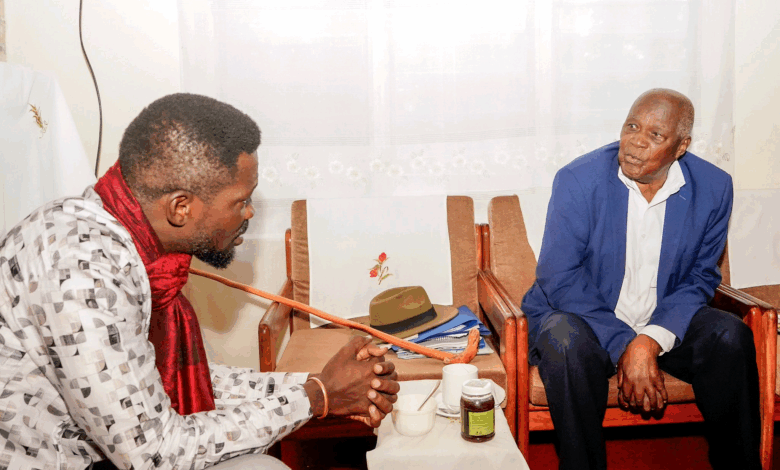
Bushenyi, Uganda — Presidential candidate Robert Kyagulanyi (Bobi Wine) paid a heartfelt visit to Mzee William Mukaira, aged 97, at his home in Bushenyi Town. In a post on X (formerly Twitter), Kyagulanyi described Mukaira as “a 97-year-old senior citizen decorated as an educationalist, activist, farmer, a post-independence leader and a business mogul.”
Mukaira has, according to Kyagulanyi, “remained loyal to the truth and justice … stood with the oppressed …” Despite his stature and achievements, he was recently released from prison after being accused of treason, a charge Kyagulanyi calls “trumped up … by this criminal regime.”
The History Behind the Incarceration
To understand the significance of Kyagulanyi’s words, it helps to look back at what really happened in Mukaira’s case — a fraught episode in Uganda’s political history.
Who Is Mzee William Mukaira?
-
Mukaira was born around 1930 and has long been a prominent figure in Bushenyi District.
-
He is an educator: he founded Valley College in Bushenyi, which expanded over the years to include O- and A-levels, enrolling over a thousand students.
-
Politically, he became Bushenyi District chairperson for the Forum for Democratic Change (FDC), one of the main opposition parties in Uganda.
-
Besides education and politics, he was a businessman: he owns Bushenyi Wines and other enterprises.
The Charges: Col. Edison Muzoora’s Death and Treason Accusations
The treason allegations against Mukaira relate to the controversial death of Col. Edison Muzoora, a former Uganda People’s Defence Force (UPDF) officer.
-
Muzoora had deserted the UPDF in 2003 and was allegedly involved with the People’s Redemption Army (PRA), a rebel group.
-
On May 27, 2011, Muzoora’s body was found dumped at Mukaira’s home in Kyabugimbi, Bushenyi District.
-
Following this, Ugandan security arrested Mukaira (then in his 80s) and other people, including Dr. Aggrey Byamaka, on suspicion of treason, murder, and concealment of treason.
-
According to prosecutors, some individuals allegedly conspired to overthrow the government “by force of arms” between 2006 and 2011.
-
The initial murder charge was amended to treason.
-
On June 17, 2011, Mukaira was arrested from his home by plain-clothed operatives.
-
During his detention, Mukaira was admitted to Mulago Hospital due to health complications, including abdominal pain.
-
He was remanded to Luzira Prison, a high-security prison.
-
While in detention, Mukaira claimed he was tortured and mistreated.
-
After years of protracted legal battle, he was acquitted: on June 30, 2016, the High Court cleared him of all charges related to Muzoora’s death.
Why This Matters to Kyagulanyi and His Movement
-
In his post, Kyagulanyi framed Mukaira’s ordeal as symbolic: despite his age, wealth, and influence, Mukaira remained true to justice and the oppressed.
-
By visiting him, Kyagulanyi is linking his own political message — “People Power, Our Power” and “A New Uganda Now” — to Mukaira’s legacy of activism, resistance, and sacrifice.
-
The narrative resonates strongly: Mukaira’s arrest on treason charges has long been seen by many as politically motivated, particularly given his opposition roots in the FDC and his influence in Bushenyi.
Broader Context: State and Opposition Tensions
-
The case of Col. Muzoora has been controversial, with security agencies alleging that his death was connected to a plot to overthrow the government.
-
Gen. David Tinyefuza, Coordinator of Intelligence and Security Agencies, publicly stated that those arrested (including Mukaira) may have been complicit in treason because of “hiding” Muzoora.
-
There were also diplomatic overtones: at one point, Rwanda denied any role in Muzoora’s death, suggesting the matter had international implications.
Conclusion
The meeting between Kyagulanyi and Mzee William Mukaira is more than a courtesy call — it is deeply symbolic. Kyagulanyi’s praise of Mukaira as “loyal to truth and justice” taps into a powerful narrative: that even elderly patriots, once persecuted by the state, can inspire a vision of change. Mukaira’s past — his education work, his business success, his political activism, and his incarceration on treason charges — provides a concrete example of longstanding resistance against political repression.
For Kyagulanyi, aligning with Mukaira sends a message: the struggle for a new Uganda is intergenerational, built on the sacrifices and convictions of those who have long resisted injustice.