

UgandaToday: At 101, Elder Nsigo Still Stands Guard at Kasubi Tombs — A Living Link to Buganda’s Royal Heritage
By UgandaToday News Desk
At Kasubi, History Has a Human Face
At a time when many people associate heritage with monuments, museums and ancient buildings, a remarkable story is unfolding at the historic Kasubi Royal Tombs in Kampala.
It is the story of Elder Nsigo, a 101-year-old gatekeeper whose presence at the Kasubi Tombs has become a striking reminder that cultural heritage is not preserved only by buildings—it is also carried by people.
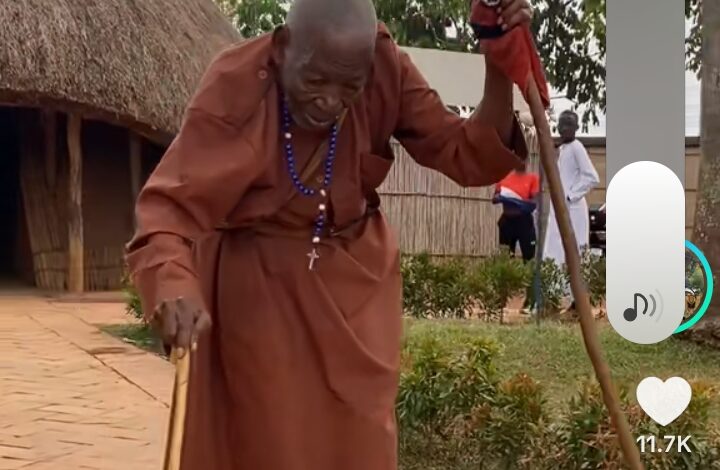
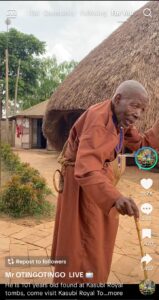
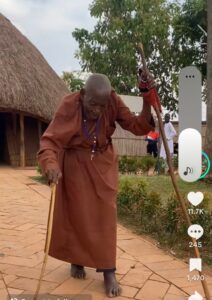
Photographs circulating on social media show Nsigo, dressed in traditional attire and leaning on his walking stick, going about his duties at the historic site.
His age, demeanour and continued presence have drawn attention from visitors, including foreign tourists who have stopped to meet and photograph the elderly custodian.
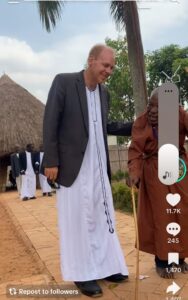
One of the photographs shows Nsigo posing beside a white tourist, creating a powerful image of two generations and cultures meeting at one of Uganda’s most important heritage sites.
A 101-Year-Old at the Gateway of History
According to information accompanying the photographs shared online, Elder Nsigo is 101 years old and serves as a gatekeeper at the Kasubi Tombs.
UgandaToday has not independently verified his age or the full details of his service history, but the images offer a compelling human-interest window into the people who help keep the country’s cultural heritage alive.
For a man who has lived through more than a century of Uganda’s history, standing at the entrance of a royal site carries an almost poetic significance.
Nsigo represents a generation that has witnessed enormous changes in Uganda—from the final years of colonial rule and independence to the transformation of Kampala into a modern city.
Yet at Kasubi, he remains surrounded by traditions whose roots reach deep into Buganda’s history.
Kasubi Is More Than a Tourist Attraction
The significance of Kasubi cannot be measured simply by the number of tourists who visit.
UNESCO describes the Tombs of Buganda Kings at Kasubi as a major spiritual centre for the Baganda and a place where traditional and cultural practices have been preserved. The site covers about 26.8 hectares on Kasubi Hill in Kampala.
At its centre stands the Muzibu Azaala Mpanga, the principal tomb structure associated with the burial of four Kabakas of Buganda.
The present palace complex dates back to the 19th century: the palace was built in 1882 and converted into a royal burial ground in 1884. UNESCO recognises the site for its exceptional architectural, historical, spiritual and cultural significance.
That makes Nsigo’s position particularly intriguing.
He is not simply standing at the entrance of an ordinary tourist attraction. He is standing at the gateway to a living cultural institution.
Where Royal History Meets the Modern Tourist
The photograph of Nsigo with a foreign visitor perhaps tells the story better than a thousand words.
The tourist appears to be enjoying a moment of interaction with the elderly gatekeeper, while Nsigo, leaning on his traditional walking stick, remains unmistakably rooted in the cultural environment around him.
It is a meeting between Uganda’s past and the world’s present.
For the visitor, the encounter may be a memorable holiday experience. For Uganda, however, such moments demonstrate the power of cultural tourism to create direct human connections between communities and visitors from different parts of the world.
A monument can be photographed.
A building can be reconstructed.
But meeting someone who has personally lived through a century of history is an experience that cannot easily be replicated.
The Survivor Behind the Smile
What makes Elder Nsigo’s story especially compelling is the contrast between his age and the youthful curiosity of the tourists who encounter him.
At 101, he belongs to a generation whose memories stretch far beyond the digital photographs and social-media videos through which his story is now reaching the world.
His traditional clothing, walking stick and surroundings reinforce the sense that he is part of a cultural landscape rather than merely an employee at a heritage attraction.
His appearance has therefore become almost symbolic: a living elder standing amid the physical remains of a royal past while visitors from around the world come to learn, observe and remember.
Kasubi’s Own Story of Survival
The Kasubi Tombs have themselves survived a turbulent history.
The main tomb structure was devastated by fire on 16 March 2010, prompting an extensive international reconstruction and conservation effort. UNESCO subsequently placed the site on the List of World Heritage in Danger.
Years of restoration followed.
In September 2023, UNESCO announced that the Tombs of Buganda Kings at Kasubi had been removed from the List of World Heritage in Danger following successful restoration work. The reconstruction programme was completed in the summer of 2023.
More recently, UNESCO’s World Heritage Committee commended Uganda, the Buganda Kingdom, local communities and other partners for completing the reconstruction of the Muzibu Azaala Mpanga and continuing efforts to transmit traditional custodial knowledge to future generations.
In that context, the presence of an elderly custodian such as Nsigo acquires an even deeper meaning.
The buildings can be restored with craftsmanship, expertise and international support.
But the traditions surrounding them must also be carried from one generation to another.
The Unspoken Lesson for Uganda
Elder Nsigo’s story raises an important question for a country blessed with extraordinary cultural heritage:
Who will tell Uganda’s story when the people who remember its older chapters are gone?
Uganda possesses royal sites, ancient cultural institutions, traditional kingdoms, historical monuments and communities with enormous reservoirs of knowledge.
Yet much of this heritage exists in the memories and experiences of elderly men and women whose stories may never have been formally recorded.
Nsigo’s presence at Kasubi should therefore inspire more than admiration.
It should inspire documentation.
His memories, stories and experiences could potentially form part of an oral-history record—not only for Buganda but for future generations of Ugandans seeking to understand how their society evolved.
A Photograph Worth More Than a Thousand Words
The image of a 101-year-old Ugandan elder standing beside a foreign tourist is therefore much more than a social-media photograph.
It captures heritage, tourism, age, identity and human connection in one frame.
The tourist may eventually return home with photographs of Kampala and Kasubi.
But Uganda should also ensure that the story of people such as Nsigo remains here—properly recorded, preserved and passed on.
Because monuments tell us where we came from.
People like Elder Nsigo can tell us what it felt like to live through the journey.
Uganda’s Living Heritage
As Uganda seeks to expand cultural tourism and attract visitors interested in experiences beyond wildlife and conventional sightseeing, stories such as Nsigo’s demonstrate the enormous potential of human-centred heritage tourism.
A visit to Kasubi can be about royal history, architecture and spirituality.
But it can also be about meeting the people who keep that history alive.
At 101, Elder Nsigo appears to be doing exactly that—standing at the gateway of one of Uganda’s greatest cultural treasures, while the world comes to him.
And perhaps that is the most powerful message contained in these photographs:
Sometimes, the most extraordinary museum piece is not an ancient object. It is a living human being who has survived long enough to become history himself.
#UgandaToday #KasubiTombs #KasubiRoyalTombs #ElderNsigo #Buganda #BugandaHeritage #UgandaHeritage #CulturalTourism #VisitUganda #UgandaTourism #AfricanHeritage #LivingHeritage #RoyalHeritage #Kampala #UNESCOWorldHeritage #MuzibuAzaalaMpanga #DiscoverUganda #UgandaStories #HistoryLivesOn #bit.ly/3REw5gR