Apollo 12: The Lightning-Struck Mission That Proved The Moon Could Be Reached With Precision
+256 702 23 93 37: On 19 November 1969, two American astronauts landed on the Moon less than 200 metres from an unmanned spacecraft that had arrived there more than two years earlier. But their journey nearly ended in disaster seconds after launch, when lightning struck their rocket and threatened to cripple the mission.

UgandaToday: Apollo 12: The Lightning-Struck Mission That Proved The Moon Could Be Reached With Precision

On 19 November 1969, two American astronauts landed on the Moon less than 200 metres from an unmanned spacecraft that had arrived there more than two years earlier. But their journey nearly ended in disaster seconds after launch, when lightning struck their rocket and threatened to cripple the mission.
Today In History: The Uganda Today Historical Perspective
19 November 1969 | Oceanus Procellarum, The Moon
The journey to the Moon on 19 November 1969 was not simply another demonstration of America’s ability to send astronauts into space. It was a test of whether human beings could navigate to a specific location on another celestial body, conduct scientific work, recover equipment from an earlier mission and return with knowledge that could change the understanding of the lunar environment.
Apollo 12 was launched on 14 November 1969 with astronauts Charles “Pete” Conrad, Richard F. Gordon Jr. and Alan L. Bean aboard.
Five days later, Conrad and Bean descended to the lunar surface in the Lunar Module Intrepid, while Gordon remained in lunar orbit aboard the Command Module Yankee Clipper.
Their destination was Oceanus Procellarum, commonly known as the Ocean of Storms, on the Moon’s surface.
The mission was the second successful crewed lunar landing following Apollo 11 in July 1969. However, its significance lay in a new objective: demonstrating that spacecraft could land with considerably greater precision and undertake extended scientific exploration.
Lightning Struck The Rocket Twice
Apollo 12 nearly suffered a catastrophic failure before it even escaped Earth’s atmosphere.
On 14 November 1969, the Saturn V rocket carrying the astronauts was struck by lightning shortly after launch. The electrical disturbances affected spacecraft systems, causing warning indications and threatening the mission’s ability to continue.
A second lightning strike followed moments later.
The astronauts and launch-control engineers faced a rapidly developing emergency. Telemetry readings were disrupted, and the spacecraft’s electrical systems were affected.
The mission was saved through the intervention of ground controllers, who guided the astronauts through recovery procedures that restored the spacecraft’s essential systems.
The launch continued, and Apollo 12 eventually entered its intended trajectory towards the Moon.
The episode became a significant reminder of how space exploration depended not only on sophisticated machines but also on human judgment, communication, engineering discipline and the ability to respond calmly when unexpected events occurred.
NASA’s account of the mission records the lightning strikes at 36 and 52 seconds after launch and the subsequent recovery of the spacecraft’s systems.
The Mission That Aimed For A Small Target
Apollo 11 had demonstrated that astronauts could land on the Moon. Apollo 12 was designed to demonstrate that they could do so more accurately.
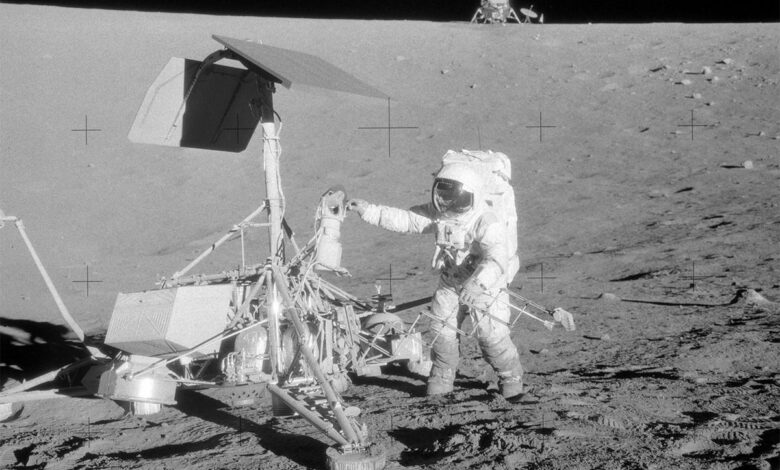
The crew targeted a landing area close to Surveyor 3, a robotic spacecraft that had landed on the Moon on 19 April 1967.
The objective was to make a landing sufficiently precise that astronauts could walk to the earlier spacecraft, inspect it and retrieve selected components for scientific examination on Earth.
On 19 November 1969, Conrad and Bean achieved that objective.
They landed approximately 200 metres from Surveyor 3, a remarkable achievement in navigation and spacecraft control at the time.
The landing proved that lunar missions could be planned around specific geological locations and existing equipment, rather than relying only on broad landing zones.
Precision would become increasingly important in later missions, especially those seeking scientifically valuable terrain and challenging geological features.
Two Astronauts Walked Back Into Lunar History

Once on the surface, Conrad and Bean carried out two moonwalks.
They photographed the landscape, collected geological samples, examined the surrounding terrain and deployed scientific instruments.
They also visited Surveyor 3, which had been sitting on the Moon for approximately 31 months.
The astronauts retrieved components from the robotic spacecraft, including parts of its television camera, to allow scientists to investigate how prolonged exposure to the lunar environment had affected materials.
This was an early example of human exploration building upon robotic exploration.
Surveyor 3 had helped establish the nature of the lunar surface before astronauts arrived. Apollo 12 then returned to the site to inspect the spacecraft and gather evidence that could inform future missions.
The mission returned approximately 34.35 kilograms of lunar material, according to NASA’s lunar landing records.
The Moon Became A Scientific Laboratory

Apollo 12 was not simply about planting flags or taking photographs.
The astronauts deployed an Apollo Lunar Surface Experiments Package, a collection of scientific instruments designed to study the Moon’s environment.
The experiments contributed to a growing understanding of lunar seismic activity, solar wind, magnetic fields and the physical environment of the Moon.
The collected rocks and soil also helped scientists study the Moon’s geological history.
Unlike Earth, where wind, water, vegetation and tectonic activity constantly alter the surface, much of the lunar terrain preserves a record of ancient events. Lunar material can therefore help scientists understand the history of the Moon and, indirectly, the early evolution of the solar system.
The Apollo programme’s scientific contribution extended well beyond the astronauts’ immediate observations. It created a body of research material that scientists continued examining long after the missions ended.
What Apollo 12 Means For Uganda’s Next Generation
Uganda was not part of the Apollo programme, and Apollo 12 was an American-led mission. Yet its story carries lessons that are relevant to Uganda’s educational and technological ambitions.
The mission was built around the integration of mathematics, physics, electronics, engineering, communications, geology and teamwork.
The lightning strikes demonstrate the importance of problem-solving under pressure. The pinpoint landing illustrates the value of precision. The recovery of Surveyor 3 components shows how one generation of technology can provide information for the next. The lunar experiments demonstrate the value of curiosity-driven research.
For Ugandan schools, universities and institutions promoting science, technology, engineering and mathematics, Apollo 12 offers a useful case study of what happens when scientific knowledge is translated into practical problem-solving.
Uganda and Africa need not reproduce the Apollo programme to benefit from its lessons. Satellite technology, Earth observation, weather forecasting, telecommunications, agricultural monitoring, mapping, environmental management and engineering innovation all provide opportunities for young people to apply scientific knowledge to local challenges.
The question is not whether Uganda will send astronauts to the Moon tomorrow.
It is whether the country can nurture the scientists, technicians, engineers, innovators and problem-solvers capable of developing technologies that improve life here on Earth.
The Legacy Of A Mission That Almost Failed

Apollo 12 was a successful mission, but its success was not guaranteed.
The lightning strikes could have ended the mission before the astronauts reached orbit. The landing required careful navigation. The lunar work demanded coordination, discipline and scientific focus.
Its achievement was not merely that two human beings walked on the Moon for a second time.
It was that NASA demonstrated a growing capacity to conduct targeted exploration, recover from unexpected technical challenges and use human presence to extend the work of robotic spacecraft.
On 19 November 1969, the Moon became more than a destination. It became a place where precision, persistence and scientific investigation could be demonstrated on a scale previously unimaginable.
And for Uganda, the enduring message is that the great achievements of tomorrow begin with the knowledge, discipline and imagination invested in today’s young minds.