Francis Babu’s Hard-Hitting Message: Has The NRM Lost Its Democratic Promise?
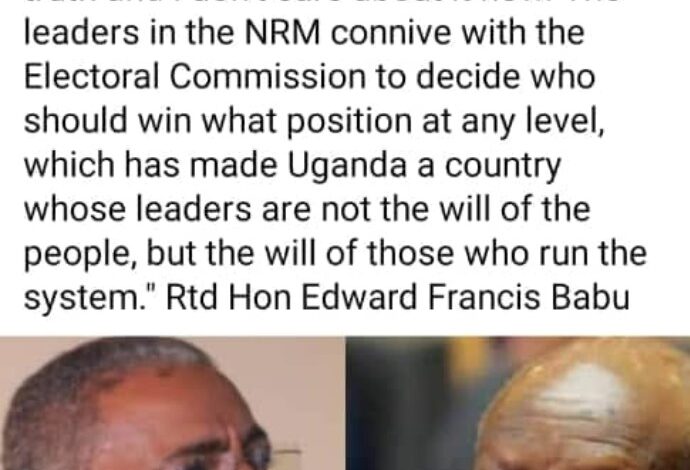
+256 702 23 93 37: In the purported remarks, Babu is quoted as saying that the confusion surrounding corruption, greed, tribalism and vote rigging represents the games of leaders within his own party. He is further quoted as declaring that those who speak the truth are chased away, but that he intends to remain committed to telling the truth.

UgandaToday: Francis Babu’s Hard-Hitting Message: Has The NRM Lost Its Democratic Promise?

By Uganda Today Political Desk
Uganda’s political landscape has been given another subject for reflection following a statement circulating on social media and attributed to veteran politician and former minister Captain Francis Babu, in which he reportedly accuses leaders within the ruling National Resistance Movement (NRM) of presiding over corruption, greed, tribalism and electoral manipulation.
The statement, which has attracted attention because of its unusually blunt language, paints a picture of a ruling party struggling with internal contradictions between its founding democratic ideals and the political practices allegedly taking root within its structures.
In the purported remarks, Babu is quoted as saying that the confusion surrounding corruption, greed, tribalism and vote rigging represents the games of leaders within his own party.
He is further quoted as declaring that those who speak the truth are chased away, but that he intends to remain committed to telling the truth.
Although the authenticity and original context of the circulating quotation require independent confirmation, its central themes are consistent with concerns Babu has previously raised publicly about the state of democracy within the NRM.
A Veteran Insider Turns The Spotlight On His Own Party
Francis Babu is not an ordinary political commentator observing the NRM from the opposition benches.
He is a veteran politician and former minister who has been associated with the ruling movement for many years. His experience within the party gives his criticism a particular political significance.
Babu has previously spoken publicly about weaknesses in the party’s internal democratic processes, including the management of elections and the treatment of dissatisfied members.
In August 2025, Nile Post reported that Babu had criticised the NRM’s recently concluded party primaries, describing them as embarrassing and questioning the effectiveness of the party’s internal dispute-resolution mechanisms.
Speaking on NBS Barometer, he reportedly described the system as spoiled and questioned where the NRM had gone wrong.
He also expressed concern about the use of money in politics and the erosion of leadership values.
That earlier intervention provides important context for understanding the latest statement attributed to him.
Corruption, Greed And Tribalism: The Questions Behind The Accusations
Perhaps the most politically sensitive part of the circulating statement is its reference to corruption, greed and tribalism.
These are not minor accusations in a country whose political leadership has repeatedly promised to fight corruption, promote national unity and strengthen accountable governance.
The NRM has governed Uganda since 1986, presenting itself as a movement that emerged from a struggle against dictatorship, electoral manipulation and political exclusion.
Its historical message included the promise of restoring democratic participation, institutional accountability and national cohesion.
Consequently, allegations that these principles are being compromised within the party raise questions about whether the movement is maintaining the standards it once championed.
However, allegations of corruption, tribalism or organised electoral manipulation should be subjected to evidence and appropriate investigation rather than treated as established facts merely because they appear in a political statement.
Are Internal NRM Elections Becoming A Test Of Loyalty Rather Than Popularity?

Another important dimension of Babu’s reported remarks concerns the manner in which political leaders emerge within the ruling party.
Uganda’s political system gives party primaries enormous significance because winning the NRM flag in many constituencies provides a considerable electoral advantage.
This has made internal elections highly competitive, sometimes resulting in bitter disputes, accusations of irregularities and the emergence of independent candidates.
In April 2025, Nile Post reported that the NRM Electoral Commission faced the challenge of rebuilding confidence following controversies surrounding the 2020 party primaries.
The report highlighted concerns about voter registers, misconduct, violence and disputes over the legitimacy of primary-election outcomes.
Babu himself was quoted in that report arguing that the electoral system was not necessarily the problem, but that the behaviour of some party members was damaging its credibility.
The bigger question, therefore, is whether the NRM can establish internal electoral procedures that are trusted by both winners and losers.
A political party cannot convincingly preach democracy nationally while allowing its own members to lose confidence in the processes through which their leaders are selected.
The Electoral Commission And The Question Of Public Confidence
The most serious part of the screenshot’s attribution is the allegation that NRM leaders connive with the Electoral Commission to determine who wins particular positions.
This is an allegation of considerable gravity.
Uganda’s Electoral Commission is constitutionally mandated to organise and conduct public elections. Its independence, impartiality and credibility are essential to the legitimacy of the country’s electoral process.
It is important, however, to distinguish between the NRM’s internal Electoral Commission, which manages party elections, and the national Electoral Commission, which administers public elections.
The two institutions have different responsibilities.
Any suggestion of collusion involving the national Electoral Commission would require specific evidence, investigation and a response from the institution concerned.
Nevertheless, public confidence in elections is not built merely by announcing winners. It depends on transparent procedures, credible voter registers, impartial administration and effective mechanisms for resolving disputes.
As Uganda moves through successive electoral cycles, the credibility of these institutions will remain central to the country’s democratic future.
Babu’s Political History Adds Weight To The Debate
Babu’s relationship with internal party politics has not always been smooth.
In November 2010, Uganda Radio Network reported that he had accused NRM officials of frustrating his attempt to contest for Kampala mayor on the party ticket.
The party had endorsed Peter Ssematimba, prompting Babu to pursue an independent candidacy.
He complained at the time that he had not received a fair hearing from party officials.
More recently, in the debate surrounding the NRM Central Executive Committee, Babu has also challenged proposals affecting the participation of senior party members.
New Vision reported on his opposition to a proposal to restrict senior party leaders from holding party and government positions simultaneously. He described the proposal as undemocratic and reaffirmed his intention to contest for the position of first national vice-chairperson.
These episodes illustrate a politician who has repeatedly engaged in debates about party procedures, political competition and the distribution of leadership opportunities.
The NRM’s Democratic Challenge
The NRM faces a challenge that extends beyond winning elections.
It must also maintain confidence among its own supporters, particularly those who believe that party membership should provide a genuine opportunity to participate in leadership selection.
When unsuccessful candidates and dissatisfied members repeatedly question internal processes, party unity becomes difficult to sustain.
The emergence of political pressure groups, competing factions and ambitious contenders for senior party positions further demonstrates the importance of transparent internal competition.
Ultimately, the strength of a political movement should not be measured only by its ability to retain power. It should also be measured by its ability to accommodate disagreement, uphold its constitution and allow members to compete fairly.
Is This A Warning The NRM Should Ignore?
Whether the circulating statement is eventually authenticated in its entirety or not, the issues it raises deserve serious public discussion.
Babu’s previously documented interventions demonstrate that concerns about internal democracy, electoral disputes and political accountability are not new subjects in his public engagement.
For the NRM leadership, the challenge is to demonstrate that criticism from within the movement is welcome and that allegations of irregularities can be addressed through credible institutional mechanisms.
For the Electoral Commission, public trust requires continued transparency and demonstrable independence.
And for Ugandans, the fundamental question remains whether political leadership truly reflects the will of voters.
Democracy is not simply about who occupies an office after an election. It is also about how that person gets there.
Uganda Today Editorial Note: The latest quotation in this article is attributed to Captain Francis Babu in a social media screenshot. Uganda Today has not independently established its original publication date, platform or complete context. The specific allegations concerning collusion with the Electoral Commission remain unverified.
#FrancisBabu #NRM #UgandaPolitics #ElectoralDemocracy #PoliticalAccountability #UgandaToday