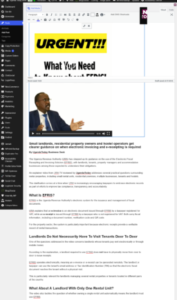
URA Clarifies EFRIS Rules For Landlords, Tenants And Rental Businesses
+256 702 23 93 37: Small landlords, residential property owners and hostel operators get clearer guidance on when electronic invoicing and e-receipting is required. From the Shs2.82 million annual rental-income threshold to electronic receipts for tenants and EFRIS requirements for hostels, URA's latest guidance answers some of the questions confronting Uganda's property sector.




UgandaToday: URA Clarifies EFRIS Rules For Landlords, Tenants And Rental Businesses
Small landlords, residential property owners and hostel operators get clearer guidance on when electronic invoicing and e-receipting is required
By UgandaToday Business Desk
The Uganda Revenue Authority (URA) has stepped up its guidance on the use of the Electronic Fiscal Receipting and Invoicing Solution (EFRIS), with landlords, tenants, property managers and accommodation businesses among those expected to understand their obligations.
An explainer video from URA TV reviewed by UgandaToday addresses several practical questions surrounding rental properties, including small rental units, residential premises, multiple businesses, tenants and hostels.
The clarification comes at a time when URA is increasingly encouraging taxpayers to embrace electronic records as part of efforts to improve tax compliance, transparency and accountability.
What Is EFRIS?
EFRIS is the Uganda Revenue Authority’s electronic system for the issuance and management of fiscal documents.
URA explains that an e-invoice is an electronic document issued through EFRIS by a taxpayer registered for VAT, while an e-receipt is issued through EFRIS by a taxpayer who is not registered for VAT. Both carry fiscal information, including a document number, verification code and QR code.
For the property sector, the system is particularly important because electronic receipts provide a verifiable record of rental transactions.
Landlords Do Not Necessarily Have To Visit Tenants Door To Door
One of the questions addressed in the video concerns landlords whose tenants pay rent electronically or through mobile money.
According to the explanation, a landlord required to use EFRIS does not have to physically move from door to door to issue receipts.
EFRIS operates electronically, meaning an e-invoice or e-receipt can be generated remotely. The landlord or taxpayer can use the tenant’s email address or Tax Identification Number (TIN) so that the electronic fiscal document reaches the tenant without a physical visit.
This is particularly relevant for landlords managing several rental properties or tenants located in different parts of the country.
What About A Landlord With Only One Rental Unit?
The video also tackles the question of whether owning a single rental unit automatically means the landlord must use EFRIS.
The answer is not necessarily.
URA’s current guidance states that taxpayers earning less than Shs2.82 million in rental income annually are among those not required to issue e-invoices or e-receipts through EFRIS for their business transactions, although they may use the system voluntarily.
The Shs2.82 million threshold is equivalent to about Shs235,000 per month when spread across 12 months.
This means the number of rental units alone does not determine the EFRIS obligation. The level of annual rental income is an important consideration.
Small Rental Units In Low-Income Areas
The video gives the example of small rental units earning Shs100,000 per month.
A landlord with one such unit would earn Shs1.2 million annually, while two units at Shs100,000 each would generate Shs2.4 million annually.
Both figures fall below the Shs2.82 million annual threshold highlighted by URA.
However, landlords should consider their total annual rental income from all sources, rather than looking at each property in isolation. URA’s rental-income guidance states that an individual’s gross rental income is determined from all sources.
This distinction is important for landlords with several properties.
Tenants Also Stand To Benefit
EFRIS is not designed only to benefit URA or landlords.
The electronic documentation provides tenants with reliable records of rental expenditure.
In a notice published on September 3, 2026, URA advised tenants to obtain an EFRIS receipt from their landlords whenever they pay rent and to ensure that the receipt reflects the actual amount paid. URA says such documentation can, where applicable, help tenants claim qualifying rental expenses for income-tax purposes and input tax where the tenant is VAT registered and the rental expense qualifies.
The requirement also strengthens transparency because the rental income declared by a landlord can be matched against documented transactions.
Different Businesses, Different EFRIS Accounts
Another issue addressed in the video concerns people operating more than one business.
Where different businesses are registered as independent companies, the video explains that each business will have its own EFRIS account and, where necessary, its own EFRIS device.
The practical implication is that businesses should maintain proper separation of their financial and fiscal records instead of treating independently registered companies as though they were a single business.
For entrepreneurs with multiple companies, proper registration and accounting structures therefore become increasingly important.
EFRIS Applies To Residential And Commercial Rent
A common misconception is that electronic fiscal receipting applies only to commercial buildings.
The URA explainer makes it clear that EFRIS requirements for the real-estate sector cover both commercial and residential rental activities, subject to the applicable requirements and exemptions.
This means residential landlords should not assume that their properties are automatically outside the EFRIS framework simply because they are occupied as homes.
At the same time, landlords whose rental income falls below the applicable Shs2.82 million annual threshold are identified by URA as an exempt category from the mandatory EFRIS requirement.
What About Hostels For University Students?
The video also addresses hostels.
The answer is yes.
According to the URA explainer, hostels fall within the accommodation sector, meaning providers of hostel accommodation are required to consider the applicable EFRIS requirements.
This is particularly significant for property owners around universities and other institutions of higher learning, where rental accommodation is a major business.
Hostel operators should therefore ensure that their tax registration, rental records and electronic fiscal documentation are properly aligned with URA requirements.
Why EFRIS Matters To The Property Sector
Beyond tax administration, electronic receipts can help bring greater order to Uganda’s rental economy.
For landlords, digital records can make it easier to maintain transaction histories. For tenants, receipts provide evidence of what was actually paid. For businesses, electronic documentation can support accounting and tax compliance.
URA has also emphasized that expenses requiring EFRIS documentation may not qualify for income-tax deduction where the supplier was required to use EFRIS but failed to provide the required electronic fiscal document.
That makes EFRIS increasingly relevant not merely as a compliance exercise, but as part of proper business record keeping.
A Caution For Landlords And Tenants
The rules surrounding EFRIS, rental income tax, VAT and other tax obligations can vary according to the nature of the taxpayer and the type and value of the business.
For example, URA states that landlords earning commercial rental income of Shs150 million or more annually are required to register for VAT, and VAT-registered taxpayers are obliged to use EFRIS and issue electronic fiscal documents.
Landlords and property businesses should therefore avoid relying solely on the number of rental units they own when determining their obligations.
Instead, they should examine their total rental income, taxpayer status, type of property, VAT position and the specific EFRIS requirements applicable to their business.
UgandaToday Editorial Note
This article is based on the URA TV EFRIS explainer video supplied to UgandaToday and has been cross-checked against current URA guidance published in September 2026. Taxpayers with circumstances not covered by the general guidance are encouraged to confirm their individual obligations directly with URA.