Shs350 Million Bridge, Wooden Crossing and the Big Question: Balaam’s Anti-Corruption Tour Puts Local Governments on the Spot
+256 702 23 93 37: At the centre of the controversy is Tokwe Bridge in Bundyelume Village, Tokwe Sub-county, a project that residents say was constructed at a reported cost of Shs350 million but collapsed before it could be commissioned.

UgandaToday: Shs350 Million Bridge, Wooden Crossing and the Big Question: Balaam’s Anti-Corruption Tour Puts Local Governments on the Spot
By Uganda Today Editorial Desk
A government-funded bridge that reportedly cost taxpayers Shs350 million, yet was found broken, incomplete and without basic steel reinforcement, has become one of the most striking images from Local Government Minister Balaam Barugahara Ateenyi’s ongoing anti-corruption inspections across Uganda.
The discovery was made in Bundibugyo District, where Minister Balaam was conducting an inspection under the Government’s anti-corruption campaign aimed at exposing alleged misuse of public resources, poor service delivery and shoddy government projects.
At the centre of the controversy is Tokwe Bridge in Bundyelume Village, Tokwe Sub-county, a project that residents say was constructed at a reported cost of Shs350 million but collapsed before it could be commissioned.
The findings have raised a fundamental question that goes far beyond one bridge:
How can taxpayers spend hundreds of millions of shillings on a bridge that ends up leaving communities relying on a makeshift wooden crossing?
The Shs350 Million Question
According to reports from the minister’s inspection, Tokwe Bridge was constructed using stones, sand and cement, but allegedly without steel reinforcement or even steel wire.
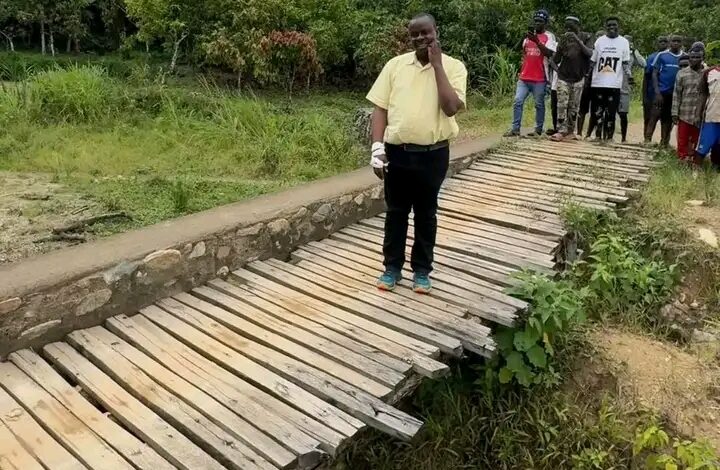
Residents told the minister that sections of the structure collapsed shortly after construction, forcing members of the community to improvise a temporary wooden bridge to enable people to cross.
The New Vision reported that residents no longer felt safe using the structure and, in some instances, preferred crossing the running water rather than risking the damaged bridge.
The contrast is difficult to ignore: a multimillion-shilling government project on one side, and a basic wooden crossing on the other.
It is precisely this disparity that has turned the Tokwe Bridge into a symbol of the wider questions surrounding accountability in local government infrastructure projects.
Balaam Demands to Know: Where Did the Money Go?
During his August 22 inspection, Balaam questioned whether Ugandans had received value for money from the project.
The minister has demanded answers about the people responsible for designing, supervising, certifying and paying for the works.
Those questions go to the heart of public procurement.
A bridge is not merely a physical structure. It represents an investment of taxpayers’ money, engineering expertise, procurement decisions and government oversight.
If the reported Shs350 million expenditure is eventually confirmed against the actual work delivered, investigators will have to establish whether the discrepancy arose from poor workmanship, weak supervision, procurement failures, inflated costs, corruption—or a combination of several factors.
It is important, however, that allegations are subjected to proper investigation and that individuals are given an opportunity to account before conclusions of criminal wrongdoing are reached.
The Wooden Bridge That Tells a Bigger Story
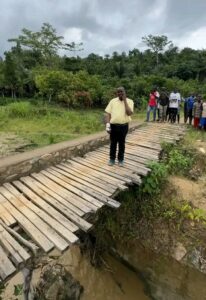
Perhaps the most powerful image emerging from the controversy is not the damaged concrete structure itself, but the wooden bridge residents constructed to replace it.
The temporary crossing illustrates what happens when public infrastructure fails: ordinary citizens are left to find their own solutions.
For rural communities, bridges are lifelines.
They connect farmers to markets, children to schools, patients to health facilities and communities to the wider economy.
When such infrastructure collapses, the cost is therefore not limited to the money allegedly lost in construction.
There is also the economic cost of delayed movement, disrupted trade, safety risks and lost confidence in public institutions.
And Tokwe Is Reportedly Not Alone
The Bundibugyo inspection revealed other troubling infrastructure concerns.
Residents reportedly took the minister to Nyampiri Bridge in Kituu Sub-county, which they said had cost Shs82 million but was also constructed without steel reinforcement.
The minister was further shown an open-drift bridge on Manjuguja Stream which residents said had cost Shs35 million but was washed away only months after construction.
According to reports, residents alleged that the drift was repeatedly reconstructed, creating concerns about whether recurring expenditure could be exposing public resources to abuse.
These claims now require detailed technical and financial scrutiny.
Balaam’s Countrywide Inspection Campaign
The Bundibugyo episode is part of a broader campaign by Balaam and the Ministry of Local Government to inspect government projects and investigate complaints about corruption, poor workmanship and failures in service delivery.
The minister has recently toured several parts of the country, including the West Nile and western regions, inspecting roads, bridges, schools, health facilities and other government-funded projects.
In Maracha District, for example, Balaam inspected the Aru Bridge and a four-kilometre road project reportedly costing Shs1.9 billion, demanding Bills of Quantities to compare the approved quantities and costs against what was physically delivered.
The Ministry of Local Government says the inspections are intended to strengthen accountability and ensure that public resources are used for their intended purposes.
Arrests and the Accountability Question
The Bundibugyo operation has already moved beyond inspection.
The Ministry of Local Government reported that the Bundibugyo Town Clerk and Commercial Officer were arrested during the anti-corruption operations, while the State House Anti-Corruption Unit was also involved in investigations.
The New Vision separately reported that Balaam ordered the arrest of the district engineer and town clerk to answer questions concerning the allegations surrounding the infrastructure projects.
The arrests should not, however, be interpreted as proof of guilt. They represent part of an investigative process, with the relevant authorities expected to establish the facts and allow due process to take its course.
A Necessary Debate About Value for Money
The Tokwe Bridge controversy raises a broader question for Uganda’s decentralised system of government:
Who watches the money after it leaves the Treasury and reaches the district?
Government allocates billions of shillings to local governments for roads, bridges, schools, health facilities and other public services.
Yet the effectiveness of those investments ultimately depends on procurement, engineering standards, supervision, certification, payment and monitoring.
A project can therefore fail long before a bridge collapses.
It can fail at the planning stage.
It can fail during procurement.
It can fail when materials are substituted.
It can fail when supervision is compromised.
And it can fail when officials certify work that does not meet the required standards.
Balaam’s Campaign Faces an Even Bigger Test
The minister’s inspections have generated considerable public interest because they take accountability out of offices and put government projects under direct physical scrutiny.
But exposing questionable projects is only the beginning.
Ugandans will ultimately want to know what happens after the cameras leave.
Will investigations lead to prosecutions where evidence supports them?
Will public funds be recovered?
Will contractors responsible for defective work be held accountable?
Will engineers and officials who approved substandard projects face appropriate professional or administrative action?
And, perhaps most importantly, will the affected communities eventually receive infrastructure that is safe and fit for purpose?
These questions will determine whether the anti-corruption inspections become a lasting accountability mechanism or simply another round of public exposés.
The Bridge Is Broken—But the Accountability Must Not Be
The image of a Shs350 million bridge reportedly reduced to ruins while residents rely on a wooden crossing is more than an infrastructure story.
It is a story about public trust.
Every shilling spent on a government project comes from citizens, directly or indirectly. When infrastructure fails prematurely, the public is entitled to ask what happened to the money and who was responsible for ensuring that the project met the required standards.
Minister Balaam’s nationwide campaign has placed those questions firmly on the table.
Now, the responsibility lies with investigators, engineers, auditors, procurement authorities and the courts—where necessary—to establish the facts.
For the people of Bundibugyo, however, the most immediate demand remains simple:
Give them a bridge that works.
And for Uganda’s taxpayers, the larger demand is equally straightforward:
Let every public shilling deliver public value.
#UgandaToday #BalaamBarugahara #ExposeTheCorrupt #AntiCorruption #Bundibugyo #TokweBridge #Shs350Million #ValueForMoney #PublicFunds #Accountability #Uganda #LocalGovernment #ServiceDelivery #FightingCorruption #PhoenixNews #OperaNewsFeeds #bit.ly/3REw5gR