How Vietnam’s Gravity-Fed Urban Farms Are Redefining Sustainable Food Production
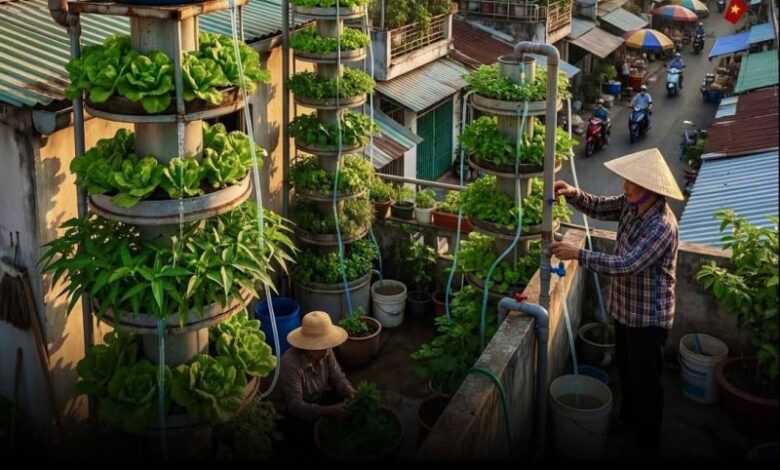
+256 702 23 93 37: Rainwater is collected from rooftops and stored in elevated barrels or tanks. Instead of using electric pumps, the water naturally flows downward through a network of pipes, irrigating vegetables planted in vertically stacked containers.


UgandaToday: How Vietnam’s Gravity-Fed Urban Farms Are Redefining Sustainable Food Production
By UgandaToday
As cities around the world grapple with shrinking agricultural land, rapid urbanisation and the growing impacts of climate change, Vietnam is showcasing an innovative approach that could inspire sustainable food production far beyond its borders.
Across several Vietnamese cities, urban farmers are embracing vertical farming towers that use gravity-fed irrigation systems powered by harvested rainwater, enabling them to grow vegetables efficiently without relying on electricity or water pumps.
The low-cost, environmentally friendly approach is increasingly attracting attention as governments and urban planners search for practical ways to strengthen food security while reducing pressure on natural resources.
Harnessing Gravity Instead of Electricity
At the heart of the innovation is a remarkably simple concept.
Rainwater is collected from rooftops and stored in elevated barrels or tanks. Instead of using electric pumps, the water naturally flows downward through a network of pipes, irrigating vegetables planted in vertically stacked containers.
The system requires little energy, reduces operating costs and makes efficient use of every drop of harvested rainwater.
For many households, it also offers a dependable source of irrigation during periods of water scarcity while lowering monthly utility expenses.
Turning Rooftops into Productive Farms
With urban land becoming increasingly scarce, Vietnamese growers are transforming rooftops, balconies and other small spaces into productive gardens.
By arranging crops vertically rather than horizontally, families can cultivate leafy vegetables, herbs and other produce within a surprisingly small footprint.
Beyond supplying fresh food, these rooftop gardens help cool buildings, improve air quality and introduce much-needed greenery into densely populated neighbourhoods.
Supporting Climate Resilience
Climate experts continue to warn that changing rainfall patterns, rising temperatures and expanding cities pose growing risks to global food production.
Nature-based solutions such as gravity-fed irrigation offer an adaptable response by combining traditional water conservation practices with modern urban farming techniques.
Because the systems rely on harvested rainwater and require minimal infrastructure, they remain accessible to households with limited financial resources while reducing greenhouse gas emissions associated with conventional irrigation methods.
Lessons for Uganda’s Growing Cities
The Vietnamese experience offers valuable insights for rapidly expanding urban centres such as Kampala, Wakiso, Mukono and Mbarara.
Uganda receives substantial seasonal rainfall that often goes underutilised. Rooftop rainwater harvesting combined with vertical gardening could enable households, schools and community organisations to grow vegetables throughout much of the year while reducing dependence on expensive irrigation systems.
Such initiatives could also contribute to improved household nutrition, lower food costs and greener urban environments.
Simple Innovations with Big Impact
The success of Vietnam’s gravity-fed urban farming towers demonstrates that groundbreaking innovation does not always depend on sophisticated technology.
Sometimes, practical solutions rooted in efficient design and sustainable resource management can deliver significant environmental, economic and social benefits.
As cities continue to expand worldwide, integrating food production into urban landscapes may become an increasingly important strategy for enhancing resilience, conserving water and building healthier communities.
Editorial Note: The widely shared image accompanying this story is illustrative of the concept. While gravity-fed rainwater irrigation and rooftop urban farming are established sustainable practices used in Vietnam, readers should note that individual viral images may be enhanced, staged or AI-generated, and should not be treated as documentary evidence of a specific installation.