Africa Built Europe: Why The Continent Remains Central To Europe’s Prosperity
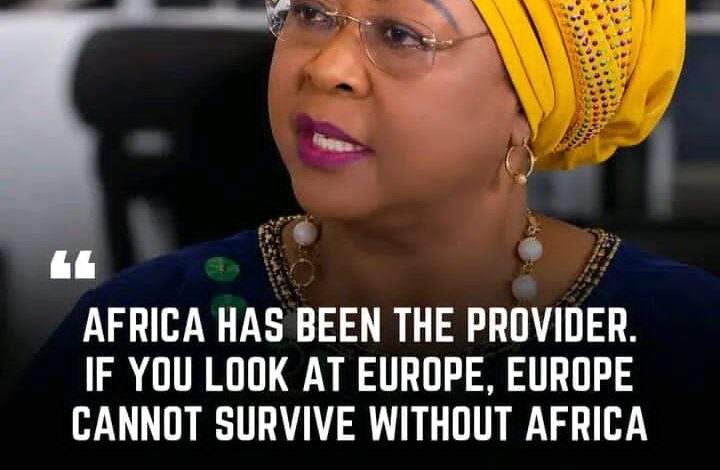
+256 702 23 93 37: This article draws on the arguments of Dr Arikana Chihombori-Quao, a prominent Pan-African advocate and former African Union Ambassador to the United States, who has consistently challenged the historical and contemporary economic relationship between Africa and Europe.

UgandaToday: Africa Built Europe: Why The Continent Remains Central To Europe’s Prosperity
Uganda Today | International Affairs, History & Business
The assertion that Europe’s development cannot be separated from Africa’s resources, labour and economic contribution is more than a political slogan. It raises a fundamental question about the history of global economic development: How much of Europe’s prosperity has been built through its relationship with Africa, and why does the continent remain indispensable to Europe’s future?
This article draws on the arguments of Dr Arikana Chihombori-Quao, a prominent Pan-African advocate and former African Union Ambassador to the United States, who has consistently challenged the historical and contemporary economic relationship between Africa and Europe.
Her argument deserves serious consideration—not simply as a question of historical injustice, but as a debate about the future of global trade, industrialisation and Africa’s economic sovereignty.
Africa’s Resources And The Foundations Of European Industrialisation
The historical relationship between Africa and Europe is inseparable from the transatlantic slave trade, colonialism and the extraction of natural resources.

For centuries, millions of Africans were forcibly taken to the Americas, where their labour helped sustain plantation economies producing sugar, cotton, tobacco and other commodities traded in European markets. The wealth generated through slavery, colonial commerce and imperial expansion contributed to the accumulation of capital that supported European economic development.
Africa’s contribution, however, was not limited to forced labour.
The continent supplied gold, copper, diamonds, rubber, cocoa, cotton, coffee and other valuable commodities. European industries and trading networks benefited from access to these resources, while African economies were frequently reorganised to serve external markets.
In his landmark work, How Europe Underdeveloped Africa, Guyanese historian Walter Rodney argued that Europe’s economic advancement was closely linked to the exploitation and underdevelopment of African societies.
Modern scholarship continues to examine these historical connections. A 2020 review published in the Journal of Economic Literature identified lasting effects of colonial institutions, extractive arrangements and the partition of Africa on the continent’s economic and political development.
The transatlantic slave trade, colonial-era African mining and the Berlin Conference. These visuals illustrate the historical relationship between Africa’s resources and European expansion.
The Colonial Economy: Africa As A Supplier, Europe As A Manufacturer
The colonial period entrenched a system in which African territories were primarily producers of raw materials, while Europe increasingly became the centre of industrial manufacturing and high-value processing.
Railways, ports and other infrastructure were often developed to connect mines and agricultural production zones to export routes. In many cases, these investments served extraction and trade rather than the creation of integrated African industrial economies.

Uganda provides an important example.
Under British colonial rule, cotton and coffee became major export crops. Agricultural production was linked to overseas markets, while processing, manufacturing and commercial decision-making remained heavily influenced by external interests.
The pattern was not uniform across the continent. Some African societies developed industries, participated in international commerce and negotiated opportunities within colonial economies. Nevertheless, the broader economic structure often favoured the export of primary commodities and the importation of finished goods.
This imbalance is central to the argument made by Dr Chihombori-Quao.
In a public discussion hosted by the UCLA International Institute, she criticised the design of colonial infrastructure, arguing that roads and railways were frequently built to move resources from extraction sites to ports for shipment to Europe. She challenged European countries to account for their historical role in Africa’s development.
Europe’s Modern Economy Still Needs Africa
The argument that Africa remains indispensable to Europe is not confined to history.
Today, Africa supplies commodities that are important to European manufacturing, energy security, agriculture and technological development.

The Democratic Republic of Congo is a major global source of cobalt, a mineral used in many rechargeable batteries. South Africa is a significant producer of platinum-group metals, which are important in industrial applications and some clean-energy technologies. Other African countries supply manganese, graphite, lithium, copper and other minerals increasingly sought after by manufacturers.
These resources are particularly important as Europe pursues its energy transition, expands electric mobility and seeks to strengthen its technological and industrial competitiveness.
The European Union’s own trade figures underline the importance of the relationship.
According to the European Council, EU-Africa trade in goods reached approximately €355 billion in 2024. European imports from Africa amounted to €189.5 billion, while exports to Africa totalled €165.2 billion. Trade in services exceeded €110 billion.
The figures demonstrate that Africa is not merely a recipient of European development assistance. It is also a major trading partner, supplier of strategic commodities and an important market for European businesses.
Suggested images: Cobalt and copper mining in the DRC, platinum production in South Africa and lithium extraction in Africa. Captions should identify the actual country and mine shown.
The Green Transition: Africa’s New Strategic Importance
Europe’s pursuit of a low-carbon economy has created a new dimension to its relationship with Africa.
Electric vehicles, wind turbines, solar panels, batteries and advanced electronics require minerals that are abundant in several African countries. As European governments seek to reduce dependence on fossil fuels and strengthen supply chains, Africa’s resource base has become increasingly strategic.
This creates a significant opportunity for African economies.
However, the central question is whether Africa will continue exporting raw minerals while importing expensive finished products, or whether it will become an industrial partner capable of processing its own resources.
A 2023 study published in MRS Bulletin argued that Africa’s transition from raw material exports to mineral value addition is essential for sustainable development. The study identified energy, finance, markets and skills as key challenges facing the continent’s industrialisation ambitions.
For Uganda, this debate has practical implications. The country’s mineral potential, agricultural production, renewable energy resources and strategic position within the East African Community could support a stronger industrial economy if investment is directed towards processing, manufacturing and skills development.
The development of Africa’s industrial capacity would also create opportunities for European companies seeking reliable suppliers, new markets and investment partnerships.
Africa Must Move Beyond Supplying Europe
Perhaps the most important aspect of Dr Chihombori-Quao’s argument is that Africa should not measure its economic success solely by the volume of resources it exports.

The continent must increasingly become a producer of finished goods, technology and industrial services.
Instead of exporting unprocessed cocoa, African countries should manufacture more chocolate. Instead of exporting raw minerals, they should develop refining and manufacturing capacity. Instead of exporting agricultural produce at low prices, they should invest in food processing and packaging.
This requires stronger regional integration.
The African Continental Free Trade Area (AfCFTA) offers an opportunity to create a larger market for African-manufactured goods, encourage cross-border investment and reduce dependence on fragmented national economies.

Africa must also address challenges within its own borders, including political instability, corruption, inadequate infrastructure, unreliable electricity, limited industrial financing and inconsistent policies.
The responsibility for Africa’s development cannot be placed entirely on Europe. African governments, businesses and institutions must create conditions that enable the continent to benefit from its resources.
A Partnership Of Equals, Not Dependence
Europe’s development has been shaped by centuries of interaction with Africa, including slavery, colonialism, resource extraction and trade. These historical connections are well documented, although the precise contribution of Africa to Europe’s overall industrialisation remains a subject of scholarly debate.

It would be an overstatement to suggest that Europe could not survive in any form without Africa. Europe possesses its own resources, industries, technology and economic capabilities.
However, it is equally misleading to dismiss Africa’s contribution to Europe’s development or its continuing strategic importance.
The modern relationship between the two continents is one of substantial economic interdependence. Europe needs African markets, commodities and strategic resources. Africa needs investment, technology, industrial partnerships and access to international markets.
The challenge is to ensure that this interdependence produces mutual prosperity rather than reproducing the inequalities of the past.
For Africa, the message is clear: the continent’s future should not be defined by what it supplies to Europe, but by what it can build from its own resources.
As Dr Chihombori-Quao’s argument suggests, Africa’s wealth has long helped sustain economies beyond its borders. The next chapter must be about ensuring that African people themselves become the principal beneficiaries of that wealth.
Caption: African commodities continue to move through international shipping networks linking the continent to European markets. The challenge for African economies is to capture more value through local processing and manufacturing.
#AfricaAndEurope #AfricaRising #PanAfricanism #AfricanIndustrialisation #AfricaEconomicDevelopment #UgandaToday