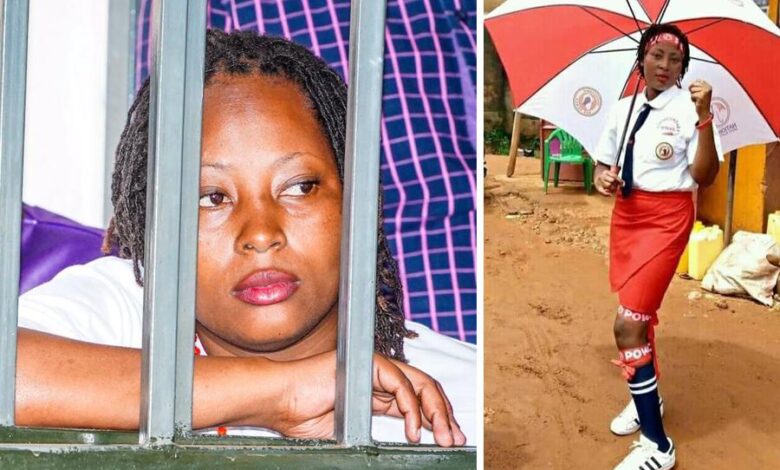
Olivia Lutaaya Released Again: Five Years Of Arrests, Detention And A Political Struggle That Refuses To Die
+256 702 23 93 37: Lutaaya, whose political journey has been marked by repeated arrests, prolonged detention, a controversial military court conviction and a subsequent presidential pardon, walked out of prison on Friday, October 30, 2026. But perhaps the most striking aspect of her release was not simply her return to freedom. It was her declaration that imprisonment had not changed her political convictions or loyalty to NUP president Robert Kyagulanyi Ssentamu, popularly known as Bobi Wine.

UgandaToday: Olivia Lutaaya Released Again: Five Years Of Arrests, Detention And A Political Struggle That Refuses To Die
Open X link below and watch tel conversation of Kyagulanyi welcoming Olivia Lutaaya from political detention
https://x.com/uganda43443/status/2116216368647557544/video/1?t=20
Uganda Today | Politics & Human Rights
By Uganda Today Reporter
The release of National Unity Platform (NUP) supporter Olivia Lutaaya from prison has once again brought Uganda’s treatment of opposition supporters, political freedoms and the administration of justice into the national spotlight.
Lutaaya, whose political journey has been marked by repeated arrests, prolonged detention, a controversial military court conviction and a subsequent presidential pardon, walked out of prison on Friday, October 30, 2026.
But perhaps the most striking aspect of her release was not simply her return to freedom. It was her declaration that imprisonment had not changed her political convictions or loyalty to NUP president Robert Kyagulanyi Ssentamu, popularly known as Bobi Wine.
Speaking shortly after her release at the NUP headquarters in Makerere-Kavule, Kampala, Lutaaya made it clear that she had no intention of denouncing her political leader.
“I will not denounce my leader with whom we were on that day. I belong to the NUP and all the charges brought against me were about NUP,” she declared.
Her statement was a powerful response to a political and legal ordeal that has stretched across almost six years, with two major periods of imprisonment and a series of allegations that have attracted considerable public attention.
The 2020 Arrest That Changed Her Life
Lutaaya’s troubles with the authorities began during the heated political atmosphere surrounding the 2021 presidential elections.

On December 30, 2020, she was arrested in Kalangala District alongside other NUP supporters during Bobi Wine’s presidential campaign activities.
The security operation resulted in the arrest of several opposition supporters, including individuals associated with Kyagulanyi’s campaign team.
She was subsequently accused of involvement in activities that security agencies associated with threats to national security. She was reportedly released in February 2021.
However, her freedom was short-lived.
On May 8, 2021, she was arrested again under circumstances she would later describe as frightening and humiliating.
In an interview with Daily Monitor in December 2024, Lutaaya recounted how individuals who initially contacted her under the pretext of investigating a theft involving a boda boda rider eventually took her into custody.
She said she was moved between different locations, including a safe house in Bukoto, where she encountered other detainees.
According to her account, she later discovered that her name was associated with terrorism investigations.
Her account raised troubling questions about the use of unofficial detention facilities and the treatment of individuals arrested in connection with political activities.
From Safe Houses To The General Court Martial
Following her arrest in May 2021, Lutaaya was transferred through different detention facilities, including the Special Investigations Unit in Kireka, before being held at Kigo and Luzira prisons.
She was eventually charged alongside other NUP supporters before the General Court Martial in Makindye.
The prosecution accused the group of treachery and unlawful possession of ammunition and explosives. Authorities alleged that the suspects were connected to plans involving explosive devices and attacks on government installations.
Lutaaya consistently disputed the allegations in her public account of the events.
Her detention became a subject of public debate, particularly among human rights advocates and opposition politicians who questioned why civilians were being prosecuted before military courts.
In September 2023, Daily Monitor published a special report titled Olivia Lutaaya: A Criminal Or Prisoner Of Conscience?, highlighting the circumstances surrounding her detention and the controversy over trying civilians in military courts.
Her case became emblematic of the wider debate about the independence of the justice system, the rights of political activists and the boundaries between national security enforcement and political freedoms.
The 2024 Confession: Freedom At A Heavy Price
One of the most disturbing chapters in Lutaaya’s story emerged in October 2024, when she and other NUP supporters changed their pleas and admitted offences before the General Court Martial.
After approximately 40 months in detention, the accused pleaded guilty to charges including treachery and unlawful possession of explosives.
They were subsequently sentenced to five years’ imprisonment, with the period already spent on remand taken into account.
However, Lutaaya later told journalists that the decision to plead guilty was driven by desperation and the desire to regain freedom after years behind bars.
In an interview published by Daily Monitor on November 26, 2024, she described how she and her colleagues allegedly felt compelled to admit offences they maintained they had not committed.
Her account raised serious questions about whether prolonged detention can undermine an accused person’s ability to make a genuinely voluntary decision when entering a guilty plea.
The government, on its part, maintained that the accused had faced legitimate criminal charges and that their release followed the established presidential pardon process.
On November 22, 2024, President Yoweri Museveni exercised his constitutional prerogative of mercy and pardoned Lutaaya and 18 other NUP supporters.
They subsequently walked out of prison, ending a lengthy period of incarceration.
Freedom Was Short-Lived: Arrested Again In 2025
For Lutaaya, the presidential pardon did not mark the end of her encounters with the criminal justice system.
On November 7, 2025, she was arrested in Mbarara during Bobi Wine’s presidential campaign activities in Bwizibwera.
The arrest followed security operations and clashes involving NUP supporters during the campaign.
She was subsequently charged before the Kanyanya Magistrate’s Court in connection with alleged unlawful military drilling.
The charges related to a parade held at NUP’s Makerere-Kavule headquarters on February 12, 2025, to celebrate Bobi Wine’s birthday.
Prosecution alleged that Lutaaya and other party members participated in military-style exercises without authorisation from the Minister of Internal Affairs. She also faced allegations concerning attire resembling security uniforms.
She was remanded to Luzira Prison.
Her lawyers raised concerns about her treatment during arrest, with reports indicating that they wanted her examined by a private doctor after she complained of pain. The prosecution and court proceedings also generated debate about access to medical attention for detained suspects.
The fresh arrest was particularly controversial because it came less than a year after her release through a presidential pardon.
October 30, 2026: Olivia Walks Free Again
On Friday, October 30, 2026, Lutaaya was finally released from prison following another admission of charges relating to unlawful drilling.
According to reports published by Pulse Uganda, she confirmed that her release came without conditions and that she had no intention of abandoning her political allegiance to NUP.
Her return to Makerere-Kavule was welcomed by party officials, including Secretary General David Lewis Rubongoya.
Rubongoya described her as someone who had paid an enormous price for her political beliefs.
In a statement welcoming her back, he observed that, out of NUP’s six years of existence, Lutaaya had spent approximately five years in detention at different times.
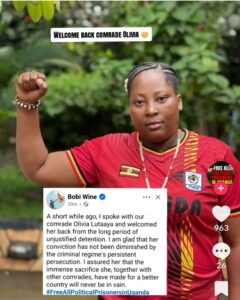
NUP president Bobi Wine also welcomed her release, describing her imprisonment as unjustified and praising her determination to remain committed to what she believes in.
Her release came a day after two other NUP members, Kato Paul and Kadonya, were reportedly released after approximately ten months in detention over related unlawful drilling charges.
Lutaaya used her first public appearance to appeal for the release of her co-accused who have denied the allegations.
She argued that those who were not involved in the activities giving rise to the charges should not continue suffering imprisonment.
A Mother’s Political Journey And The Human Cost Of Detention
Beyond the political controversies, Lutaaya’s story is also one of a mother whose family life was profoundly affected by prolonged imprisonment.
Before becoming politically active, she operated a small cosmetics business in Namuwongo, Kampala.
Her involvement in politics, according to her December 2024 interview with Daily Monitor, was partly influenced by her experience seeking medical assistance for her sick son in 2019.
She recounted how difficulties accessing treatment and meeting medical expenses made her question the state of public healthcare and eventually encouraged her to take an interest in political affairs.
She became involved in the People Power movement, which subsequently evolved into the National Unity Platform.
During her years in detention, she also experienced the loss of people close to her, including a local community leader who had influenced her political awakening.
Her experiences illustrate how prolonged imprisonment can affect not only the individual detainee but also children, families and communities.
What Does Olivia Lutaaya’s Story Say About Uganda’s Democracy?
Lutaaya’s release should be welcomed as an opportunity to reflect on the importance of constitutional freedoms, due process and the protection of citizens’ political rights.
Her case raises difficult questions that Uganda cannot afford to ignore.
Why should a citizen’s political participation repeatedly result in prolonged encounters with the criminal justice system?
How should the state balance legitimate national security concerns with the constitutional rights of citizens to associate, assemble and participate in political activities?
And what safeguards exist to ensure that prolonged detention does not become an instrument of punishment before a final determination of guilt?
It is important to acknowledge that criminal allegations must be investigated and prosecuted where sufficient evidence exists. Political affiliation does not place anyone above the law.
Equally, belonging to an opposition political party should never make someone vulnerable to arbitrary arrest, intimidation, unfair treatment or punishment for exercising constitutionally protected freedoms.
Lutaaya’s case has also revived debate about the prosecution of civilians before military courts, particularly following the Constitutional Court’s February 2025 judgment concerning the trial of civilians by military courts.
The broader issue is not whether Uganda should enforce its laws. It is whether those laws are applied fairly, consistently and without political discrimination.
Freedom Must Mean More Than Walking Out Of Prison
As Olivia Lutaaya returns to her family and political community, Uganda must confront the larger questions raised by her experiences.
Her story is not simply about the release of one NUP supporter. It is about the relationship between citizens and the state, the independence of institutions, the protection of human rights and the meaning of political freedom.
The fact that she has emerged from prison still declaring allegiance to the political movement that brought her into the public spotlight makes her release particularly significant.
For her, freedom has come twice, following two different legal battles.
The real test now is whether that freedom will be respected and whether other Ugandans, regardless of their political affiliation, can exercise their constitutional rights without fear.
Olivia Lutaaya is free again. But the questions surrounding her years of detention remain very much alive.
#OliviaLutaaya #BobiWine #NUP #UgandaHumanRights #PoliticalFreedom #UgandaToday