Uganda’s Anti-Corruption Crusade: Minister Balaam’s Hospital Raid Sparks Debate Over Justice, Accountability
+256 702 23 93 37 Watch video Dr. Baluku being put on handcuffs

UgandaToday: Uganda’s Anti-Corruption Crusade: Minister Balaam’s Hospital Raid Sparks Debate Over Justice, Accountability
By Uganda Today News Desk
Uganda’s renewed campaign against corruption has taken a dramatic turn following the arrest of a doctor at Kiryandongo General Hospital over allegations that he demanded money from a patient to facilitate a medical procedure. The incident has ignited a national debate about public-sector accountability, access to free healthcare and the limits of ministerial intervention in law enforcement.
The operation, associated with Minister of Local Government Dr Balaam Barugahara Ateenyi, has drawn attention to the government’s determination to confront alleged corruption in public institutions. However, the decision to have a doctor arrested in the operating theatre has also raised difficult questions about patient safety, the presumption of innocence and the proper procedures for investigating suspected offenders.
The controversy comes as the government intensifies its nationwide anti-corruption campaign, encouraging citizens to report suspected abuse of public resources and failures in service delivery.
The Kiryandongo Hospital Incident
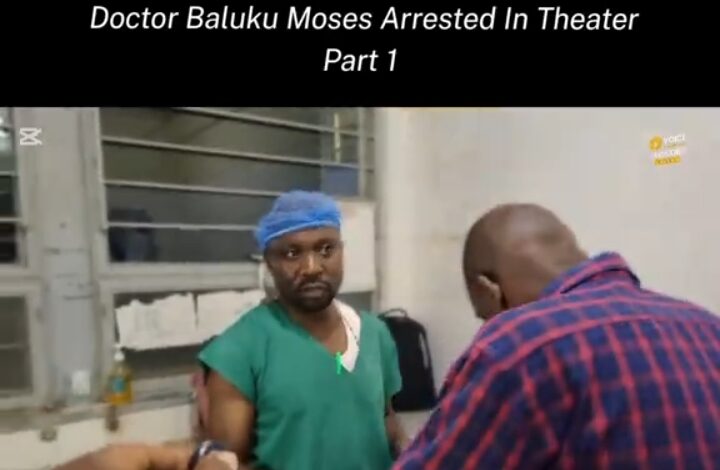
A video circulating online shows a confrontation involving a medical doctor in surgical clothing at Kiryandongo General Hospital. The footage, carrying an on-screen description identifying the incident as an arrest at the hospital’s theatre, shows the doctor engaging with a man in a checked shirt while other medical personnel remain nearby.
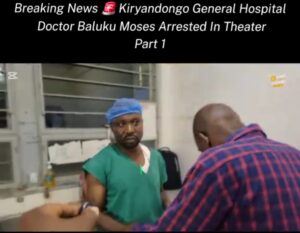
The doctor has been identified in media reports as Dr Baluku Moses. He was reportedly arrested over allegations that he demanded Shs150,000 from a patient to facilitate a medical procedure.
The allegation is particularly serious because public hospitals are expected to provide essential services without patients being subjected to unofficial payments for treatment that should be available through the public health system.
However, the alleged payment, the circumstances in which it was demanded and whether the doctor committed a criminal offence must be established through a proper investigation.
The footage also raises questions about the circumstances surrounding the arrest, including whether the procedure was still underway, what arrangements were made for the patient’s safety and whether the medical team had an opportunity to ensure continuity of care.
These are important questions because an anti-corruption operation in a hospital involves not only the rights of the suspect but also the safety of a patient who may be undergoing a life-saving intervention.
Why The Allegations Matter
Alleged extortion in public hospitals is not simply an administrative problem. It can become a matter of life and death when patients or their relatives are unable to raise money demanded before treatment is provided.
Families who turn to government hospitals frequently do so because private healthcare is beyond their financial means. A demand for unofficial payment can therefore create a devastating choice between paying money they do not have and risking a delay in treatment.
A report published by Uganda Radio Network on October 8, 2026, detailed allegations of extortion, the sale of government medicines and other misconduct at Kiryandongo General Hospital. The report said patients had complained of being charged for services including X-rays and scans, while allegations were also raised about payments demanded for mortuary services.
The State House Anti-Corruption Unit was directed to investigate the complaints. Hospital management had not responded to the allegations by the time of that report. These remain allegations requiring verification, rather than proof that every member of staff at the facility is involved in misconduct.
The latest incident has consequently intensified scrutiny of the hospital and renewed calls for stronger oversight of public health services.
Balaam’s Wider Campaign Against Corruption
The Kiryandongo operation forms part of a broader campaign led by Balaam Barugahara, who was appointed Minister of Local Government in 2026.
Working with the State House Anti-Corruption Unit and other government institutions, the minister has undertaken visits to districts and public facilities to receive complaints, inspect service delivery and demand explanations from officials.
The campaign has focused on alleged corruption in local governments, including irregular procurement, recruitment irregularities, absenteeism, misuse of public funds, questionable allocation of public resources and failures in the implementation of government programmes.
The approach seeks to bypass administrative barriers that can prevent citizens’ complaints from reaching the authorities responsible for investigating them.
During public meetings, commonly referred to as accountability barazas, residents have been encouraged to speak directly to government representatives about alleged wrongdoing in their communities.
The Ministry of Local Government has also reported investigations into allegations of jobs being sold, stalled public projects, questionable expenditure and irregularities in the management of public facilities.
In August 2026, the Daily Monitor reported that 110 local government staff were facing disciplinary action following inspections under the anti-corruption campaign. The reported concerns included alleged ghost beneficiaries, absenteeism, procurement irregularities and misuse of public funds.
The scale of the reported investigations illustrates the extent of the accountability challenge facing local government institutions, although disciplinary action and arrest must not be confused with a final determination of criminal guilt.
Arrests, Investigations And The Question Of Due Process
While the minister’s approach has attracted support from citizens frustrated by alleged corruption, it has also generated concern about the methods used to identify, confront and apprehend suspects.
On October 13, 2026, Business Focus reported that Inspector General of Government Aisha Naluzze had criticised aspects of the minister’s anti-corruption operations, particularly the risk of treating suspects as guilty before the relevant legal processes had established their culpability.
The criticism brings an important constitutional principle into the debate: a person accused of an offence is presumed innocent until proved guilty according to law.
The minister’s supporters may argue that forceful interventions are necessary to overcome entrenched corruption and demonstrate that public officials can no longer act with impunity. Critics, however, can reasonably question whether public confrontations and dramatic arrests are always the most effective way to secure evidence and deliver justice.
The two objectives need not be mutually exclusive. Uganda can pursue a vigorous anti-corruption campaign while ensuring that investigations are evidence-based, arrests are lawful and suspects receive fair treatment.
The distinction is particularly important in cases involving professionals whose immediate responsibilities include the safety and welfare of other people.
What Does The Law Say About A Doctor Arrested In Theatre?
The arrest of a doctor in a clinical environment presents a more complex situation than the apprehension of a suspect in an ordinary public setting.
If investigators have credible evidence that a medical professional demanded an unlawful payment, they have a legitimate responsibility to investigate and, where legally justified, take appropriate action.
However, the operation must also account for the patient’s condition. Where a surgical procedure is in progress, the immediate priority must be to ensure that the patient is not abandoned or exposed to avoidable medical risk.
The relevant authorities should establish whether the arrest was conducted under lawful authority, whether the patient received uninterrupted care and whether any necessary handover to another qualified medical professional was arranged.
The video alone cannot establish all these facts.
Nor does the footage independently prove that the doctor received a bribe, that the alleged payment was unlawful in the circumstances, or that every required arrest procedure was followed.
A transparent investigation should therefore address both the alleged extortion and the manner in which the arrest was executed.
The Government’s Campaign Must Produce Lasting Results
The effectiveness of the anti-corruption drive should ultimately be measured by more than the number of suspects arrested or the dramatic nature of ministerial inspections.
The more meaningful indicators are whether stolen public funds are recovered, prosecutions are supported by credible evidence, public services improve and citizens can obtain essential services without being subjected to unofficial charges.
In a statement reported by Uganda Broadcasting Corporation on October 7, 2026, the State House Anti-Corruption Unit said the nationwide campaign had resulted in 267 arrests, 253 officials being interdicted and nearly 40 accused persons being brought before court.
The unit also reported that Shs22.7 billion was linked to corruption-related complaints and cases under investigation. It cautioned that the amount should not be interpreted as money conclusively established to have been stolen or lost.
That distinction is essential. Arrests, interdictions and suspected financial irregularities are important stages in accountability efforts, but they are not substitutes for completed investigations, fair hearings and proven outcomes.
The government must also address the institutional weaknesses that enable corruption to persist. These include inadequate supervision, weak internal controls, shortages of essential supplies, poor complaint-handling systems and the potential abuse of discretionary authority.
In public hospitals, accountability must go hand in hand with reliable funding, adequate staffing, essential medicines and equipment, and accessible channels through which patients can report demands for unofficial payments.
Protecting Patients While Fighting Corruption
The Kiryandongo incident presents a test of whether Uganda can confront alleged corruption without compromising the very public services that citizens depend on.
If a medical worker unlawfully demands money before providing essential treatment, the allegations deserve serious investigation and appropriate action where wrongdoing is established.
Equally, a patient undergoing surgery must never become an unintended casualty of an enforcement operation. Medical continuity and patient safety must remain central to any intervention at a health facility.
The Ministry of Health, hospital administrators, police, prosecutors and anti-corruption agencies should work together to establish clear procedures for handling suspected offences in clinical settings. Such procedures should allow investigators to preserve evidence and hold suspects accountable while ensuring that patients continue receiving necessary care.
The public also needs clear information about the outcome of the investigation into Dr Baluku Moses, including whether charges are brought, whether the allegations are substantiated and what corrective measures are taken at the hospital.
A Defining Moment For Accountability
Minister Balaam Barugahara’s campaign has placed local government accountability firmly in the public spotlight. Its willingness to confront complaints directly and demand answers from public officials reflects the urgency of addressing corruption that undermines service delivery.
But the campaign’s credibility will depend on whether it combines determination with restraint, transparency and respect for the law.
The Kiryandongo hospital case therefore raises a question larger than the fate of one doctor: can Uganda build an anti-corruption system that is feared by wrongdoers, trusted by ordinary citizens and fair to those accused of offences?
The answer will depend not on the spectacle of an arrest, but on the quality of the evidence, the fairness of the process, the protection of patients and the eventual results.
For Ugandans seeking affordable healthcare and honest public service, the ultimate measure of success will be a system in which patients receive appropriate treatment without unlawful demands for money—and in which anyone accused of wrongdoing is investigated and held accountable through lawful procedures.
Editorial note: The allegations against Dr Baluku Moses and other individuals mentioned in connection with the hospital investigation should be treated as allegations unless and until established by competent authorities. The minister’s actions and the circumstances of the arrest warrant independent scrutiny alongside the underlying corruption allegations.