Nantabulirirwa Yasabala Bwa Bbumba: Did Uganda Ignore The Economic Warning That Could Cost It Dearly?
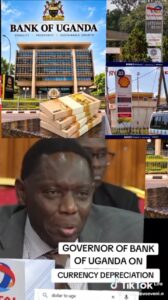
+256 702 23 93 37: Watch Bank of Uganda Governor Dr Michael Atingi-Ego's presentation to parliamentary committees on April 28, 2026, as he explains the potential implications of the original Protection of Sovereignty Bill for foreign-exchange inflows, the balance of payments, the Uganda shilling and domestic price stability.


UgandaToday: Nantabulirirwa Yasabala Bwa Bbumba: Did Uganda Ignore The Economic Warning That Could Cost It Dearly?
As the Shilling Slides, Import Costs Rise And Inflation Edges Up, Bank Of Uganda Governor Michael Atingi-Ego’s Warning On The Sovereignty Bill Deserves Renewed National Attention
By UgandaToday Editorial Desk
Watch Bank of Uganda Governor Dr Michael Atingi-Ego’s presentation to parliamentary committees on April 28, 2026, as he explains the potential implications of the original Protection of Sovereignty Bill for foreign-exchange inflows, the balance of payments, the Uganda shilling and domestic price stability.
“A country without reserves is not sovereign.”
In April 2026, Uganda’s central bank sounded a warning about the possible economic consequences of the proposed sovereignty legislation. Months later, as the shilling faces renewed pressure, UgandaToday revisits the Governor’s remarks and examines the relationship between foreign-exchange supply, currency depreciation and the cost of living.
KAMPALA, UGANDA — There is an old Luganda proverb that carries a powerful lesson for individuals, institutions and nations: “Nantabulirirwa yasabala bwa Bbumba.”
Literally translated, it means that one who refuses to heed advice sets sail in a boat made of clay. Such a vessel may appear capable of carrying its passenger at first, but water will eventually weaken it, leaving the traveller exposed to danger.
It is a proverb about the consequences of ignoring warnings, the fragility of poor decisions and the price of discovering too late that a seemingly strong foundation cannot withstand the forces working against it.
Today, as Ugandans contend with a weakening shilling, rising costs and renewed anxiety about the cost of living, the proverb offers a compelling lens through which to revisit a warning delivered by Bank of Uganda Governor Dr Michael Atingi-Ego to Parliament in April 2026.
During his appearance before parliamentary committees examining the proposed Protection of Sovereignty Bill, the Governor cautioned that provisions in the legislation, as originally presented, could disrupt foreign financial inflows, undermine the country’s balance of payments, weaken the Uganda shilling and ultimately push domestic prices upwards.
Parliament subsequently passed the Bill on May 5, 2026, after adopting amendments that narrowed its scope and removed several controversial provisions. The central economic question, however, remains relevant: how should Uganda protect its national interests without undermining the financial flows, investor confidence and economic relationships on which its stability depends?
The Governor’s warning was not a declaration that economic disaster was inevitable. It was an assessment of identifiable risks that policymakers needed to consider before making decisions with potentially far-reaching consequences.
With the shilling now facing renewed pressure, those warnings deserve careful examination.
The Warning From The Central Bank
On April 28, 2026, Dr Atingi-Ego appeared before the joint parliamentary committees on Legal and Parliamentary Affairs and Defence and Internal Affairs to present the central bank’s assessment of the proposed legislation.
The Bank of Uganda expressed concern that provisions in the original Bill could interfere with cross-border financial flows, including foreign investment, remittances and portfolio capital. These flows are important to Uganda’s foreign-exchange supply and its ability to finance payments to the rest of the world.
The Governor’s central argument was that sovereignty cannot be separated from economic resilience.
As reported by Parliament, he warned: “A country without reserves is not sovereign.”
The point was fundamental. A country may seek to strengthen its independence through legislation, but it also requires adequate foreign-exchange reserves, a functioning financial system and the ability to meet international obligations.
Uganda imports fuel, machinery, industrial inputs, medicines and other essential commodities. Importers generally need foreign currency to pay international suppliers. Export earnings, foreign investment, tourism receipts and remittances help replenish the country’s foreign-exchange supply.
If significant inflows are disrupted while demand for dollars remains strong, pressure on the domestic currency can intensify.
A weaker shilling then makes imported goods more expensive in local-currency terms, potentially transmitting exchange-rate pressures into transport, production, food distribution and household expenditure.
That was the economic chain of risk the Governor asked Parliament to consider.
Source: Parliament of Uganda, “Central Bank Weighs In On Sovereignty Bill”, April 28, 2026.
The Shilling’s Slide: A Warning Sign That Cannot Be Ignored
By October 2026, the exchange-rate question had become even more pressing.
A Reuters report published on October 8 said the Uganda shilling had declined by more than 11 per cent against the US dollar during 2026, touching multiple record lows. The report attributed the continuing pressure to strong demand for foreign currency from sectors including merchandise imports, energy and telecommunications.
It also reported expectations of further pressure as businesses accumulated dollars ahead of the fourth-quarter holiday season.
This is a significant development for an economy that depends on imported goods and inputs.
When the shilling loses value against the dollar, an importer who previously needed fewer shillings to purchase a dollar must spend more local currency for the same transaction. Unless the importer absorbs the difference, the additional cost may be passed on to wholesalers, retailers and ultimately consumers.
The effect can be felt in the cost of petrol and diesel, transport services, construction materials, industrial machinery, imported medicines and manufactured products.
Businesses that borrow in foreign currency or depend heavily on imported inputs may also face higher operating costs, putting pressure on profit margins, investment and employment.
For families, the consequences can be particularly difficult because incomes do not necessarily rise at the same pace as prices.
A worker whose salary remains unchanged may find that the same money buys less fuel, fewer groceries or a smaller quantity of household necessities.
The depreciation of the shilling does not automatically mean every commodity will become more expensive by the same proportion. The final impact depends on the imported content of a product, existing inventories, domestic competition, taxes, transport expenses and the willingness of businesses to absorb higher costs.
Nevertheless, a sustained weakening of the currency presents a real economic risk that policymakers and the public cannot afford to dismiss.
Source: Reuters, October 8, 2026, “Africa-FX-Uganda’s Currency Expected To Remain On The Ropes”.
Inflation: The Official Numbers And The Reality Of Household Budgets
The distinction between inflation and the cost of living is essential to understanding Uganda’s present economic situation.
According to the Uganda Bureau of Statistics, annual headline inflation rose to 4.6 per cent in September 2026, up from 4.1 per cent in August. Annual core inflation increased from 3.5 per cent to 3.7 per cent over the same period.
These figures show that the rate at which the general price level was rising had increased. They do not, by themselves, establish that Uganda was experiencing runaway inflation in the technical economic sense.
But there is another important consideration: a lower inflation rate does not mean that prices have returned to their previous levels.
Inflation measures how quickly prices are changing, not whether goods and services have become affordable again.
If the price of a household essential rises and subsequently stabilises, a family must still pay the higher price. When several years of price increases accumulate, the burden can remain heavy even if annual inflation is relatively moderate.
That is why official inflation figures and the lived experience of households can appear different.
A low-income family may devote a large share of its income to food, transport, rent, electricity and school-related expenses. Even a moderate additional increase in these costs can force difficult choices.
For small businesses, the same pressure can mean reducing stock, postponing expansion, borrowing to maintain operations or passing increased costs to customers.
The latest figures therefore require a balanced interpretation. Uganda’s annual inflation rate had risen, but the more immediate question for households is whether wages, agricultural earnings and business incomes are keeping pace with the prices they actually pay.
The shilling’s depreciation adds another risk to that equation, particularly if imported inflation becomes more pronounced.
Source: Uganda Bureau of Statistics, September 2026 Consumer Price Index release, published September 30, 2026.
The Sovereignty Bill: Protecting Independence Without Weakening Economic Foundations
The controversy surrounding the Protection of Sovereignty Bill exposed a difficult policy question: how can a country protect itself against improper external interference while preserving legitimate international economic relationships?
Supporters of sovereignty legislation argue that governments must be able to protect national decision-making, regulate foreign influence and ensure that external funding does not undermine public institutions or national security.
Those objectives are distinct from the question of whether particular regulatory provisions could unintentionally discourage legitimate investment, restrict lawful financial transactions or introduce uncertainty for businesses and households receiving money from abroad.
The Bank of Uganda’s intervention focused on those potential economic consequences.
It was not an argument that Uganda should surrender its right to regulate foreign interests. Rather, it was a warning that the design and implementation of regulation matter as much as its stated objective.
Parliament announced on May 6 that it had passed the Bill the previous day, adopting amendments intended to narrow its scope, remove contentious provisions and introduce safeguards.
That legislative history matters. The Governor’s warning concerned the Bill as originally presented, and it would be inaccurate to assume that every risk identified in that version necessarily survived the amendments or has since materialised.
Equally, it would be premature to conclude that the subsequent depreciation of the shilling proves that the Bill caused the currency’s decline.
Exchange rates are influenced by numerous factors, including import demand, export receipts, global dollar movements, investor behaviour, commodity prices and domestic economic conditions.
The appropriate test is whether the final law, its regulations and its implementation protect national interests without imposing unnecessary costs on productive economic activity.
This is where the Governor’s advice retains its significance: economic consequences should be examined, measured and addressed rather than dismissed because they arise in a politically sensitive debate.
Who Ultimately Pays When The Shilling Weakens?
The exchange-rate debate can sound abstract when expressed in terms of balance-of-payments accounts, foreign reserves and capital flows. Its consequences, however, are tangible.
Consider a Ugandan manufacturer that relies on imported machinery or raw materials. If the dollar becomes more expensive, the business may need additional shillings to maintain the same level of production.
A transport operator facing higher fuel costs may increase fares or reduce services. A retailer buying imported stock may adjust prices. A construction company may find that its budget no longer covers the materials it planned to purchase.
These adjustments can spread through the economy.
Agriculture may also be affected when imported fertilisers, equipment, fuel and other inputs become more expensive. Although a weaker currency can sometimes improve the competitiveness of Ugandan exports, that benefit depends on export demand, domestic production capacity and the cost of imported inputs.
Not every sector loses equally, and some exporters may benefit. But for households and businesses that rely on imported essentials, the immediate pressure can be substantial.
The broader concern is the possibility of a cycle in which currency depreciation raises business costs, higher costs feed into prices, and uncertainty discourages investment that could otherwise expand domestic production.
Uganda cannot eliminate every external shock. It can, however, reduce vulnerability by strengthening exports, supporting domestic production, maintaining adequate foreign-exchange reserves and building confidence in the country’s economic management.
That is why sound economic advice should be treated as a resource for decision-making, not an obstacle to political objectives.
What Should Government And The Central Bank Do Now?
The present exchange-rate pressure calls for a coordinated response rather than a search for a single explanation or a quick political remedy.
First, government should assess the economic effects of major laws and regulations before and after implementation. Where legitimate concerns emerge, transparent review and evidence-based adjustments can help reduce uncertainty.
Second, the Bank of Uganda should continue communicating clearly about inflation, exchange-rate developments, foreign reserves and monetary policy. The public needs to understand what the central bank can influence, what lies beyond its control and what measures are being considered.
Third, Uganda should expand the sources of foreign currency through competitive exports, tourism, productive investment and value addition. Exporting more finished products can help the country earn foreign exchange while creating jobs and strengthening domestic industry.
Fourth, government should promote predictable rules for investors and lawful cross-border transactions while maintaining appropriate safeguards against financial crime and improper foreign interference.
Finally, economic policy must account for the cost-of-living pressures faced by ordinary citizens. Stronger domestic production, improved agricultural productivity, efficient transport systems and responsible fiscal management can help reduce vulnerability to imported shocks.
No single intervention will resolve all these challenges. The objective should be a resilient economy capable of absorbing external pressures without transferring a disproportionate burden to households and small businesses.
Nantabulirirwa Yasabala Bwa Bbumba: A Lesson For Policymakers
The Luganda proverb is not a substitute for economic data, nor should it be used to declare that one policy decision alone explains every movement in the shilling.
Its enduring wisdom lies elsewhere.
A nation that receives a technically grounded warning from its central bank has an opportunity to examine the assumptions behind the warning, test the evidence and adjust its decisions where necessary.
The responsibility of policymakers is not to accept every prediction uncritically. It is to ensure that important risks are investigated before they become costly problems.
The responsibility of the public is to demand transparent explanations of economic decisions and their consequences.
And the responsibility of the media is to connect technical policy debates to the realities of people who must buy food, pay rent, run businesses and plan for the future.
As Uganda confronts a weakening currency and rising annual inflation, the Governor’s April presentation deserves renewed scrutiny—not as proof that every warning has come true, but as a reminder that economic stability depends on anticipating risks and responding to evidence.
The question is not whether Uganda should defend its sovereignty. It is how the country can protect that sovereignty while strengthening the economic foundations that make genuine independence possible.
For a nation navigating difficult economic choices, the proverb offers a final, timely caution: a vessel should be tested before it is launched, and wise advice should be weighed before the journey becomes dangerous.
Will Uganda’s policymakers treat the warnings of economic institutions as an early-warning system—or only recognise their value after the costs have reached the household budget?
That is the question the country must continue to ask.
#UgandaToday #PhoenixNewsFeeds #OperaNewsFeeds #UgandaEconomy #UgandaShilling #CostOfLiving