Lionel Messi Bows Out Of Argentina Duty: The End Of A 21-Year Football Love Story
+256 702 23 93 37: Editor's Note: Messi has not retired from professional football altogether. His retirement is from the Argentina national team. He remains a professional player with Inter Miami.

UgandaToday: Lionel Messi Bows Out Of Argentina Duty: The End Of A 21-Year Football Love Story
By Uganda Today Sports Desk
There are football retirements, and then there are moments that feel like the closing of an entire chapter in sporting history.
On Tuesday, October 6, 2026, Lionel Andrés Messi walked onto the pitch at Buenos Aires’ Monumental Stadium for the final time as an Argentina international, bringing an extraordinary 21-year relationship with the national team to an emotional conclusion.
The 39-year-old captain marked his farewell in typically Messi fashion — scoring and creating goals as Argentina defeated Benin 3-0 in a friendly played largely as a celebration of one of football’s greatest-ever careers. More than 85,000 supporters gathered to say goodbye to the man who transformed from a heavily criticised prodigy into an adored national icon.


Editor’s Note: Messi has not retired from professional football altogether. His retirement is from the Argentina national team. He remains a professional player with Inter Miami.
From Budapest To Buenos Aires — The Journey Ends
Messi’s Argentina story began on August 17, 2005, when an 18-year-old forward made his senior international debut against Hungary.
More than two decades later, the journey ended in the same colours — the famous sky blue and white shirt — before an Argentine crowd that had come to celebrate rather than judge.
The Argentine Football Association records Messi as Argentina’s most-capped player and greatest goalscorer. His international career brought 207 appearances before the farewell match, while his final goal against Benin took his official total to 126 goals according to post-match reporting.
His record is more than statistics. It represents a generation of Argentines who watched him grow from a gifted youngster into the country’s undisputed football leader.
The Boy Once Accused Of Not Doing Enough For Argentina
Messi’s relationship with Argentina was never straightforward.
For years, his performances for Barcelona were compared relentlessly with what he produced for the national team. Critics questioned his commitment and argued that he could never truly occupy the emotional place in Argentine football held by Diego Maradona.
He reached the 2014 World Cup final with Argentina but lost to Germany. He subsequently endured further disappointment in Copa América finals.
In 2016, following another painful final defeat to Chile, Messi temporarily announced his international retirement.
But Argentina was not ready to let him go.
He returned — and what followed changed the story forever.
The Redemption: Copa América, World Cup And More
The breakthrough came at the 2021 Copa América, when Messi finally lifted a major senior international trophy with Argentina.
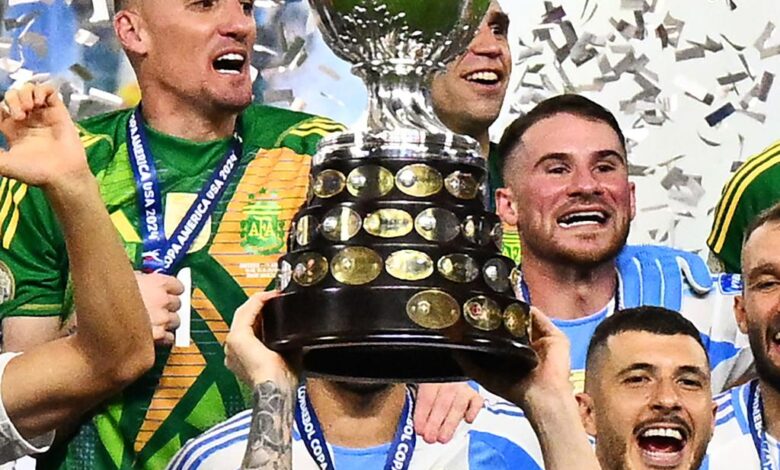
That triumph was followed by the 2022 Finalissima, victory at the 2022 FIFA World Cup in Qatar, and another Copa América title in 2024.
The World Cup triumph was particularly significant.
For years, Messi had been compared with Maradona because of the latter’s legendary role in Argentina’s 1986 World Cup triumph. In Qatar, Messi finally won the trophy that had eluded him and completed what many regarded as the missing piece of his extraordinary career.
The Argentine Football Association lists his major senior titles as the 2021 Copa América, 2022 Finalissima, 2022 World Cup and 2024 Copa América.


The 2026 World Cup: One Last Dance
Messi’s final World Cup came in 2026.
At 39, he again defied expectations, producing eight goals and four assists during Argentina’s campaign. He also became the oldest Argentine to score at a World Cup and extended his extraordinary record of World Cup appearances and goals.
Yet the fairytale ending was denied.
Argentina reached the World Cup final but lost 1-0 to Spain after extra time.
For Messi, it was a painful conclusion to his sixth World Cup, but it did little to diminish the scale of what he had already achieved.
Argentina’s campaign nevertheless reinforced the extraordinary longevity of its captain.
August 31: Messi Finally Says Enough
The decision to retire from Argentina’s national team was formally announced on August 31, 2026.
Messi acknowledged that the decision was painful but said he understood that the time had come. He stressed that he had always given everything to the national shirt and believed younger players deserved the opportunity to take Argentina forward.
His decision came shortly after the World Cup final defeat to Spain.
For Argentine supporters, however, retirement did not mean they were prepared to say goodbye immediately.
Argentina coach Lionel Scaloni pushed for Messi to return for one final appearance in Buenos Aires, leading to the farewell fixture against Benin. FIFA confirmed that the match had been arranged specifically as Messi’s final appearance for the national team.
One Final Masterclass Against Benin
And so came October 6.
At the Monumental, Messi’s final Argentina performance became another memorable chapter.
He scored from the penalty spot and created two more goals as Argentina defeated Benin 3-0. The occasion was transformed into a national celebration, with more than 85,000 people filling the stadium.
Argentina’s colours illuminated Buenos Aires, while supporters sang the national anthem and celebrated the man who had carried their hopes through some of the country’s greatest football moments.
Messi was visibly emotional after the final whistle.


A Legacy Measured In More Than Goals
Messi leaves Argentina with a statistical record that may stand for generations.
He played in six World Cups, appeared in 34 World Cup matches and scored 21 World Cup goals. He won the World Cup in 2022, two Copa América titles and the Finalissima.
He is also Argentina’s all-time leading scorer and record appearance-maker.
But numbers cannot fully explain Messi’s significance.
He changed the emotional relationship between a player and a nation.
He experienced the hostility of disappointed supporters, the pain of lost finals, the comparisons with Maradona and even an earlier retirement. He returned, endured, won and ultimately became the captain whose name is now inseparable from one of the greatest periods in Argentina’s football history.
From Maradona’s Shadow To Messi’s Own Monument
For much of his career, Messi was asked whether he could become the next Maradona.
That question has effectively disappeared.
Messi did not become Maradona.
He became Messi.
Like Maradona, he delivered Argentina a World Cup. But Messi’s story was different — built over more than two decades, through technological changes, different generations of players and coaches, heartbreak, criticism and eventual redemption.
The Argentine Football Association describes his departure as the end of a more than two-decade story in which the number 10 became inseparable from the national team.
The Beginning Of A Post-Messi Argentina
The emotional farewell also raises an important question: What happens to Argentina now?
For years, Messi was the team’s creative reference point, captain and psychological leader.
Argentina possesses talented younger players, and the team built under Lionel Scaloni has developed a collective identity rather than depending exclusively on one individual.
But replacing Messi is not simply a question of finding another number 10.
It means replacing a player who could change a match with one pass, one dribble, one free-kick or one moment of inspiration.
It means replacing the captain whose presence alone could alter the atmosphere inside a stadium.
And, perhaps most importantly, it means beginning a new Argentine football era without the man who defined the previous one.
He Is Leaving Argentina — Not Football
For Ugandan football lovers who may interpret the news as Messi’s complete retirement, an important clarification is necessary.
Messi has retired from international football, not from the professional game.
He continues his club career with Inter Miami, meaning supporters will still have opportunities to watch one of the sport’s greatest players in action.
But the blue-and-white shirt will no longer carry his name on competitive international duty.
That is the chapter that has now closed.
The Last Tango Of A Legend
Perhaps the most fitting way to describe Messi’s departure is not as surrender, defeat or disappearance.
It is completion.
He came to Argentina as a teenager carrying extraordinary expectations.
He endured criticism.
He lost finals.
He walked away and returned.
He won the Copa América.
He won the World Cup.
He lifted another Copa América.
He returned for one last World Cup.
And finally, he walked onto the Monumental pitch one last time, scored, assisted twice and heard an entire stadium tell him what perhaps Argentina could not always say during the difficult years:
Thank you.
Lionel Messi’s Argentina story has ended.
His football story has not.
But when future generations ask what it meant to wear the Argentina shirt as a global superstar, they will inevitably be shown the number 10 — and the face of Lionel Messi.
For 21 years, Argentina was Messi’s stage. On October 6, 2026, the curtain finally came down.
Uganda Today Must-Read Takeaway
Messi’s retirement from Argentina is not merely a football story. It is a story about perseverance, rejection, redemption, leadership and legacy — a reminder that even the greatest athletes can endure failure before achieving the success history eventually remembers.
#LionelMessi #Argentina #MessiRetires #FootballLegend #WorldFootball #UgandaToday
Source Note: This story is based on current reporting from Reuters, FIFA, the Associated Press, AFP and the Argentine Football Association, cross-checked because of the fast-moving nature of the retirement and farewell reports.