Jimmy Spire Ssentongo Uses Satire To Question The Culture Of Fear In Uganda
+256 702 23 93 37: Watch Video Song: In a recently released song titled “No Country,” Ssentongo combines lyrics, visual storytelling and artificial intelligence-generated production to deliver a message centred on fear, silence, citizenship and the difficulty many ordinary people face when expressing themselves freely.

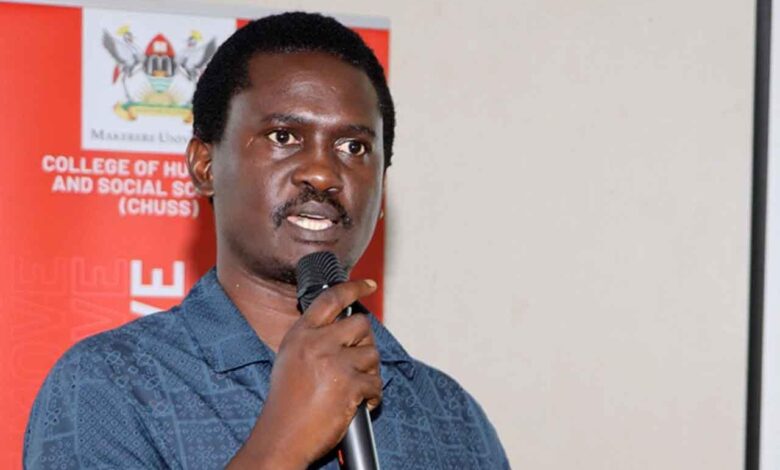

UgandaToday: Jimmy Spire Ssentongo Uses Satire To Question The Culture Of Fear In Uganda
Renowned Cartoonist And Makerere Academic Turns To Song And AI To Deliver A Stark Social Commentary
Renowned Ugandan cartoonist, academic and social commentator Dr Jimmy Spire Ssentongo has used music to raise questions about what he portrays as a growing culture of fear among Ugandans when dealing with government and public authority.
In a recently released song titled “No Country,” Ssentongo combines lyrics, visual storytelling and artificial intelligence-generated production to deliver a message centred on fear, silence, citizenship and the difficulty many ordinary people face when expressing themselves freely.
Ssentongo himself described the production as one of the songs he wrote and arranged, adding that he used artificial intelligence to complete the production. He said he hoped the song would “touch hearts.” (sotwe)


A Different Medium For A Familiar Message
For Ssentongo, the song represents another avenue through which social and political questions can be placed before the public.
He is perhaps better known for his cartoons, columns and social-media commentary, where he has consistently used satire and visual art to interrogate governance, corruption, human rights and other issues affecting Ugandan society.
Makerere University identifies him as a Senior Lecturer in the Department of Philosophy, where he has taught since 2011. The university also records his work as a columnist and editorial cartoonist for The Observer, a role he has held since 2006. (chuss.mak.ac.ug)
His academic background is in philosophy, ethics and humanistic studies, giving his public interventions an additional dimension: he frequently approaches political and social questions not merely as matters of partisan politics, but as questions of morality, citizenship and the relationship between individuals and institutions.
‘No Country’ And The Question Of Fear
The central theme presented through the song is the fear that Ssentongo says has become embedded in the relationship between ordinary citizens and government.
The concern is not simply about fear of government as an institution. Rather, the message raises broader questions about what happens to a society when citizens begin to censor themselves, avoid difficult conversations or hesitate to challenge those exercising public authority.
That question is particularly significant in a country where criticism of powerful institutions can sometimes generate intense public debate, confrontation and, in some cases, allegations of intimidation.
Ssentongo has himself previously been at the centre of such controversies.
In March 2024, Makerere University academic staff petitioned the Inspector General of Police over alleged threats against him following his social-media campaign highlighting alleged corruption and misuse of public resources at Parliament. Daily Monitor reported that the Makerere University Academic Staff Association had condemned the alleged threats and expressed concern over his safety. (Monitor)
Those events provide important context for understanding why questions of fear, silence and speaking out feature prominently in Ssentongo’s public commentary.
From Potholes To Parliament And Public Accountability
Ssentongo has built much of his public profile around the use of art and social media to draw attention to problems that might otherwise remain buried in official reports or public speeches.
His #KampalaPotholesExpo, for example, encouraged members of the public to document and share images of deteriorating roads in Kampala. The campaign attracted considerable public attention and became part of a wider national conversation about the state of the capital’s infrastructure.
He later became involved in other online campaigns focusing on public services and accountability.
His approach has been described by Daily Monitor as a form of satire capable of challenging social norms and political structures, while Ssentongo himself has explained the role of satire as a way of expanding forms of speech and triggering public debate on uncomfortable subjects. (Monitor)
The move from cartoons to music therefore appears less like a departure from his traditional work and more like an expansion of the same creative vocabulary.
An Academic Who Has Made Public Engagement Part Of His Work
Ssentongo’s involvement in public debate is also consistent with his stated view that academics should engage with the problems affecting their communities.
Makerere University describes him as an “engaged academic” who believes scholars should actively participate in addressing societal problems. His work has earned him several recognitions, including the Human Rights Defender of the Year Award and the Civil Liberties Award in 2023. (Makerere University News)
Makerere’s current profile also records that he received the Kofi Annan Cartooning with Courage Award from the Freedom Cartoonists Foundation in Geneva in 2026. (chuss.mak.ac.ug)
These recognitions have helped establish him as one of Uganda’s prominent voices at the intersection of academia, art, satire and civic engagement.
When Citizens Become Afraid To Speak
The deeper question raised by the song is whether fear can gradually become normalised within a society.
When citizens fear asking questions, challenging decisions or criticising institutions, public accountability can become more difficult. Equally, when criticism is treated as hostility and citizens interpret every disagreement as potentially dangerous, the space for constructive democratic conversation can narrow.
Ssentongo’s message invites Ugandans to reflect on that relationship between fear and citizenship.
It also raises a philosophical question familiar to his academic work: what does it mean to be a citizen in a society where people may possess formal freedoms but nevertheless hesitate to exercise them?
That question is not confined to politicians or activists. It concerns journalists, academics, artists, business people, civil servants and ordinary citizens alike.
The Cartoonist Finds Another Canvas
For a cartoonist accustomed to communicating complicated ideas through a single drawing, music offers an entirely different canvas.
A cartoon can compress an argument into one powerful image. A song, by contrast, can build an emotional narrative through words, rhythm, repetition and visual imagery.
In “No Country,” Ssentongo appears to be using that longer form to explore a subject that cannot easily be reduced to a single cartoon: the psychological consequences of living in an environment where people may become cautious about what they say and whom they criticise.
The use of AI also adds another contemporary layer to the project.
Rather than simply being a political song, it is also an experiment in how emerging technology can enable an individual writer and artist to produce a multimedia work without necessarily relying on a conventional music-production establishment.
A Song As A Conversation
Whether listeners agree with Ssentongo’s interpretation of Uganda’s political and social environment or not, the song places an important subject on the public table: the relationship between authority, fear and freedom of expression.
It is a conversation that extends beyond any individual government, political party or election cycle.
For a country to sustain meaningful public debate, citizens must be able to question institutions, officials and policies, while public authorities must also be able to respond to criticism through lawful and peaceful means.
That is ultimately where Ssentongo’s latest artistic intervention leaves its audience — not merely with a song, but with a question about the kind of society Ugandans want to create and the extent to which fear should determine what citizens are prepared to say.
EDITOR’S NOTE
Uganda Today presents the song and the views expressed through it as the artistic and personal commentary of Dr Jimmy Spire Ssentongo. The publication does not independently endorse every assertion contained in the work. References to alleged threats or other disputed matters are identified as allegations and are based on previously published reports.
#JimmySpireSsentongo #NoCountry #Uganda #FreedomOfExpression #CivicSpace #UgandaToday