When One President Seems To Have Three Faces: The Fascinating Samia Suluhu Lookalike Phenomenon
+256 702 23 93 37: The “Co-Wives” Photograph That Wasn't What It Seemed President Samia has previously been at the centre of another social-media storm involving photographs of her sitting beside other women.

UgandaToday: When One President Seems To Have Three Faces: The Fascinating Samia Suluhu Lookalike Phenomenon
How Tanzania’s First Female President Became The Centre Of A Remarkable Lookalike Fascination
There are moments when politics, photography and human resemblance collide to produce images that leave the public staring at their screens in disbelief.
Tanzania’s President Samia Suluhu Hassan has experienced precisely that phenomenon.
For years, photographs and videos circulated on social media have drawn attention to women who appear remarkably similar to Tanzania’s first female president—sometimes so similar that casual observers have wondered whether they were looking at President Samia herself, a relative, or even a carefully positioned double.
The fascination is understandable.
President Samia’s distinctive facial structure, eyes, complexion, stature and characteristic headscarf have made some of her lookalikes extraordinarily convincing.
But behind the amusement lies a deeper and fascinating story about human resemblance, identity and the way social media can transform an ordinary physical similarity into a national and international talking point.
The Kenyan Woman Who Had People Doing A Double Take
One of the best-documented examples emerged in Kenya shortly after Samia became Tanzania’s president in March 2021.
Mwaka Bakari, then a Member of the Mombasa County Assembly representing Timbwani Ward, suddenly found herself receiving an extraordinary number of calls and messages from people telling her that she looked strikingly like the newly inaugurated Tanzanian leader.
The resemblance was described in terms of physique, facial structure and eyes.
Bakari herself joked about the extraordinary similarity, wondering whether there could somehow be a family connection across the Tanzania-Kenya border.
Her story quickly became part of the wider fascination surrounding President Samia’s appearance.
What made the episode particularly interesting was that it demonstrated how powerful visual resemblance can be. A person who had lived an ordinary political life in Mombasa suddenly became internationally recognisable because strangers believed she could almost pass for the Tanzanian president.
When Social Media Creates “Twins” Out Of Strangers
The Samia phenomenon also illustrates one of the peculiarities of the social-media age.
A photograph that might once have been seen by a few people can now travel across East Africa within minutes.
Once viewers notice a resemblance, comparisons multiply.
One person posts a photograph.
Another places two photographs side by side.
A third creates a video.
Soon, thousands of people are debating whether the individuals are sisters, twins, relatives—or whether there is something more mysterious behind the resemblance.
But appearance alone cannot establish a family relationship.
And that distinction becomes particularly important when the person involved is a head of state.
The “Co-Wives” Photograph That Wasn’t What It Seemed
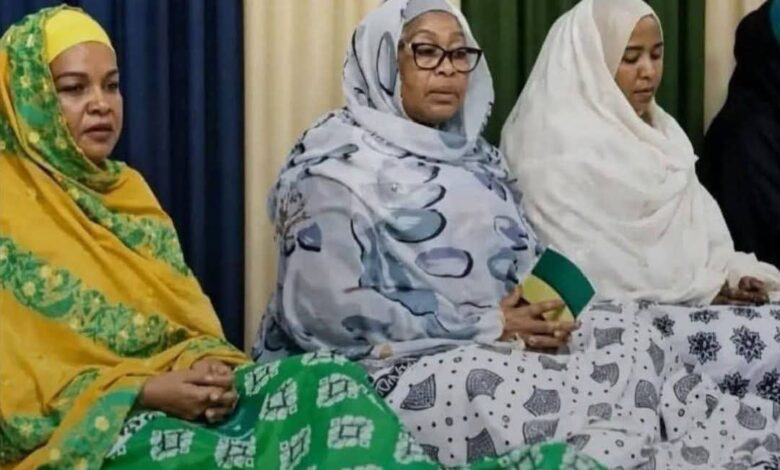
President Samia has previously been at the centre of another social-media storm involving photographs of her sitting beside other women.
Posts circulated claiming that the women were her husband’s other wives and that the image showed a family gathering.
Fact-checkers, however, established that the claim was false.
The photograph was taken during a memorial event for Zanzibar’s first president, Abeid Amani Karume. Two of the women were identified as Mariam Mwinyi, wife of Zanzibar’s then-president Ali Hassan Mwinyi, and Zena Ahmed, Zanzibar’s Chief Secretary.
The episode provides an important lesson for today’s digital audience:
A photograph can be genuine while the story attached to it is completely false.
That distinction is increasingly important when dealing with images of public figures.
Why Do Some People Look Almost Identical?
Human beings naturally search for patterns.
Scientists have long recognised that unrelated people can sometimes possess extraordinarily similar combinations of facial characteristics.
The phenomenon becomes especially striking when people share similar hairstyles, clothing, expressions and camera angles.
For President Samia, the effect can be amplified by her distinctive public appearance.
Her regular use of headscarves, formal attire and similar photographic poses can make comparisons with people of similar facial characteristics even more convincing.
A photograph freezes one particular expression.
Two people photographed at the same angle, wearing similar clothing and displaying similar expressions can consequently appear almost indistinguishable.
More Than A Curiosity
The fascination with Samia’s lookalikes is not merely about entertainment.
It touches on a much larger question:
What makes us recognise another human being?
Is identity contained in the eyes?
The shape of the face?
The voice?
The manner of walking?
The way a person smiles?
Or is identity something much deeper than physical appearance?
For an ordinary person, being mistaken for a famous individual may be amusing.
For a president, however, identity carries enormous significance.
A head of state represents government, authority and national sovereignty. Consequently, images purporting to show the president can have consequences far beyond simple amusement.
The Digital Age Has Changed Everything
President Samia’s experience is also a reminder of how rapidly misinformation can travel.
Fact-checkers have repeatedly had to examine photographs and videos falsely attributed to the Tanzanian leader.
In one case, a photograph claimed to show Samia with her “co-wives” was found to have been taken at an entirely different event.
Another viral claim involving a video supposedly showing Samia arriving in Kenya was also found to be false; verification established that the footage came from a 2021 cultural event in Mwanza, Tanzania.
The lesson is straightforward:
Seeing is no longer necessarily believing.
A photograph may be authentic but incorrectly captioned.
A genuine video may be taken from another year and presented as current.
And a woman who looks extraordinarily like a president may simply be a woman who happens to possess an extraordinary resemblance to her.
Samia: The Original Behind The Copies
Whatever the fascination with her lookalikes, there is only one President Samia Suluhu Hassan.
She became Tanzania’s first female president on March 19, 2021, succeeding John Pombe Magufuli after his death. Tanzania’s official State House website continues to identify her as the President of the United Republic of Tanzania.
Her historic rise transformed her into one of East Africa’s most recognisable political figures.
And perhaps, ironically, the more recognisable she became, the more people began noticing those who looked remarkably like her.
The Bigger African Story
Across Africa, politics is often intertwined with personality, symbolism, clothing and public image.
Presidents become instantly recognisable.
Their faces appear on television, newspapers, billboards, social-media feeds and official government communications.
That visibility creates another unusual phenomenon: people who resemble them can suddenly attract public attention simply because of their faces.
In Samia’s case, that resemblance has generated amusement, curiosity and, occasionally, misinformation.
But perhaps the most beautiful way to interpret the phenomenon is simpler.
Nature does not produce every human face from an entirely unique template.
Sometimes, somewhere across a border, another person can emerge carrying a striking visual echo of someone else.
And when that someone happens to be the president of a neighbouring country, the resemblance becomes a story.
A Face, A Reflection And A Lesson
The fascination surrounding President Samia and her lookalikes ultimately tells us something about ourselves.
We are fascinated by resemblance because it challenges our assumptions about identity.
We laugh when two strangers look like twins.
We become curious when one resembles a celebrity.
And when the person involved is a president, curiosity can quickly become a viral phenomenon.
But the Samia story also carries a serious journalistic warning.
Before sharing the photograph, verify the story behind it.
Because in today’s digital world, a picture may tell the truth about what a camera captured—but the caption may tell an entirely different story.
And sometimes, the woman standing beside the president is not her sister, not her co-wife, not her twin and certainly not her “second president”.
She may simply be someone who happens to have been given one of nature’s most remarkable coincidences:
the face of a famous stranger.