The Cashew Giant of Brazil: Inside the World’s Largest Cashew Tree Sprawling Across 2.1 Acres
+256 702 23 93 37: The Brazilian landmark attracts thousands of eco-tourists every year while highlighting the importance of biodiversity conservation.


UgandaToday: The Cashew Giant of Brazil: Inside the World’s Largest Cashew Tree Sprawling Across 2.1 Acres
By UgandaToday Science & Environment Desk
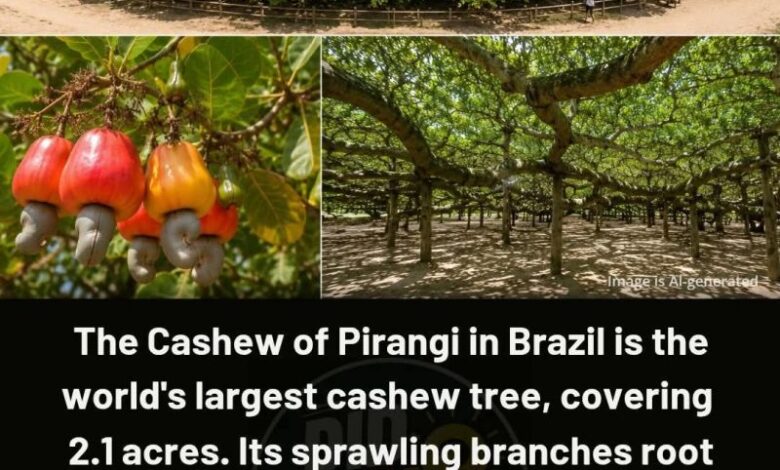
At first glance, it resembles a dense tropical forest. But hidden within Brazil’s northeastern coastline stands what scientists and botanists recognize as a single colossal tree—the legendary Cashew of Pirangi, a natural wonder that stretches across approximately 2.1 acres (about 8,500 square metres).
Located near the coastal city of Natal in Brazil’s Rio Grande do Norte State, the remarkable tree has fascinated researchers, tourists and conservationists for more than a century. Its enormous canopy is so extensive that many first-time visitors mistake it for an entire grove rather than a single living organism.
A Tree That Behaves Like a Forest
Unlike ordinary cashew trees that grow upright, the Cashew of Pirangi has developed an extraordinary growth pattern.
Its heavy branches gradually bend towards the ground. Whenever these branches touch the soil, they produce new roots, anchoring themselves before continuing to grow outward. This natural process, known as layering, enables the tree to continuously expand without becoming separate trees.
The result is an immense interconnected network of trunks, limbs and roots that all belong to one living plant.
Visitors walking beneath its canopy often find themselves navigating shaded pathways resembling a miniature forest rather than standing beneath a single tree.
Nature’s Engineering Marvel
Experts believe the tree’s unusual size results from a rare genetic mutation combined with favourable tropical conditions.
The warm coastal climate, fertile sandy soils and consistent rainfall have allowed the tree to flourish for decades.
Despite appearing to consist of hundreds of individual trees, botanists confirm that it is one continuous organism connected through its original root system and interconnected branches.
This unique adaptation has earned the tree international recognition as one of the world’s most remarkable botanical attractions.
More Than 60,000 Cashew Fruits Every Year
The giant tree remains highly productive.
During the fruiting season, it reportedly produces more than 60,000 cashew apples annually, each carrying the familiar kidney-shaped cashew nut attached beneath the fleshy fruit.
The colourful cashew apples are widely consumed in Brazil, where they are made into fresh juice, jams, desserts and fermented beverages.
The nuts, after careful processing to remove naturally irritating oils in their shells, are exported worldwide as one of the globe’s most popular snack foods.
A Major Tourist Attraction
The Cashew of Pirangi has become one of Brazil’s most visited natural attractions.
Raised walkways and observation points allow visitors to explore the vast canopy without damaging the tree’s root system. Educational tours explain the biology of cashew trees, sustainable conservation and the importance of protecting unique ecosystems.
Thousands of tourists visit annually, contributing significantly to the local economy through eco-tourism.
Lessons for the World
Beyond its astonishing size, the Cashew of Pirangi demonstrates nature’s incredible capacity for adaptation.
Its continued survival underscores the importance of conserving biodiversity and protecting exceptional natural landmarks from urban expansion and environmental degradation.
As climate change increasingly threatens forests around the world, remarkable living monuments such as the Cashew of Pirangi remind humanity of the resilience—and fragility—of Earth’s ecosystems.
Could Uganda Learn from Cashew Cultivation?
Although Uganda is not widely known as a major cashew producer, parts of the country’s warmer regions possess climatic conditions suitable for cashew cultivation.
Agricultural experts note that expanding cashew farming could provide farmers with an additional high-value cash crop while supporting agroforestry initiatives and improving climate resilience in suitable districts.
The Brazilian giant also serves as a powerful reminder of the economic and ecological value of preserving long-lived trees for future generations.
A Living Symbol of Nature’s Wonders
For more than a century, the Cashew of Pirangi has continued to grow outward, quietly demonstrating one of nature’s most extraordinary survival strategies.
What appears from above to be a lush green forest is, in reality, a single tree—a breathtaking reminder that some of Earth’s greatest wonders are still alive, growing, and inspiring millions around the world.