Army Commander at No. 27? The Muhoozi Question and Uganda’s Collapsing Order of Precedence
Yet critics argue that the conduct and political influence of Uganda’s current Chief of Defence Forces, Gen. Muhoozi Kainerugaba, increasingly portrays a radically different power structure — one in which military authority appears to overshadow constitutional institutions with little or no restraint.

UgandaToday: Army Commander at No. 27? The Muhoozi Question and Uganda’s Collapsing Order of Precedence
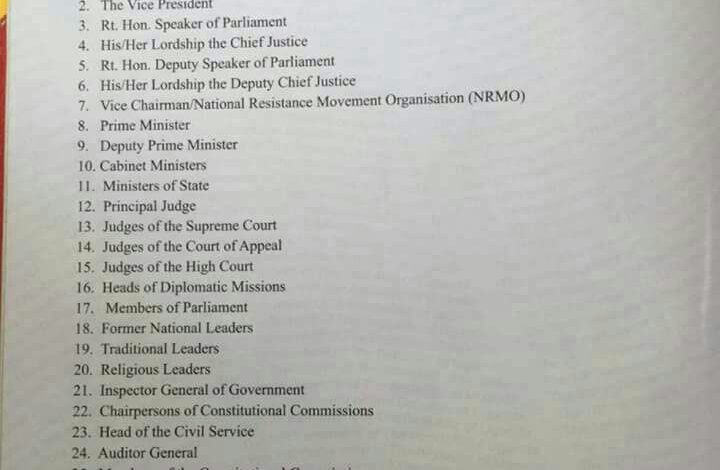
A simmering constitutional and political debate has once again resurfaced in Uganda following renewed public scrutiny of the country’s official Order of Precedence — a protocol hierarchy that places the Army Commander far below the nation’s top constitutional offices.
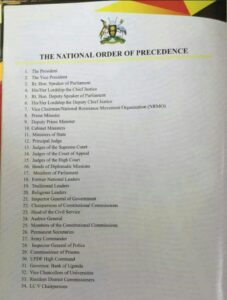
A circulating government protocol document titled “The National Order of Precedence” ranks the President first, followed by the Vice President, Speaker of Parliament, Chief Justice and other constitutional office bearers. The Army Commander appears at number 27 on the list, below Permanent Secretaries, the Inspector General of Government, Members of Parliament and even Resident District Commissioners.
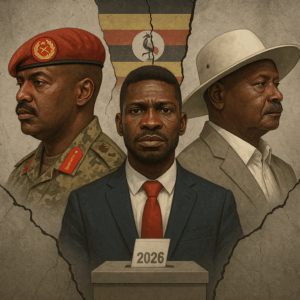
Yet critics argue that the conduct and political influence of Uganda’s current Chief of Defence Forces, Gen. Muhoozi Kainerugaba, increasingly portrays a radically different power structure — one in which military authority appears to overshadow constitutional institutions with little or no restraint.
The Protocol Versus The Reality
Under Uganda’s official state protocol, Parliament and the Judiciary rank significantly above the Army Commander. The Speaker of Parliament occupies the third highest office in the land, while Members of Parliament themselves are listed at number 17.
However, observers say Gen. Muhoozi’s public conduct — particularly through his social media posts and political pronouncements — has repeatedly demonstrated open disregard for those constitutional hierarchies.
The debate intensified after the CDF previously branded legislators “parliamentary clowns” following summons by Parliament’s Defence Committee over his controversial statements regarding opposition veteran Dr. Kizza Besigye.
At the time, Muhoozi defiantly declared:
“I WILL NEVER appear before parliamentary CLOWNS!”
He further threatened to “arrest them all,” remarks that generated widespread concern among constitutional lawyers and opposition figures who argued that such statements undermined civilian oversight over the military.
Parliament Reduced to Spectators?
Political analysts argue that the absence of any meaningful reprimand from President Yoweri Museveni has emboldened the First Son and accelerated perceptions that formal state institutions now operate under an unofficial military-political centre of power.
That perception has only deepened following Muhoozi’s increasing involvement in parliamentary politics despite being a serving military officer.
In recent weeks, the General openly weighed in on the race for the Speaker of Parliament, publicly endorsing and later withdrawing support for Speaker Anita Among amid internal political realignments.
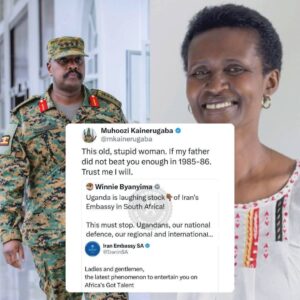
Critics argue that such interventions blur the constitutional separation between the military and civilian political institutions.
The Speaker Race and Muhoozi’s Shadow
The controversy escalated further after reports emerged showing senior politicians openly pledging allegiance to Muhoozi and his Patriotic League of Uganda (PLU) movement during events linked to the incoming 12th Parliament.
At one gathering, Speaker Anita Among reportedly praised Muhoozi and requested that he address Members of Parliament during parliamentary induction.
The optics, analysts say, were extraordinary: the third highest constitutional office in the land appearing politically subordinate to an official ranked 27th in the country’s own protocol hierarchy.
The situation has fuelled fears that Uganda’s formal constitutional architecture is steadily giving way to personalised power networks centred around the First Family.
Social Media Power and Fear Politics
Muhoozi’s social media activity has for years dominated Uganda’s political discourse. From threatening foreign leaders to commenting on opposition politicians and parliamentary affairs, the General’s posts frequently trigger national debate.
International observers have increasingly noted his growing influence within the Ugandan state. A recent Associated Press analysis described him as emerging as Uganda’s “de facto ruler” despite his father remaining president.
The article further observed that Muhoozi’s public profile and political assertiveness increasingly eclipse traditional institutional structures.
Constitutional Order or Military Supremacy?
Uganda’s Constitution envisions civilian supremacy over the military, with Parliament mandated to exercise oversight over defence institutions.
Yet the recurring confrontations between Muhoozi and Parliament continue raising uncomfortable questions:
- Does Uganda’s constitutional order still function as officially designed?
- Has the military effectively become politically untouchable?
- And what meaning does the official Order of Precedence still hold if state conduct increasingly contradicts it?
For many critics, the issue is no longer merely about protocol rankings.
It is about whether Uganda’s institutions still command authority — or whether authority now flows primarily from proximity to power.
#UgandaToday
#MuhooziKainerugaba
#UgandaPolitics
#ParliamentUG
#RuleOfLaw
#PhoenixNewsFeeds