Uganda Today: Why the Economy Won’t Improve Until the Drinking Stops: A Sobering Reflection from Uganda’s Boda-Boda Culture”
By Uganda Today Reporter
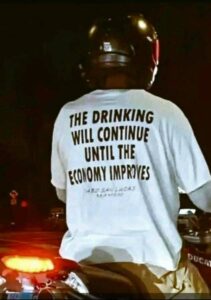
Featured image: A motorcycle rider donning a shirt that reads “Drinking will continue until the economy improves”
In the boda-boda bustling streets of Kampala and towns beyond, witty slogans often flash past on the backs of boda-boda riders, painted on helmets, jackets, or t-shirts. One such eye-catching inscription, seen on the back of a rider’s t-shirt, boldly reads: “Drinking will continue until the economy improves.”
Though humorous at face value, the slogan encapsulates a deeper, graver societal paradox. It implies that excessive drinking is a coping mechanism—a response to economic hardship. But what if the reverse were true? What if, in fact, the economy will not improve until the drinking stops?
This analytical piece explores that very argument, with Uganda as a case study.

The Alcohol-Economy Nexus: A Vicious Cycle
Uganda ranks among the highest alcohol-consuming countries per capita in Africa, according to various World Health Organization (WHO) reports. Much of this consumption is informal and unregulated—local brews like waragi, malwa, and enguli are widely accessible, often stronger than commercial liquor, and deeply rooted in rural and peri-urban communities.
While social drinking may be culturally embedded, the excessive and often reckless consumption of alcohol contributes to several socio-economic dysfunctions that actively erode the economic fabric:
-
Reduced Productivity
Uganda’s labor force, especially among the youth, is increasingly strained by alcoholism. Daily drinking sessions, often beginning before noon in some communities, have created a segment of the population unable to sustain steady work. This severely undercuts national productivity and impedes small-scale enterprise, which is the backbone of Uganda’s economy. -
Escalating Healthcare Costs
Alcohol-related diseases—including liver failure, cardiovascular complications, and mental health disorders—exert a heavy toll on an already burdened healthcare system. In communities where healthcare is largely out-of-pocket, families are plunged into poverty by treating preventable conditions born of alcohol abuse. -
Rising Crime and Domestic Violence
There is a well-documented link between alcohol consumption and domestic violence in Uganda. The Uganda Police Annual Crime Report has consistently highlighted alcohol as a major contributing factor in assault and murder cases, especially within households. The destabilization of family units leads to wider societal dysfunction and impairs economic planning at the household level. -
Loss of Human Capital
Young men and women—the engine of national productivity—are being lost to the bottle. A generation that should be acquiring skills, building businesses, or innovating for Uganda’s development is instead being numbed into inertia by cheap and easily available liquor.
Boda-Bodas and the Normalization of Drinking Culture
The boda-boda rider whose shirt sparked this conversation is not an anomaly. Many riders are known to drink on duty, contributing to reckless road behavior, road carnage, and needless deaths. The normalization of such messages—where alcohol becomes both comic relief and coping strategy—is symptomatic of a society numbing itself instead of confronting systemic issues head-on.
This normalization perpetuates the myth that personal and national challenges are too overwhelming to face soberly. Yet, every bottle consumed to “drown sorrows” deepens the very economic despair it seeks to escape.
Reversing the Logic: Sober Communities, Stronger Economies
Rather than waiting for economic conditions to improve to stop drinking, Uganda must embrace the opposite route: reigning in alcohol abuse as a precursor to economic revival.
-
Public Health Campaigns must intensify efforts to educate communities on the long-term impact of alcoholism—not just physically, but economically.
-
Community-Based Interventions like church and mosque programs, SACCOs, and vocational training centers must integrate alcohol recovery support for at-risk individuals.
-
Stricter Regulation on alcohol sales, especially in rural trading centers and urban slums, is long overdue. Licensing should be enforced, and underage drinking curbed with community participation.
-
Alternative Social Recreation programs must be developed, especially for the youth—sports, music, and entrepreneurship initiatives that offer alternatives to the drinking culture.
Conclusion: From the Bottom of the Bottle, No Vision is Clear
Uganda’s road to economic transformation cannot be paved through bars and local brew dens. If anything, it is obstructed by them. The witty statement, “drinking will continue until the economy improves,” while humorous, dangerously flips the logic of development.
It is high time we asked: How can a man build a house while drunk? How can a nation build an economy while inebriated? The painful answer is—it can’t.
Until the drinking stops, the economy may never improve.
Editor’s Note:
This article is inspired by a real-life t-shirt worn by a Ugandan boda-boda rider. The image appears as the featured photo to shed light on the silent but growing crisis of alcohol dependency as a barrier to national development.
Publisher