

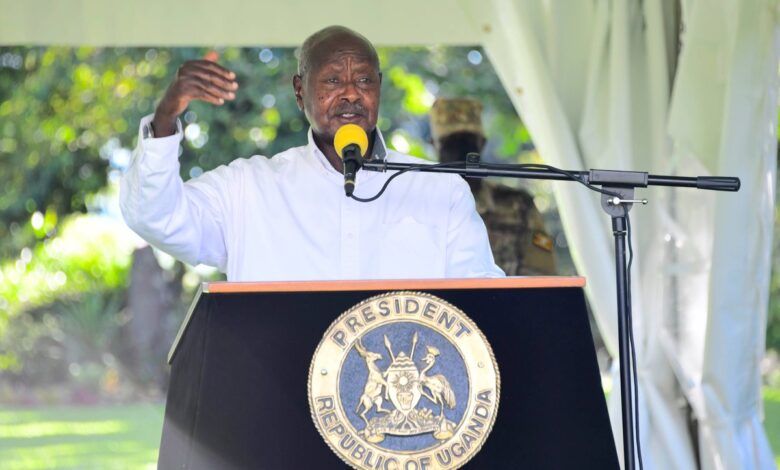
Uganda Today: Museveni’s 2024 State of the Nation Address: Economic Triumph or Tailored Narrative?
By Uganda Today Newsroom
Published on: June 7, 2025
www.ugandatoday.co.ug
Kampala, Uganda – In his State of the Nation Address delivered last Wednesday, President Yoweri Kaguta Museveni painted a picture of a transformed Uganda, showcasing robust economic metrics and a generational shift from the days of war, poverty, and illiteracy to a new era of macroeconomic stability and industrial ambition.
The President’s address, grounded in data and decade-spanning comparisons, emphasized Uganda’s journey from a struggling post-conflict economy to one of Africa’s fastest-growing markets, as recognized by the International Monetary Fund (IMF), which ranked Uganda 7th globally among the fastest-growing economies.
Population and Literacy Surge
In 1986, when Museveni assumed power, Uganda’s population stood at 14 million. Today, it has more than tripled to 46 million. More significantly, literacy has climbed from 43% in 1986 to 80% in 2024 — a signal, Museveni said, of “human capital development driven by Universal Primary and Secondary Education programs.”
From Subsistence to Enterprise
The President noted a radical shift from a predominantly subsistence-based economy to a more commercial and service-driven model. In 1986, 90% of Ugandan households were dependent on subsistence farming. That figure has since dropped to 33% — a structural economic transformation attributed to targeted wealth creation programs like the Parish Development Model and Emyooga.
GDP Growth and Fiscal Momentum
Uganda’s economy has expanded from a modest USD 3.9 billion in 1986 to an estimated USD 60 billion in 2024, with annual growth averaging 6.5%. By 2030, projections place GDP at USD 150 billion, underpinned by growing export volumes, foreign direct investment, and public-private infrastructure projects.
Revenue mobilization has also grown substantially: from UGX 5 billion collected in 1986 to UGX 31.9 trillion in 2025. This accounts for 14% of GDP, a signal of improved domestic revenue performance.
Exports Boom: From Beans to Gold Bars
Uganda’s export receipts have jumped by 26%, reaching USD 9.3 billion by 2025. Leading the pack are gold (USD 3.7 billion), coffee (USD 1.8 billion), and milk (USD 285 million) — the latter showing a remarkable leap from just USD 28 million in 2015.
While the economy remains heavily reliant on primary commodities, manufactured goods like cement (USD 335 million), steel (USD 230 million), and sugar (USD 190 million) are emerging contributors to Uganda’s export portfolio.
Investing in Ugandans: Strategic Wealth Initiatives
Museveni highlighted over UGX 8 trillion invested across ten strategic wealth creation initiatives aimed at tackling unemployment, rural poverty, and youth disenfranchisement:
-
Parish Development Model – UGX 3.4 trillion
-
Emyooga – UGX 553 billion
-
Youth Livelihood Programs – UGX 207 billion
-
Agricultural Reactive Facility – UGX 495 billion
-
Women Entrepreneurship Program – UGX 168 billion
-
Youth Venture Capital Fund – UGX 12.5 billion
“The emphasis,” he said, “is not on handouts, but on enabling enterprise at the grassroots.”
Macroeconomic Stability and Investment Climate
Museveni’s address pointed to a currency that has appreciated 6% in 12 months, placing the Ugandan Shilling among Africa’s most stable currencies. Inflation, currently at 3%, is the second lowest on the continent.
Foreign direct investment stands at USD 3.8 billion, while tourism and remittances contribute USD 1.5 billion and USD 1.4 billion respectively.
Tackling Poverty and Inequality
The poverty rate has declined from 20% in 2021 to a projected 16% by 2025. Uganda’s Gini coefficient — a measure of income inequality — improved slightly from 41% in 2020 to 38% in 2025. While these improvements are modest, the President argued they are the fruits of sustained and targeted policy interventions.
The Unanswered Questions
Despite the impressive figures, critics argue the address glossed over key challenges: rising debt levels, a struggling health sector, education quality concerns, youth unemployment, and governance issues. The disconnect between macroeconomic indicators and household realities in rural Uganda remains a sore point for the opposition and civil society.
As Uganda looks towards Vision 2040, Museveni’s 2024 State of the Nation Address reinforced his long-standing narrative of transformation and resilience. Yet, as the numbers dazzle, the test remains whether economic growth is equitably shared and whether the social fabric can absorb the weight of rising expectations among Uganda’s 46 million citizens.
Published by www.ugandatoday.co.ug, your trusted source for news and analysis
Website: https://www.ugandatoday.co.ug/about-cmk
Website: https://www.ugandatoday.co.ug
WhatsApp: +256 702 239 337
X (formerly Twitter): @uganda43443 | @ugtodaynews
Email: ugandatodayedition@gmail.com
Let’s help you grow your brand and keep your audience informed. Partner with Uganda Today—