Inside Charlene Ruto’s Cross-Border Love Story: How Tanzanian Tech Mogul Isaya Yunge Won the Kenyan President’s Daughter
+256 702 239337: And then there is the question that has set social media ablaze: just how much did the Tanzanian entrepreneur allegedly put on the table to marry into the Ruto family?


UgandaToday: Inside Charlene Ruto’s Cross-Border Love Story: How Tanzanian Tech Mogul Isaya Yunge Won the Kenyan President’s Daughter
A presidential daughter, a Tanzanian tech entrepreneur and a traditional ceremony that has captivated East Africa
East Africa has a new high-profile family connection after Kenyan President William Ruto’s daughter, Charlene Chelagat Ruto, formally entered a traditional marriage process with Tanzanian technology entrepreneur Isaya Yunge.
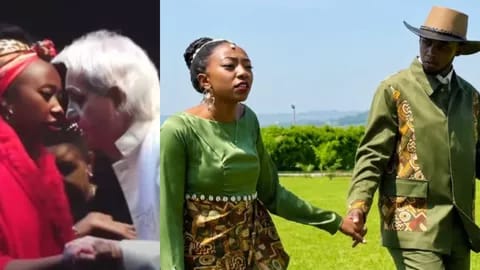
The couple’s traditional Koito ceremony was held on August 8, 2026, at President Ruto’s Intonna Heritage Farm in Kilgoris, Narok County, bringing together the Kenyan First Family, Yunge’s Tanzanian relatives and a high-profile circle of political, business and social figures.
But beyond the colourful outfits, cattle, gifts and presidential security, the story of Charlene and Yunge is particularly intriguing because it brings together two people whose journeys could hardly have started more differently.
One is the daughter of one of East Africa’s most powerful political figures.
The other grew up amid family instability and poverty in Mwanza before building a career in technology and social entrepreneurship.
And then there is the question that has set social media ablaze: just how much did the Tanzanian entrepreneur allegedly put on the table to marry into the Ruto family?
The Sh7 billion dowry claim that has gone viral
Reports circulating online have claimed that Yunge paid a staggering KSh7 billion in dowry, alongside gifts said to include two helicopters, a bus and a gold ring allegedly worth about KSh56 million.
The claim has generated enormous interest across East African social media, with some posts presenting the figures as fact. (LinkedIn)
However, UgandaToday could not independently verify the KSh7 billion figure from authoritative reporting or an official statement from either family.
That distinction is important.
What credible reporting does establish is that the Koito involved traditional bridewealth negotiations, including cattle, milk-related rituals and gifts. The negotiations were conducted largely behind closed doors, in keeping with the private nature of the ceremony. (The Standard)
So, while the KSh7 billion claim makes for a sensational headline, it should be treated as an unverified claim rather than an established fact.
And perhaps that is what makes the story even more fascinating: the actual value of the negotiated bridewealth remains a closely guarded family matter.
Who is Isaya Yunge? From foster homes to the African technology scene
Yunge’s background reads more like a motivational film than the biography of a man who would eventually find himself marrying into Kenya’s First Family.
Born and raised in Mwanza, Tanzania, Yunge experienced a difficult childhood after his parents separated. According to his Ashoka profile, he moved between foster homes, joined school later than many of his peers and spent part of his childhood herding animals.
At one point, he also lived on the streets of Mwanza.
Yet education remained his escape route.
As a teenager, Yunge became involved in helping street children. At just 16, he persuaded Radio Free Africa to give him a programme through which street children could discuss their experiences.
The initiative attracted support from UNICEF and eventually ran for several years. Yunge was later selected as a UNICEF African Youth Ambassador and attended the G8 Summit in Germany as a young representative. (Ashoka)
That early experience appears to have shaped the entrepreneur he would become.
The man behind SomaApp
Yunge later turned his attention to technology, particularly the problem of African students failing to access scholarship opportunities.
In 2016, he created SomaApp, a mobile platform designed to match students with scholarships for which they qualify.
The idea was simple but potentially transformative: instead of students searching endlessly for opportunities, the technology would help connect them to relevant scholarships.
His work attracted international recognition.
Yunge was named among Forbes Africa’s 30 Under 30 in 2018, listed in the technology category as founder of SomaApps Technologies.
The same year, he received the Queen’s Young Leaders Award, recognising his work using technology to improve educational opportunities for young Africans. (EatV)
His journey therefore presents an interesting contrast to the wealth-and-power image surrounding his new family: Yunge’s public profile was initially built around technology, education and youth empowerment rather than politics.
Enter Charlene Ruto: Life in Kenya’s First Family
Charlene Ruto, born in 1993, is the third-born daughter of President William Ruto and First Lady Rachel Ruto.
She studied communications at Daystar University and later pursued postgraduate studies at Les Roches Crans-Montana in Switzerland, where she obtained an MBA.
Before becoming a prominent public figure, she worked in media relations. She later became associated with public relations and branding work at Weston Hotel, a family-linked hospitality business. (The Star)
Charlene has also built a public profile around youth empowerment, entrepreneurship, agriculture and environmental issues.
Her visibility increased dramatically after her father became Kenya’s Deputy President in 2013 and later President in 2022.
Unlike some political families whose children remain largely hidden from public view, Charlene has frequently appeared at youth and development events both in Kenya and abroad.
Her public activities have sometimes attracted controversy, particularly over the unofficial description of her as Kenya’s “First Daughter” and questions surrounding the nature of her public engagements.
But she has continued carving out an identity separate from her father’s political career.
The daughter who once asked for a husband
Charlene’s journey to the altar has also had an unusual public chapter.
In February 2024, during American televangelist Benny Hinn’s Healing the Nation crusade in Nairobi, Charlene asked for prayers for a husband.
Hinn subsequently prayed publicly that she would find a husband who would support her calling.
The moment immediately became a Kenyan social-media sensation.
Within days, several men jokingly — and in some cases apparently seriously — declared their interest in becoming President Ruto’s son-in-law.
One Kenyan admirer even offered 40 cows as dowry in a 2022 declaration of affection, while other personalities later publicly proposed to Charlene. (Tuko.co.ke – Kenya news.)
Few could have predicted that the man who eventually emerged would be neither a Kenyan politician nor a celebrity, but a Tanzanian technology entrepreneur.
From prayer request to Tanzanian fiancé
By August 2026, the answer to the much-discussed prayer appeared to have arrived.
Yunge, 36, formally became engaged to Charlene in the traditional ceremony at Kilgoris.
The event brought the two families together in a carefully organised cultural celebration featuring traditional Kalenjin customs.
Photographs released from the ceremony showed cattle, milk-pouring rituals, decorated gifts and guests dressed in elaborate African attire. (Tuko.co.ke – Kenya news.)
President Ruto and Rachel Ruto were present, while prominent Kenyan figures also attended.
The ceremony was therefore much more than an ordinary family gathering. It was a meeting of two East African families whose worlds stretch across politics, technology, business and philanthropy.
Why the Koito ceremony matters
The ceremony was conducted according to Kalenjin Koito traditions, a major stage in the marriage process in which the two families formally come together and bridewealth negotiations take place.
The word Koito is commonly associated with the process of formally giving a daughter in marriage.
Unlike a simple wedding reception, the ceremony carries deep cultural meaning because it establishes a relationship between families rather than merely celebrating the couple.
That cultural dimension was clearly visible at the Ruto family ceremony, where cattle and milk featured prominently.
The negotiations themselves were private, meaning outsiders may never know the complete list or value of the bridewealth exchanged.
A marriage that crosses borders
The union is also a reminder of how closely intertwined East African societies remain.
Kenya and Tanzania share a border, extensive trade links and communities whose cultural practices transcend national boundaries.
In this case, the relationship takes on an unusually high profile because the bride is the daughter of Kenya’s sitting President while the groom is a Tanzanian entrepreneur with an international reputation.
It is a personal relationship, but one inevitably watched through the wider lens of East African society.
Ruto’s own remarkable journey
Behind Charlene’s presidential background is another compelling story — that of her father.
William Samoei Ruto was born on December 21, 1966, in Sambut, Uasin Gishu County.
His official biography describes his rise from humble beginnings to Kenya’s highest political office. He studied Botany and Zoology at the University of Nairobi before obtaining postgraduate qualifications in plant ecology.
Before entering politics, he worked as a teacher.
He entered Parliament in 1997 and later served in several Cabinet positions before becoming Kenya’s first elected Deputy President in 2013. He was elected President in 2022. (Ruto.co.ke)
His own rise from modest beginnings to the presidency adds another layer to the story of Charlene’s choice of partner.
Two different journeys, one powerful family connection
Perhaps the most entertaining aspect of the Charlene-Yunge story is the unlikely symmetry.
Charlene grew up within the orbit of Kenyan political power and eventually became a public figure in her own right.
Yunge grew up facing circumstances that could easily have prevented him from achieving the international recognition he later received.
He moved through foster homes and experienced life on the streets.
She was raised in one of Kenya’s most prominent political families.
He built a career around technology and scholarship access.
She developed interests spanning youth empowerment, agriculture, climate issues and public relations.
Now their worlds have converged.
The Sh7 billion mystery remains
For now, however, one question continues to dominate the conversation.
Was Charlene Ruto’s bridewealth really worth KSh7 billion?
Social-media posts and secondary reports have repeated the extraordinary figure, alongside claims about helicopters, a bus and an expensive gold ring. (LinkedIn)
But with the negotiations held privately and no authoritative breakdown of the bridewealth publicly released, the figure remains unverified.
What is beyond dispute is that the ceremony was lavish, culturally significant and watched closely across East Africa.
And perhaps the biggest prize was not the alleged billions, helicopters or jewellery.
It was the joining of two families — one rooted in Kenya’s political establishment and the other in Tanzania’s emerging technology and social-entrepreneurship world.
From a Mwanza childhood marked by hardship to the doorstep of Kenya’s State House, Isaya Yunge’s journey to becoming Charlene Ruto’s husband-to-be is already one of East Africa’s most extraordinary modern love stories.