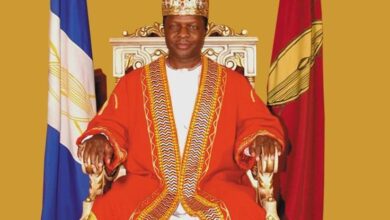
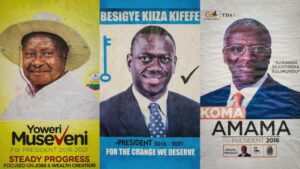

Defeated NRM primary aspirants turning to running as independents – a subtle yet significant fracture in the ruling party’s dominance
UgandaToday: From Merit to Momentum: The Enduring Chess Game of Yoweri Museveni’s Hold on Power
By Uganda Today Political Desk
As Uganda heads towards its presidential and general elections beginning 15 January 2026 through to 6 February 2026, what lies ahead is more than a routine change of guard—it is a high-stakes continuation of a political strategy that has underpinned President Yoweri Museveni’s nearly four-decade grip on power.

The early years: merit, movement and the ‘no-party’ era
When Museveni assumed leadership in 1986 after the bush war, the country’s political landscape was radically different. The model he ushered in was one of individual merit, with the so–called “Movement” system emphasising individual competence rather than formal party competition. Under the 1995 Constitution, multi-party competition was formally restrained: parties existed, but their ability to mobilise and compete was limited. ec.or.ug+3LSE+3kituochakatiba.org+3
In this environment, Museveni could present himself as a change-agent, a leader of merit who had defeated tyranny and offered a new order. The elections of 1996, for instance, were held under the Movement system and allowed candidates to run as individuals — not as party representatives. Wikipedia+1
This created the template: one in which the incumbent party (National Resistance Movement – NRM) wielded outsized resources, while opposition voices were present but constrained by the design of the system.
The shift: From individual merit to managed party politics
By 2005, recognising the pressures for pluralism and perhaps seeking new legitimacy, Museveni presided over a referendum that restored multi-party politics in Uganda. The rationale was outwardly liberalising—but for the regime, the shift incorporated party competition under heavily asymmetric conditions.
This transitional moment is critical. From then on, parties were allowed to mobilise; yet longstanding structural advantages remained with the NRM—and with Museveni himself. The merits of individual ability still mattered, but they were increasingly mediated by party machine and state-resources.
The chessboard: Museveni’s strategic adeptness
Museveni’s style has often been compared to a chess master: anticipating opposition moves, adapting rules in his favour, and ensuring his position remains unassailable. As analysed in a key 2018 review of Uganda’s case, the country’s Supreme Court had repeatedly made reforms-recommendations for credible elections—but implementation remained elusive. Particularly telling is that since 1996, Uganda has held six presidential elections — yet the underlying system of electoral reform has lagged far behind.
For Museveni, this has meant that despite judicial observations of institutional weakness — whether in electoral transparency, opposition freedoms or internal party democracy — the regime has managed to stay on the ballot and in power. The key has been calibrating the system just enough to appear competitive, while retaining the levers of control.
2026 in focus: The tension of “merit” resurfaces
As we approach the 2025/2026 election cycle (formally, the electoral roadmap issued by the Electoral Commission of Uganda shows nomination of candidates, campaigns, and polling starting 2026) ec.or.ug+1 the notion of individual merit is resurging — this time not strictly as a virtue of the governing machine, but as a pressure point.
Across the country, many party primaries — especially within the ruling NRM — have been bruising. Internal contestation has exploded into open defections, independent candidacies and, in some cases, violence. The very dynamic that once helped Museveni accumulate his credibility (as someone rising by merit) is now reopening fissures in his coalition.
Consider the following troubling data points (as supplied):
-
Total nominated MP aspirants = 2,711
-
Of these, 2,000 are directly nominated MPs for designated constituencies
-
634 are running for district women representative slots (146 districts)
-
Independent candidates sum up to 1,283, or about 47 % of total nominations
-
Of these independents, 514 (≈ 19 %) are former NRM members running independent
-
Others: NUP = 297 (≈ 11 %), DP = 94, FDC = 214, ANT = 29
These figures (while yet to be fully cross-verified publicly) signal that nearly half of all nominated aspirants are running as independents. That is a seismic shift in a system long dominated by party-machines.
What does this mean for Museveni’s dominance?
Firstly, it suggests that the “merit” narrative – that you rise within the NRM by ability – is fraying. When many from the ruling party feel compelled to abandon its ticket and run independently, the signal is clear: internal mechanisms are no longer working for all. It implicitly threatens the cohesion that the regime has relied upon.
Secondly, for Museveni as the grand strategist, this is both a risk and an opportunity. On one hand, a surge of independents could split votes, undermine the party’s control and open space for challengers. On the other hand, a well-managed system could absorb this through patronage, inducement, selective violence, alliances and the co-optation of key independents. In short: the chessboard becomes more complex, but not unmanageable.
Thirdly, the unresolved reform agenda remains a wildcard. The Supreme Court has repeatedly flagged deep structural flaws in Uganda’s electoral architecture, yet meaningful reforms remain blocked or incomplete. With a wave of independents, the façade of meritocracy is challenged—not within the system, but in the glare of public perception. Does the system still reward ability or suppress dissent?
Looking forward: A harbinger for change – or consolidation?
Given the magnitude of independent candidacies, the upcoming elections could mark a real inflection point. If these independents succeed in large numbers, they may shift the balance of power away from one-party dominance toward a more porous political field. The high number of independents also reflects growing impatience within the ruling party’s ranks and the electorate alike.
Yet, the outcome remains uncertain. Museveni’s strategic advantage—control over party, state resources, security apparatus and media—has historically proven resilient. His ability to adapt, redirect, and reconfigure alliances is well-documented. The question now is whether the system will crack or simply be redesigned around a new equilibrium.
In sum
From the early days of merit-based individual mobilisation to the restored multi-party era, Museveni’s durability stems from his reading of the political board—anticipating moves, leveraging structures, and maintaining dominance. In 2026, the rising tide of independent candidates signals that the once-dominant script (merit within the party) is under strain—and may force Museveni to shift strategy yet again. Whether this results in genuine change or another consolidation of power remains the pivotal narrative of Uganda’s election epoch.
Hashtags
#UgandaElections2026 #MeritOrMachine #ChangeOrConsolidation #UgandaToday #PhoenixNewsFeeds #OperaNewsFeeds
Publisher