
Tayebwa’s 10,000 Boda Bodas Put Uganda’s Tax Compliance Debate Under The Spotlight
+256 702 23 93 37: Uganda’s Wider Tax Challenge Uganda continues to pursue higher domestic revenue mobilisation as government seeks to finance infrastructure and public services while reducing dependence on borrowing.

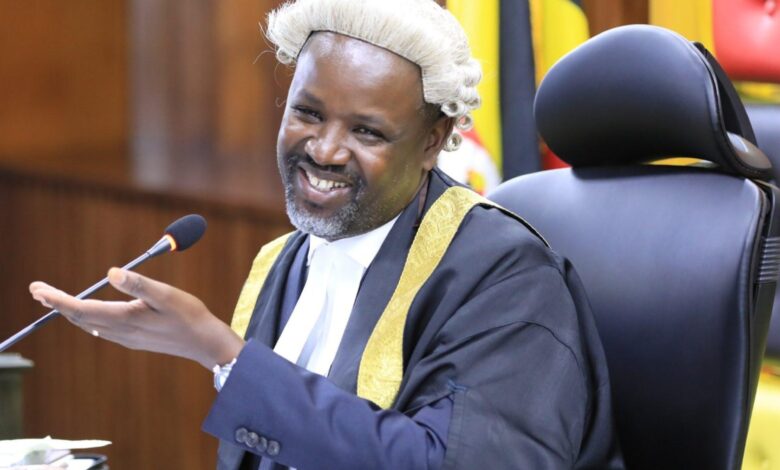
UgandaToday: Tayebwa’s 10,000 Boda Bodas Put Uganda’s Tax Compliance Debate Under The Spotlight
Deputy Speaker challenges businesses to pay their fair share of taxes as questions emerge over the potential earnings of his motorcycle enterprise

Parliament of Uganda
By Uganda Today Reporter
KAMPALA, Uganda — Deputy Speaker of Parliament Thomas Tayebwa has found himself at the centre of a public conversation about business profitability, tax compliance and accountability after revealing that his business operates more than 10,000 boda bodas across Uganda.
The disclosure comes just days after Tayebwa challenged Uganda’s business community to embrace transparency and pay taxes honestly, warning that some businesses reportedly generate billions of shillings in profits while declaring comparatively little in taxes.
His remarks have renewed interest in the relationship between private business interests, tax obligations and public accountability, particularly when prominent political leaders are involved in large commercial enterprises.
Tayebwa’s Tax Compliance Message
Speaking at the inaugural National Prayer Breakfast Business Forum at Parliament on October 7, 2026, Tayebwa called for greater tax compliance, arguing that Uganda could raise more domestic revenue by ensuring that all eligible taxpayers fulfil their obligations rather than repeatedly imposing new taxes on existing taxpayers.
He questioned how the country could adequately finance roads, electricity, water and other public services while its tax-to-GDP ratio remained relatively low.
Tayebwa suggested that Uganda could substantially improve the ratio if more businesses and individuals paid their fair share. He also emphasised the importance of transparency, ethical conduct and integrity in private enterprise.
The Deputy Speaker’s position is that a wider tax base would give government more resources to finance development without continually increasing the burden on compliant taxpayers.
The 10,000 Boda Bodas Revelation
The debate took another turn after Tayebwa disclosed that he operates a boda boda enterprise with more than 10,000 motorcycles.

According to reports published on October 11 and 13, the Deputy Speaker explained that adopting cashless payments and mobile money collections had helped his business reduce payment defaults and improve operational efficiency.
He challenged the Capital Markets Authority to consider how technology could simplify investment and capital mobilisation, drawing lessons from the management of a geographically dispersed motorcycle business.
The revelation has attracted public attention not only because of the scale of the enterprise but also because of the possible financial returns associated with thousands of income-generating motorcycles.
How Much Could 10,000 Boda Bodas Generate?
The potential earnings of such a large fleet have become a subject of online speculation. Some members of the public have attempted to estimate daily collections, monthly revenue and the value of the underlying investment.
For illustration, if 10,000 motorcycles each remitted Shs10,000 daily, the combined collections would amount to Shs100 million a day. That is a hypothetical calculation, not a verified account of Tayebwa’s earnings.
A more conservative illustration of Shs100 per motorcycle per day would produce Shs1 million daily across 10,000 motorcycles. However, that figure is equally hypothetical and should not be confused with an established estimate of the business’s actual revenue.
The distinction matters because gross collections are not the same as profit or taxable income. Motorcycle acquisition costs, financing arrangements, maintenance, insurance, administration, defaults and other operating expenses all affect the final financial outcome.
Neither the company’s actual daily collections nor its net profits and tax payments have been established by the reports reviewed for this article.
Does The Disclosure Prove Tax Evasion?
The central issue is not simply how much money a large boda boda enterprise might generate, but whether its financial records accurately reflect its taxable activities and whether all applicable tax obligations are being met.
It is important to distinguish public questions about a business’s possible earnings from evidence of tax evasion. There is no verified evidence in the reports reviewed establishing that Tayebwa or his company has evaded taxes.
The appropriate questions are whether the enterprise maintains accurate records, files the required tax returns, declares its taxable income correctly and meets its obligations under Uganda’s tax laws.
These are matters that can be established through financial documentation and the relevant tax authorities, not through social media calculations alone.
The Uganda Revenue Authority is responsible for administering the country’s tax laws and assessing compliance. Any allegation of wrongdoing would require evidence and an appropriate verification process.
Political Leadership And The Duty To Lead By Example
For a senior political leader responsible for presiding over parliamentary proceedings, the debate carries an additional public-interest dimension.
Tayebwa’s call for businesses to pay their fair share of taxes provides a clear standard against which all major enterprises can be assessed, regardless of the identity or political standing of their owners.
A credible tax system depends on the principle that the law applies equally to small traders, motorcycle operators, large corporations and politically influential businesspeople.
At the same time, owning a profitable enterprise is not evidence of wrongdoing. Successful businesses can create jobs, facilitate access to transport and generate tax revenue when they operate within the law.
The public interest therefore lies in transparent and consistent compliance, rather than assumptions about a business owner’s conduct based on the size of an investment.
Uganda’s Wider Tax Challenge
Uganda continues to pursue higher domestic revenue mobilisation as government seeks to finance infrastructure and public services while reducing dependence on borrowing.

The Ministry of Finance and the Uganda Revenue Authority have emphasised widening the tax base, improving administration, formalising economic activity and reducing revenue leakages.
The debate surrounding Tayebwa’s motorcycle business highlights a broader challenge: how to bring substantial economic activity into transparent systems without unfairly burdening those already complying with the law.
For Uganda Today, the key question remains whether the country can build a tax culture in which every eligible taxpayer contributes fairly and public confidence is strengthened by consistent enforcement.
Until verified financial and tax information becomes available, the estimated earnings of Tayebwa’s boda boda enterprise should be treated as speculation, not proof of tax evasion.
#UgandaToday #ThomasTayebwa #TaxCompliance #URA #BodaBoda #UgandaEconomy
Editor’s Note: The Shs1 million daily figure is an illustrative calculation based on Shs100 per motorcycle, not a verified estimate of Tayebwa’s income.