
UgandaToday: Rising Wave of NUP Pull-outs in Western Uganda — Allegations of Bribery and Internal Fault-Lines Rock the Opposition
By UgandaToday Political Desk
(www.ugandatoday.co.ug
A growing number of National Unity Platform (NUP) parliamentary aspirants — particularly in the Western Region — have either officially withdrawn from their races or been removed from NUP’s list of approved flagbearers. Party petitions, internal vetting disputes and fresh allegations that ruling NRM operatives are offering money to NUP hopefuls to step down have combined to produce an unfolding crisis that could materially weaken NUP’s competitiveness in key districts ahead of 2026. While bribery claims circulate widely on the ground, independent verification is limited and the allegations remain contested. This report examines the patterns, the possible motives, and what it means for the opposition and the electoral playing field.
What is happening — the facts so far
-
In recent weeks NUP’s internal vetting and finalisation of parliamentary flagbearers produced dozens of aggrieved aspirants. At least 82 petitions challenging selections were lodged; the party says nine petitions were upheld and nine flagbearers dropped after review. Those internal decisions have coincided with a number of aspirants publicly withdrawing from contests.
-
Several high-profile NUP figures were left out of the final list released by the party — a move that has fed claims of irregularity and intensified tensions inside the party. National press coverage has documented dropped incumbents and aspirants who are “weighing options” after being denied party tickets.
-
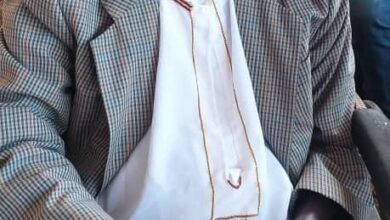
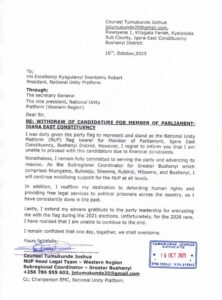
Independent of party-led removals, there are also individual withdrawals. For example, documents provided to this reporter show Counsel Joshua Tumukunde (who had been associated with NUP in Igara East / Greater Bushenyi structures) formally writing to the party to withdraw his candidature — citing financial constraints in his letter dated 16 October 2025 (copy supplied to UgandaToday). (See image/document supplied.) Another recent withdrawal reported from the West is Kabarole District’s NUP woman-flag hopeful Lillian Kobugabe, who publicly withdrew her candidacy. Media outlets and local reporting have also broadcast others stepping down in different constituencies.
Why aspirants are withdrawing — root causes and dynamics
Analysis and reporting indicate a mix of pressures pushing aspirants out of the race:
-
Internal party vetting, disputes and reshuffles.
NUP’s vetting process and the party’s decision to drop some earlier nominees has created discontent and uncertainty. Where aspirants feel unfairly treated, some choose to step down rather than contest a bruising internal fight or run as independents. The party says many of the changes followed petitions and review by the vetting committee. -
Financial strain and high cost of nomination and campaigning.
Several aspirants cite lack of resources as a reason to withdraw — the cost of nomination and expected campaign spending is steep, particularly for candidates without deep party or personal funding networks. Counsel Tumukunde’s withdrawal letter (supplied) explicitly references being “unable to proceed with this candidature due to financial constraints.” -
Allegations of inducements and state-linked interference.
Local claims and a number of media reports allege that NRM actors (including some incumbent MPs and operatives) are offering money to opposition aspirants to step aside so that NRM candidates can run with less competition. Some reports circulating on political news sites and local commentary have described offers that would “double or triple” a candidate’s immediate out-of-pocket costs for nomination — framed in conversations as a pragmatic, short-term buy-out. These are currently allegations reported by media and sources on the ground; comprehensive, independently verified evidence of a co-ordinated, large-scale bribery campaign is not publicly available. -
Tactical calculations by aspirants.
Some aspirants assess that, given party reshuffles, local polling or intimidation risks, withdrawing (or negotiating lower-profile roles) maximizes their long-term political survival or preserves local goodwill. Analysts note that commercialization of politics — where money shapes who enters or leaves races — is not new in Uganda and creates incentives for defections or withdrawals.
Is this an orchestrated NRM bribery operation? — what evidence we have
-
Allegations exist and are widespread locally. Multiple media items and social-media reports allege that NRM operatives have approached opposition aspirants with financial offers to pull out. These reports often include anecdotal claims of sums being proposed to cover immediate nomination costs and to encourage stepping aside.
-
However, independent corroboration is limited. At the time of writing, major national outlets report the pattern of withdrawals and dropped flagbearers and quote aggrieved aspirants and party statements; but there is no publicly available, forensic evidence (bank records, recorded offers, named NRM intermediaries admitting coordination) proving a centrally orchestrated, pay-for-drop campaign across Western Uganda. Journalists have found isolated cases and strong suspicions on the ground, but proving a co-ordinated NRM operation requires investigations by impartial institutions or on-the-record confessions from intermediaries.
-
A plausible mechanism exists. Scholars and monitors have documented the commercialization of Ugandan politics — patronage networks, vote-buying and use of state resources are recurring features in the literature. This creates both the motive and the means for the ruling party (or local actors) to attempt to blunt opposition challenges by inducement or co-option of aspirants. That context makes the bribery narrative credible as an explanation in some constituencies — but credibility is not the same as proof, and allegations must be independently tested.
Examples and names (what has been reported)
-
Joshua Tumukunde (Igara East, Bushenyi) — formal withdrawal letter dated 16 October 2025 (copy supplied to UgandaToday) cites financial constraints and affirms continued support for the party at subregional levels. (Document in reporter files.)
-
Lillian Kobugabe (Kabarole District Woman NUP hopeful) — reported to have withdrawn her bid, local press flagged the move as unexpected and disruptive for local party plans.
-
Winifred Nakandi (Kampala Woman MP contest) — widely reported to have withdrawn from the contest for the NUP flag, citing internal party dynamics and irregularities. (While not in Western Region, her withdrawal adds to the national pattern of exits and internal discord.)
-
Several incumbents and well-known aspirants were dropped by NUP’s vetting (for example Medard Ssegona, Joyce Bagala and others), which is a related but different phenomenon — party management removed them from the approved list after petitions/review. These drops have been widely reported and have intensified public debate about NUP’s internal processes.
-
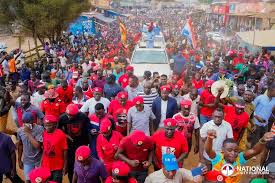
Local NUP supporters in Greater Bushenyi. Recent withdrawals have created uncertainty on the ground. -
Note: some of the above are withdrawals initiated by aspirants, others are party removals after petitions. Media coverage frequently mixes both categories when discussing “pull-outs.” We have carefully distinguished where reporting allows.
Political implications
-
Electoral competitiveness: If NUP loses credible challengers in the West — whether through internal reshuffles or inducements — the NRM stands to gain easier paths to victory in constituencies where incumbents are already strong. That could reshape seat projections in a region that has alternated between opposition strength and NRM influence.
-
Party cohesion and morale: Multiple withdrawals, high-profile drops and unresolved allegations of bribery will strain NUP’s internal cohesion. The party risks public perceptions of disarray, which opponents will exploit. Party leaders will need transparent, timely explanations to stem defections and restore trust.
-
Trust in the process: Unresolved bribery allegations and opaque internal decisions (or even perceptions of them) harm public confidence in the fairness of the electoral process — both across parties and among voters. The longer these issues remain uninvestigated, the greater the risk of post-election disputes and instability.
What should happen next — recommendations
-
Independent inquiry or monitoring: A credible, third-party investigation — either by civil society election monitors, a parliamentary committee, or a vetted media consortium — should compile and test allegations of inducements to withdraw. Evidence (bank transfers, recorded meetings, named intermediaries) should be sought and preserved.
-
Greater transparency from NUP: The party should publish clear criteria and decisions from its vetting process (redacted where necessary for privacy) and establish an accessible appeals timeline to reduce perceptions of arbitrariness.
-
Public reporting protections for aspirants: Civil society and media should encourage and protect whistleblowers who can provide verifiable evidence of inducements. Without safe channels, bribery networks remain clandestine.
-
Electoral institutions to monitor undue influence: The Electoral Commission and anti-corruption authorities should be alerted to patterns that resemble vote-buying or inducement schemes so that legal thresholds for investigation can be triggered.
Conclusion
Withdrawals and dropped flags inside NUP — particularly in the Western Region — are a symptom of multiple stresses: internal party disputes, resource shortages for aspirants, and credible local allegations that rival operatives offer inducements to step aside. While bribery claims are widely circulated and fit with known dynamics of commercialized politics, rigorous proof of a co-ordinated NRM-led “buy-out” campaign across the region is not yet publicly established. The stakes are high: without clear, transparent responses from parties, investigators and electoral institutions, citizens may lose confidence in the fairness of the upcoming elections. UgandaToday will continue to investigate and publish verified developments.
hashtags
#UgandaToday #NUP #Election2026 #WesternUganda #MoneyInPolitics #NRM #PoliticalIntegrity #VoteFree