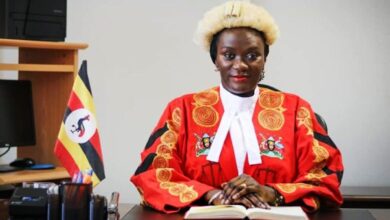
Yet, as the weeks have passed and the campaign trail has unfolded — particularly for opposition candidate Robert Kyagulanyi Ssentamu (Bobi Wine) of National Unity Platform (NUP) — Mao’s promise now appears less a guarantee of calm than an ironic premonition.
As the campaign season formally began on 29 September 2025, following the official schedule released by The Independent Electoral Commission (IEC), the expectations were high for a credible, peaceful contest. At the same time, Mao — as Minister of Justice and Constitutional Affairs — publicly assured Ugandans that the upcoming 2026 elections would likely be “the quietest” and “most peaceful” the country has ever seen.
Yet, as the weeks have passed and the campaign trail has unfolded — particularly for opposition candidate Robert Kyagulanyi Ssentamu (Bobi Wine) of National Unity Platform (NUP) — Mao’s promise now appears less a guarantee of calm than an ironic premonition.
A campaign marred by crackdown: what has actually happened
Mass arrests, violent dispersals and canine units at rallies
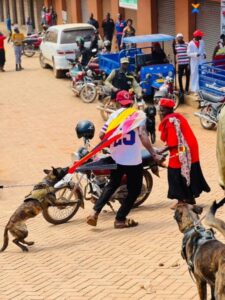
On 24 November 2025 in Kawempe (Kampala), police deployed dogs against bystanders during Kyagulanyi’s rally — a move widely condemned as an assault on the constitutional right to peaceful assembly.
Advertising
Tear-gas, pepper spray, water-cannons and baton charges were used to disperse supporters. Several people — including civilians who were not even part of the rally but merely passing through — were reportedly beaten up and there after arrested.
According to the opposition and NUP, over 300 supporters and officials have been detained since the campaign began.
Crackdowns across multiple regions — not just Kampala
In Mbarara / Bwizibwera (Ankole region), more than 100 supporters were arrested after their convoy was intercepted by security forces. Reports indicate that many detainees were severely beaten.
In Arua (West Nile region), at least 32 NUP supporters were taken into custody following clashes during a Kyagulanyi campaign visit. Police say the arrests followed allegations of vandalism and use of unauthorized campaign routes.
Similar incidents — involving beatings, arrests of supporters (and even journalists) — have been documented in Kiruhura, Mukono, Kawempe, Busia, Mayuge, Kyankwanzi, Kakumiro, among others.
Legal opposition from civil society and bar associations
The Uganda Law Society (ULS) has publicly condemned the deployment of police dogs at political rallies, declaring the move “a grave breach” of citizens’ rights. They noted that the state’s canine unit is supposed to deal with crime-scene investigations, narcotics, explosives, tracking and rescue — not crowd control at political events. ULS further decried the arbitrary arrests of innocent bystanders — passers-by, boda-boda riders, traders — affirming that such actions violate constitutional protections of liberty and due process.
The Uganda Police Force Canine Unit is designated for tasks such as crime-scene investigation, explosive and narcotic detection, tracking, and search-and-rescue. Unleashing dogs in a campaign rally is a tool of threat, fear, and force, and this must not be tolerated. ULS is also deeply concerned by reports of forceful and indiscriminate arrests in Kawempe.
We have learnt that several innocent people some merely using public roads around Kawempe and not participating in the campaign were arrested. Such arbitrary arrests amount to an abuse of the rule of law, violate the constitutional rights to liberty and due process, and undermine public trust in law-enforcement institutions. ULS therefore calls for: An immediate and unconditional halt to the use of police dogs in any political rally or campaign.
The immediate release of all innocent civilians arrested arbitrarily in Kawempe during the campaign events. Compliance with constitutional policing standards that respect human dignity and uphold the rights of all Ugandans regardless of their political affiliation. If the state permits its law-enforcement agencies to unleash living creatures as instruments of political coercion, and to arrest innocent bystanders, what does it say about the rule of law in our country? Such intimidation tactics are unacceptable in a democratic state. ULS stands ready to defend the right to freedom of association and peaceful assembly. We remain committed to upholding the rule of law and protecting the rights of all citizens. The statement signed by Anthony Asiimwe ULS Vice President, stated
What Mao said — versus what is happening
At the September 2025 launch of the campaign period and in subsequent media statements, Minister Mao said:
The election would be peaceful, with no processions, no chaotic rallies. Instead — short, controlled rallies: “you’ll announce your rally, drive there … speak to the people … then everyone goes home.”
He dismissed the need for a competitive election and uttered the most outrageous statement, suggesting that Uganda’s political transition would be negotiated “in rooms which matter,” rather than decided at the ballot box.
He cast supporters of NUP and similar parties as “regime-change fundamentalists,” unfit to govern.
Yet, the heavy-handed police and military response to NUP rallies — the arrests, teargas, dogs — reveals that “quietness” is not voluntary calm, but imposed coercion. The spectacles of force are themselves a form of political noise — and a direct denial of the democratic freedoms Mao claims to champion.
In short: rather than enabling peaceful campaigns, security forces appear to be weaponizing “order” to suffocate dissent.
The larger hypocrisy: resources for repression, not development
The use of 500 (or more) police officers, canine units, tear-gas, water-cannons, and heavy deployment across numerous districts signals serious resource allocation.
This raises a fundamental question: If the government can marshal such manpower and tools to suppress opposition rallies, why aren’t these resources directed toward pressing public needs — like infrastructure?
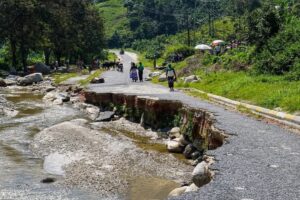
Consider, for instance, the badly dilapidated Kasese-Kilembe road, a key artery in western Uganda long in disrepair. Why not mobilise security and state capacity to improve critical infrastructure, instead of deploying forces to terrorise civilian populations exercising political rights?
Kasese Kilembe road is in a deplorable state that requires immediate attention. Photo by: (Patricia Lindrio, GPJ Uganda)
This glaring mis-prioritization underscores the political character of the crackdown: security resources are repurposed not for public good, but for controlling citizens.
Civil-society voices raise uneasy but vital questions
The ULS statement condemning the deployment of police dogs — with reference to their use by oppressive regimes in apartheid South Africa and segregation-era United States — is especially damning.
“If the state permits its law-enforcement agencies to unleash living creatures as instruments of political coercion, and to arrest innocent bystanders, what does it say about the rule of law in our country?”
These are not rhetorical questions. They strike at the heart of what democracy should mean.
Why — one might ask — is the IEC silent about these incidents? Why has the minister who promised peace ended up presiding over repression? Why are constitutional guarantees of assembly, free speech and political association being undermined just weeks into the campaign period?
Conclusion: Peace promised, repression delivered
What is unfolding on Uganda’s streets is not peaceful campaigning. It is a coercive crackdown — one that uses state power to stifle opposition. For many citizens, what once might have looked like an election is fast becoming a show of force.
Minister Mao’s invocation of constitutional values, and his 2025 call for free and fair elections, now ring hollow in the face of images showing beatings, dogs, smoke from tear-gas canisters, and detained youths.
If elections are to serve as Uganda’s path to peaceful change, those entrusted with safeguarding the rule of law must stop enabling suppression. Instead of deploying hundreds of officers to harass opposition supporters, the state should invest in the public goods citizens have long been waiting for — good roads, quality services, equal opportunity.
For now, however, the contradictions between pledges and practice remain too glaring to ignore. As journalist Derrick Wandera recently noted, the heavy-handed tactics amount to “a fundamental shift” — one that undermines not just the opposition’s ability to campaign, but Uganda’s claims to democratic legitimacy.