UgandaToday: Who Runs Uganda’s 2026 Elections? Militarisation, Silence of the Electoral Umpire, and the Politics of the National Flag
An Electoral Process Under Shadow
As Uganda inches towards the 2026 general elections, mounting concern is emerging over what critics describe as the gradual usurpation of the Independent Electoral Commission (IEC) by the military and informal state-aligned mobilisation structures. At the centre of this debate are recent arrests, inflammatory political messaging, and the IEC’s conspicuous silence in the face of alleged electoral offences.
Opposition presidential candidate Robert Kyagulanyi Ssentamu (Bobi Wine) has framed these developments as evidence of a shrinking civic space and a dangerous fusion between electoral management and coercive state power.
The Arrest of Dr. Sarah Bireete: Law Enforcement or Political Signalling?
The arrest of Dr. Sarah Bireete, Executive Director of the Centre for Constitutional Governance (CCG), has ignited debate across legal, civil society, and political circles.
Point of View One: State Enforcement Narrative
From a state-centric perspective, security agencies maintain that no individual or organisation is above the law. Under this view, Dr. Bireete’s arrest is framed as a lawful act within the mandate of security organs to preserve public order, especially during a politically sensitive pre-election period. Proponents of this argument caution against civil society actors assuming immunity under the guise of advocacy.
Point of View Two: Civil Society and Opposition Perspective
Conversely, civil society organisations and opposition leaders argue that Dr. Bireete’s arrest fits a broader pattern of criminalising constitutional oversight. Critics contend that her detention sends a chilling signal to watchdog institutions monitoring electoral integrity, effectively narrowing the democratic space at a time when independent scrutiny is most needed.

Major Emma Kuteesa and the ‘Ghetto Structures’: Who Polices the Enforcers?
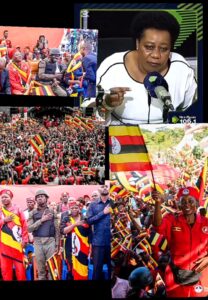
A sharper controversy has arisen around Major Emma Kuteesa, a serving Uganda People’s Defence Forces (UPDF) officer who also operates as President Museveni’s self-styled “Coordinator of Ghetto Affairs.” In a widely circulated video shared by Kyagulanyi, Kuteesa is seen addressing youths aligned to what are described as “Ghetto Structures,” during which statements are made threatening harm to businesses and individuals displaying the Uganda national flag.
https://x.com/i/status/2006253302556578068
A Troubling Question
Why, critics ask, has Major Kuteesa not been investigated or sanctioned, despite the gravity of such statements—especially when similar or lesser actions by opposition figures have attracted swift arrests?
From an electoral governance standpoint, this raises a fundamental question: can a military officer actively engage in partisan political mobilisation, issue threats, and remain unaccountable—while the IEC remains silent?
The Electoral Commission’s Deafening Silence
The IEC’s constitutional mandate includes ensuring a free, fair, and peaceful electoral process. Yet, observers point to a pattern of selective enforcement.
Case One: Campaigning and Public Disruption
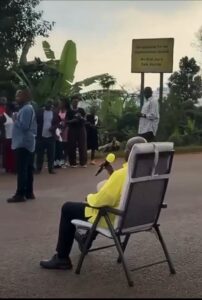
Critics cite instances where President Yoweri Museveni, a declared presidential candidate, has campaigned in the middle of major highways, leading to prolonged traffic disruptions. One widely referenced incident allegedly resulted in hours-long gridlock, paralysing economic activity, without any public reprimand from the IEC.
Case Two: Desecration of the National Flag
Another contentious example involves campaign materials attributed to the ruling NRM, where the President’s portrait allegedly replaced the Crested Crane on the national flag—an act many constitutionalists interpret as desecration under national symbols law. Again, the IEC issued no public censure.
The Politics of the Flag and the Rise of Symbolic Patriotism
Ironically, the national flag—long associated with state authority—has become a rallying symbol for opposition supporters, particularly those aligned with National Unity Platform (NUP).
Kyagulanyi’s consistent call for Ugandans to peacefully raise the national flag has reframed it as a symbol of citizen ownership of the republic, rather than state monopoly. This symbolic reclamation appears to have unsettled ruling party operatives, who increasingly perceive the flag as synonymous with NUP’s growing popular support.
Analysts argue that this shift explains the hostility toward flag-bearing citizens: when patriotism moves from the state to the people, authoritarian systems feel threatened.
Militarisation of Electoral Management: A Structural Risk
The growing visibility of military officers in political coordination roles—outside formal security duties—raises alarms about the militarisation of electoral management. When armed institutions or their affiliates assume roles traditionally reserved for civilian bodies, the IEC risks being reduced to a procedural façade.
Conclusion: Elections Without an Umpire?
The contrasting treatment of Dr. Sarah Bireete and Major Emma Kuteesa illustrates a deeper governance dilemma: selective accountability. For many Ugandans, the question is no longer whether electoral offences are being committed, but who is allowed to commit them with impunity.
As 2026 approaches, the credibility of Uganda’s elections will hinge not on rhetoric, but on whether the IEC can reclaim its constitutional authority, enforce the law evenly, and resist being overshadowed by militarised political actors.
Until then, the troubling question remains: Is Uganda heading into an election administered by an independent commission—or managed by the state’s coercive machinery?
Hashtags:
#UgandaElections2026 #ElectoralIntegrity #UgandaToday #OperaNewsFeeds #PhoenixNewsFeeds
Publisher