When the National Flag Became a Security Threat: A Chronicle of Brutality During Uganda’s Presidential Campaigns
Watch Videos: The Criminalisation of a Symbol During the heated presidential campaigns, particularly those involving National Unity Platform (NUP) candidate Robert Kyagulanyi Ssentamu, commonly known as Bobi Wine, the Ugandan flag assumed a new political meaning. NUP supporters frequently donned attire fashioned from the national colours. They waved flags at rallies, draped them over their shoulders, and used them as expressions of what they described as “people power.”
UgandaToday: When the National Flag Became a Security Threat: A Chronicle of Brutality During Uganda’s Presidential Campaigns
By Uganda Today Investigations Desk
In any sovereign nation, the national flag is a sacred emblem — a unifying symbol of identity, pride and constitutional order. But during Uganda’s most recent presidential election campaigns and their aftermath, the red, yellow and black stripes of the national flag were, in many instances, reinterpreted by security agencies as a badge of subversion.
The question that continues to linger in the public conscience is unsettling: When did Uganda’s national flag become a security threat?
The Criminalisation of a Symbol
During the heated presidential campaigns, particularly those involving National Unity Platform (NUP) candidate Robert Kyagulanyi Ssentamu, commonly known as Bobi Wine, the Ugandan flag assumed a new political meaning. NUP supporters frequently donned attire fashioned from the national colours. They waved flags at rallies, draped them over their shoulders, and used them as expressions of what they described as “people power.”
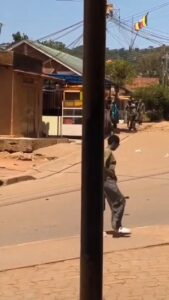
The army blatantly abused the rights of citizens when they accosted this man and forced him to bring down the national flag hoisted on a tree. In the video, at the first attempt, the man had failed to break the long stick pole and this attracted some beating.
However, security agencies appeared to view this symbolic display differently.
Advertising
Eyewitness accounts from various districts — including Kampala, Wakiso, Masaka, Jinja, and Gulu — indicated that individuals carrying or wearing the national flag were stopped, beaten, arrested, and, in some cases, detained without charge. Video footage that circulated widely on social media showed uniformed and plainclothes security personnel confiscating flags and dispersing crowds with batons, tear gas, and live ammunition.
The national flag, constitutionally meant to represent every Ugandan regardless of political affiliation, became — in practice — conflated with opposition mobilisation.
Campaign Trail Marked by Force
The election period was punctuated by violent crackdowns. Campaign rallies were blocked or violently dispersed. Opposition supporters reported arbitrary arrests, disappearances, and excessive force.
Human rights organisations documented numerous incidents in which security personnel used disproportionate force against unarmed civilians. Protesters holding flags were allegedly treated as insurrectionists rather than citizens exercising political rights.
Particularly alarming were reports that merely wearing clothing in the national colours was interpreted as an act of political defiance. In some communities, residents recounted being ordered to remove flag-themed face masks, headbands, and shirts.
Legal analysts have argued that no statutory instrument criminalises possession or display of the national flag unless it is desecrated. Yet enforcement patterns suggested that context — not law — determined treatment.
Post-Election Repression
The pattern did not subside after polling day.
Following the announcement of presidential results, heightened military deployments were observed in urban centres. Armoured vehicles lined major roads. House-to-house security operations were reported in certain suburbs perceived as opposition strongholds.
In these operations, possession of NUP paraphernalia — including red berets and national flags — reportedly triggered arrests. Families narrated instances of security forces entering homes in search of “evidence” of opposition mobilisation.
For critics, this marked a dangerous evolution: the transformation of a national symbol into an unofficial identifier of dissent.
Constitutional Questions
Uganda’s Constitution guarantees freedoms of expression, assembly, and association. It does not reserve the national flag for state institutions alone. Indeed, it belongs to the people.
The paradox, therefore, lies in the apparent contradiction between constitutional guarantees and operational enforcement. If a citizen’s display of the national flag is interpreted as a threat to national security, what does that imply about the state’s relationship with its own symbols?
Political commentators argue that the conflation of national identity with partisan contestation erodes democratic foundations. When security forces equate patriotic symbolism with rebellion, the line between state protection and political policing becomes blurred.
The Psychology of Power and Perception
Security agencies have consistently defended their operations as necessary to maintain public order and prevent unrest. Officials have often cited intelligence reports warning of planned violence.
Yet, critics contend that the securitisation of symbolic expression reflects a deeper anxiety within power structures — one in which mass mobilisation under shared national colours is perceived as destabilising.
Historically, national flags are rallying points during moments of transformation. They unify protest movements as much as they celebrate statehood. Uganda’s own independence struggle was built around reclaiming national identity. The irony is not lost on observers who now see that same symbol restricted under heavy guard.
A Nation Reflecting
As Uganda moves forward, the memory of campaign-season brutality continues to shape civic discourse. For families affected by beatings, detentions, or loss, the question remains painfully personal.
Can a country’s flag belong to all its citizens without suspicion? Can patriotic symbolism be disentangled from partisan fear?
Until those questions are resolved, the image of a uniformed officer seizing a flag from an unarmed civilian will remain etched in the nation’s democratic journey.
The story of Uganda’s recent elections is not merely about votes counted or contested. It is also about symbols — and how power can redefine their meaning. #UgandaToday #OperaNewsFeeds #PhoenixNewsFeeds #UgandaElections #HumanRightsUG #NationalFlagDebate