
UgandaToday: When Regulators Collide with the Constitution: Why ULS’ Warning Matters
By Uganda Today Editorial Desk
The Uganda Law Society’s latest pronouncements are more than routine institutional objections. They represent a familiar but deeply consequential tension in Uganda’s governance landscape — the recurring friction between regulatory authority and constitutional liberty.
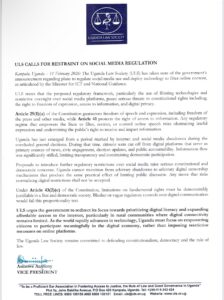
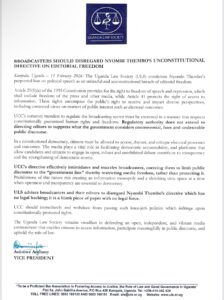
In its February 11, 2026 statements, the legal fraternity’s umbrella body did not merely critique policy direction. It delivered a cautionary constitutional argument: that state-led attempts to expand control over social media spaces and editorial decisions risk crossing into territory the Constitution deliberately shields from government intrusion.
At the heart of the dispute lies a question Uganda has wrestled with for years — where does legitimate regulation end and unconstitutional restriction begin?

The expanding reach of regulation
Governments everywhere regulate communication ecosystems. Uganda is no exception. Authorities routinely justify interventions in the name of national security, public order, misinformation, or moral protection. These are globally recognised state interests.
Yet constitutional democracies impose a higher test: restrictions on fundamental freedoms must not only serve a legitimate aim but must also be necessary, proportionate, and clearly defined. The Uganda Law Society’s concern appears anchored in this precise principle.
By invoking Articles 29 and 41 of the Constitution, ULS effectively reminds regulators that freedom of expression and access to information are not administrative privileges granted at the convenience of the state. They are rights with constitutional supremacy.
The Nyombi Thembo controversy and editorial independence
Particularly striking is ULS’ rejection of what it describes as an unlawful directive attributed to Nyombi Thembo. The Society’s position is unambiguous — editorial judgment, it argues, cannot be subordinated to regulatory preference.
This dispute is not trivial. Editorial independence is the backbone of media credibility. Once regulators acquire the practical ability to influence content decisions, even indirectly, the distinction between oversight and control becomes dangerously thin.
History offers repeated lessons: when the state begins shaping narratives rather than merely enforcing lawful standards, public trust erodes — not only in the media but in institutions themselves.
Digital spaces: the new frontier of rights
ULS’ warnings about social media regulation underscore another evolving reality. Digital platforms are no longer peripheral communication tools. They are central arenas of political debate, civic mobilisation, commerce, and social interaction.
Regulatory frameworks designed for broadcast-era information control often struggle to adapt to this decentralised environment. Measures such as filtering mechanisms, content blocking, or vague compliance obligations can quickly resemble censorship infrastructures if not carefully bounded.
The constitutional dilemma is therefore complex: how does the state address genuine harms without mutating into an arbiter of permissible speech?
The deeper governance signal
Beyond legal technicalities, ULS’ intervention highlights a broader governance issue — institutional restraint.
In stable constitutional systems, regulatory bodies exercise authority with acute sensitivity to rights implications. Power is checked not only by courts but by a culture of legality, where institutions instinctively avoid actions that may chill lawful expression.
The Law Society’s posture suggests unease that this equilibrium may be under strain.
Why this debate will persist
Uganda’s regulatory tensions are unlikely to fade soon. Digital communication is accelerating faster than legal adaptation. Political contestation increasingly unfolds online. Governments, wary of instability, will continue seeking tools of control.
But constitutional democracies demand something harder than control — they demand tolerance of dissent, discomfort, and unpredictability.That is precisely why the Constitution exists.
A constitutional moment, not a bureaucratic quarrel
Viewed in this light, ULS’ statements are not mere professional defensiveness. They are part of an enduring constitutional conversation: whether the guardians of regulation and the guardians of liberty can coexist without one eclipsing the other.
Uganda’s democratic resilience may well depend on how that question is answered — not in rhetoric, but in practice.
#UgandaToday #MediaFreedom #DigitalRights #RuleOfLaw #PhoenixNewsFeeds
#OperaNewsFeeds
Publisher