
UgandaToday: Uganda’s Strategic Game: Abstract Utopia vs Concrete Utopia
By David Kafeero

Director of Strategy and Innovation, Ideation Able Holding Ltd (Uganda)
Social Entrepreneurship Consultant
📧 Email: davidkafeero2@gmail.com
For nearly four decades, Uganda’s political evolution has been shaped not merely by leadership transitions or constitutional reforms, but by a silent, enduring strategic game — the tug-of-war between Abstract Utopia and Concrete Utopia.
The Missing Strategic Debate
Uganda has never truly engaged in a national debate distinguishing between Abstract Utopia — the realm of ideals, slogans, and moral posturing — and Concrete Utopia — the space of measurable systems, institutional accountability, and tangible progress.
In the absence of such a debate, the abstract dominates: politics becomes rhetorical, not structural; promises replace plans; and morality substitutes metrics.
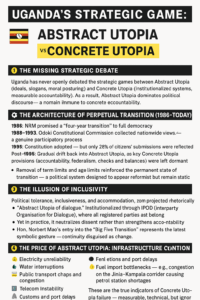
The Architecture of Perpetual Transition (1986–Today)
When the NRM took power in 1986, it promised a four-year transition to full democracy.
Between 1988 and 1993, the Odoki Constitutional Commission collected nationwide views in what remains one of Uganda’s most participatory exercises.
The 1995 Constitution that emerged was historic — but only 25% of citizen submissions made it into the final draft.

In the decades that followed, key Concrete Utopia provisions — accountability, federalism, and institutional independence — were left dormant. The subsequent removal of term and age limits cemented a system perpetually “in transition”: reformist in appearance, static in function.
The Illusion of Inclusivity
Inclusiveness and tolerance became the moral grammar of Abstract Utopia.
Institutions like the Interparty Organisation for Dialogue (IPOD) were presented as forums of pluralism. Yet, in reality, IPOD served to absorb dissent, creating symbolic participation without structural change.
Hon. Norbert Mao’s inclusion in the so-called “Big Five Transition” only deepened this paradox — a continuity project marketed as reform.
The Price of Abstract Utopia: Infrastructure Dysfunction
While the public is captivated by political drama, the concrete systems that sustain national life continue to decay:
-
Electricity remains unreliable.
-
Water interruptions persist.
-
Public transport suffers from congestion and poor planning.
-
Telecommunication is unstable.
-
Customs and port inefficiencies delay trade.
-
Fuel distribution faces chronic congestion along the Jinja–Kampala corridor, often triggering artificial shortages.
These are not abstract issues — they are tangible indicators of a Concrete Utopia failure, sacrificed at the altar of political theatre.
The Multidisciplinary Character of Abstract Utopia
This pattern extends beyond politics — it permeates law, religion, education, and economics.
Across disciplines, Uganda’s leadership culture privileges righteous inclusion over measurable results.
The consequence: governance that is performative rather than productive, inclusive in language but exclusive in delivery.
The Lesson @30 (1995–2025)
As Uganda marks 30 years under the 1995 Constitution, the central lesson is stark: the nation remains in a state of permanent rhetorical transition — a refined Abstract Utopia where:
Policy equals performance,
Accountability equals moral symbolism,
and Infrastructure equals neglected reality.
Conclusion
Uganda’s greatest strategic challenge is not leadership rotation or constitutional amendment. It is the failure to migrate from Abstract Utopia to Concrete Utopia — from moral language to measurable action.
Until that shift occurs, the republic will remain suspended between vision and reality, forever transitioning but never transforming.
Hashtags:
#UgandaToday #PhoenixNewsFeeds #OperaNewsFeeds
#AbstractUtopia #ConcreteUtopia #UgandaPolitics #GovernanceCrisis #NRMLegacy #AccountabilityMatters
Publisher

