Uganda’s Electoral Reform Debate Reignites Amid Controversial Message to MPs
For a country whose post-1995 constitutional order enshrined universal adult suffrage as the cornerstone of presidential elections, even speculative talk of abandoning that principle inevitably triggers scrutiny, anxiety, and political reflection.
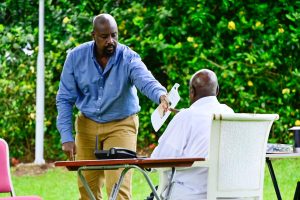
General Muhoozi Keinerugaba handing over a document to president Museveni. This meeting whose actual outcome remained speculative, very much diminished Muhoozi’s verve for 2026 elections
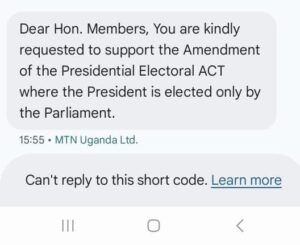
A circulating mobile phone message, purportedly addressed to members of Uganda’s 11th Parliament, has stirred fresh political debate. The brief text urges legislators to support an amendment to the Presidential Electoral Act that would allow the president to be elected “only by Parliament.” While the origin and authenticity of the message remain unverified, its implications touch the most sensitive nerve of Uganda’s political history: the long-contested question of electoral reforms.
For a country whose post-1995 constitutional order enshrined universal adult suffrage as the cornerstone of presidential elections, even speculative talk of abandoning that principle inevitably triggers scrutiny, anxiety, and political reflection.
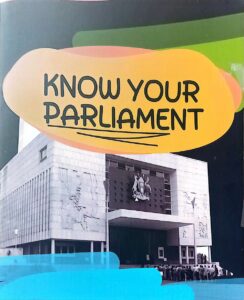
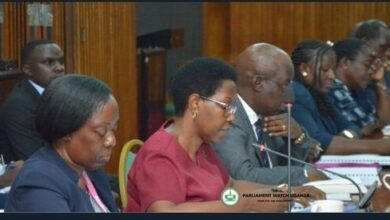
Uganda’s current Parliamentary building. New state of the art parliamentary chambers are under construction by Roko Construction Company. Parliament remains central to Uganda’s evolving constitutional debates.
The Long Shadow of the 2001 Supreme Court Petition
Uganda’s modern reform discourse cannot be separated from the landmark 2001 presidential election petition filed by Kizza Besigye against Yoweri Kaguta Museveni. Although the Supreme Court upheld the election results, the ruling acknowledged significant irregularities and recommended substantive electoral reforms.
That judgment became a reference point for opposition actors, civil society, and constitutional scholars who have since argued that structural weaknesses — including the management of elections, the role of security agencies, and the broader political playing field — were never comprehensively addressed.
Advertising
Over two decades later, critics maintain that many of those recommendations remain unresolved, fostering a persistent trust deficit around Uganda’s electoral processes.
Universal Suffrage: Principle or Obstacle?
Universal suffrage has long been presented as both a democratic ideal and a political battleground. Proponents argue it guarantees legitimacy through direct citizen participation. Skeptics, however, occasionally frame it as costly, polarizing, or susceptible to manipulation.
The controversial message now making rounds revives a question once considered politically improbable: could Uganda transition to a parliamentary electoral college model for choosing a president?
Such a shift would fundamentally alter the relationship between citizens and executive power, transferring decisive authority from voters to legislators. Supporters might argue this mirrors systems elsewhere. Opponents would see it as a dilution of democratic agency.
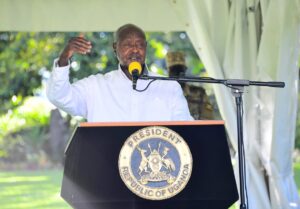
President Museveni addresses Parliament during the 2025 State of the Nation Address at Kololo. Museveni’s reform legacy continues to shape Uganda’s political trajectory.
The Muhoozi Factor and Political Sensitivities
No contemporary political analysis escapes the gravitational pull of Muhoozi Kainerugaba, the Chief of Defence Forces (CDF) and son of President Museveni. Public discourse around his perceived political ambitions has intensified in recent years, fueled by social media commentary, public rallies by supporters, and his own often provocative online presence.
Uganda’s Constitution, however, requires serving military officers to remain non-partisan. This legal boundary has made Muhoozi’s political visibility a recurring subject of controversy, with critics arguing that it blurs civil-military distinctions central to constitutional governance.
Even within the ruling establishment, unease has occasionally surfaced. Statements attributed to senior figures like Kahinda Otafiire have been widely interpreted as signaling resistance to premature succession narratives, reflecting broader tensions within elite political circles.
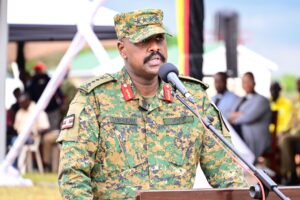
Gen. Muhoozi Kainerugaba, Uganda’s Chief of Defence Forces, whose social media post sparked fresh political controversy. Muhoozi’s public profile fuels ongoing succession discussions.
From LDU Origins to Commanding Heights
Muhoozi’s military trajectory itself has often been politicized. Observers frequently revisit his early entry into the armed forces as a Local Defence Unit (LDU), framing it within debates about privilege, institutional norms, and civil-military traditions.
Historical remarks by President Museveni about his son — including reflections on his perceived discipline, temperament, and intolerance toward corruption — have also been scrutinized. Supporters cite these as evidence of leadership qualities; critics view them as reinforcing dynastic perceptions.
Equally notable were Museveni’s earlier reassurances responding to concerns raised by figures such as Miria Matembe and David Sejusa, where he downplayed suggestions that Muhoozi’s military career signaled presidential grooming, emphasizing that he had never held elective office, “not even LC1 chairperson.”
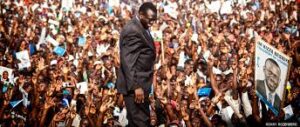
“A symbol of defiance: Dr. Kizza Besigye standing tall among his supporters, embodying Uganda’s enduring resistance against oppression.” Besigye’s 2001 petition still anchors reform arguments.
Naming, Symbolism, and Political Interpretation
Even cultural symbolism has entered the debate. Commentary occasionally invokes the meaning attached to Muhoozi’s name, interpreted by some as connoting vengeance or generational continuity. While such narratives often reside more in political rhetoric than empirical analysis, they illustrate how leadership transitions in Uganda are read through layers of history, culture, and suspicion.
The Mao Alliance and Reform Speculation
Political observers have also drawn connections between President Museveni’s cooperation with Norbert Mao and renewed conversations about constitutional and electoral reforms. Though the substance and direction of any prospective reforms remain matters of interpretation, speculation persists that institutional restructuring could reshape presidential selection mechanisms.
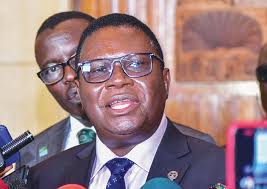
DP President and Minister of Justice Norbert Mao during a recent media briefing. Critics question his credibility on accountability. Political alliances rekindle speculation about institutional reforms.
For skeptics, the fear is not merely procedural change but perceived strategic recalibration — especially if reforms appear to coincide with succession debates.
Parliament as the Easier Path?
Uganda’s recent constitutional history provides context for such anxieties. Parliament has previously passed consequential amendments, notably removing presidential term limits (2005) and age limits (2017). These precedents reinforce perceptions that legislative routes may offer fewer uncertainties than national ballots.
If universal suffrage were ever replaced by parliamentary selection, critics argue, it would dramatically concentrate political leverage within the legislature — an arena historically dominated by the ruling party.
A Debate Larger Than Individuals
Ultimately, the significance of the circulating message lies less in its authorship than in the enduring fragility of Uganda’s reform discourse. Electoral systems are not merely technical designs; they embody social contracts between citizens and the state.
Whether Uganda maintains universal suffrage or explores alternative models, legitimacy will hinge on transparency, consensus, and constitutional fidelity — not conjecture or clandestine maneuvering.