
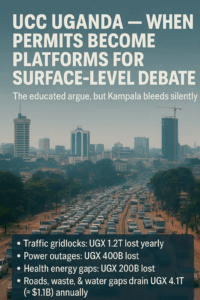
UgandaToday: UCC Uganda — When Permits Become Platforms for Surface-Level Debate

Director of Strategy and Innovation, Ideation Able Holding Ltd (Uganda)
Social Entrepreneurship Consultant
📧 Email: davidkafeero2@gmail.com
By David Kafeero | Uganda Today News
The Educated Argue, but Kampala Bleeds Silently
In the heart of Uganda’s capital, the nation’s brightest minds frequently converge on television screens, radio talk shows, and policy forums to dissect urban issues — from traffic management to energy reform. Yet, beyond the polished rhetoric and academic verbosity, Kampala continues to hemorrhage resources, time, and opportunity.
The irony is striking: while Uganda boasts an expanding pool of intellectuals and technocrats, the measurable efficiency of governance systems remains stagnant. As one city dweller recently remarked, “We don’t need more eloquent arguments — we need electricity that stays on, roads that drain, and traffic that moves.”

“Kampala’s brilliance debates problems — but never quantifies decay.”
“Efficiency, not eloquence, defines true intellect.”
The Hidden Costs of Dysfunction
Uganda’s capital is not merely congested — it is economically suffocated. According to aggregated local studies and institutional estimates:
-
Traffic gridlocks cost the economy approximately UGX 1.2 trillion annually in lost productivity and fuel waste.
Advertising
-
Power outages cause an estimated UGX 400 billion in annual losses across industries and small enterprises.
-
Health sector energy gaps drain an additional UGX 200 billion annually.
-
Road, waste management, and water infrastructure deficits further strip the city of an estimated UGX 4.1 trillion (≈ $1.1 billion) each year.
Together, these figures depict a city in crisis — where inefficiency is normalized and accountability is buried under layers of public relations statements.
Brilliance Without Impact
Kampala’s dysfunction reveals a deeper epistemic crisis — one where intellect has become performance art. Instead of driving measurable transformation, debates have become platforms for intellectual posturing. Panels, permits, and policy drafts abound, yet citizens continue to navigate flooded streets, erratic power, and uncollected waste.
“True intellect,” Kafeero argues, “is not in how elegantly one argues, but in how effectively one delivers solutions.”
Beyond Debate: Toward Measurable Governance
For Uganda to advance beyond rhetoric, a synchronized alliance between media, academia, and policy institutions is paramount. Evidence-based discourse must replace performative debates. Data-driven governance, rather than anecdotal commentary, should anchor national planning and local implementation. Until then, governance will remain a theater of performance — not a vessel of progress.
Disclaimer
The economic statistics cited in this article are based on aggregated local studies, institutional estimates, and sectoral analyses. Uganda Today and the author disclaim responsibility for absolute precision, as figures are intended to illustrate the magnitude of systemic inefficiencies rather than provide audited financial data.
Hashtags:
#EpistemicTransformation #LegacyWealthCreation #Uganda #Kampala #Phoenix #Opera #UgandaToday
Publisher